Center for Image-Guided Surgery, Focal Therapy and Artificial Intelligence for Prostate Cancer, USC Institute of Urology, 1441 Eastlake Ave, Suite 7416, Los Angeles, CA, 90089, USA.
Department of Urology, Graduate School of Medical Science, Kyoto Prefectural University of Medicine, Kyoto, Japan.
Sci Rep. 2023 Aug 18;13(1):13457. doi: 10.1038/s41598-023-40371-7.
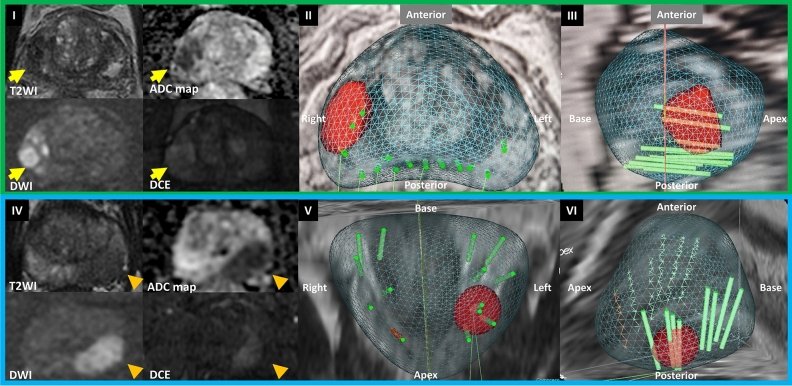
The objective of this study was to compare transperineal (TP) versus transrectal (TR) magnetic resonance imaging (MRI) and transrectal ultrasound (TRUS) fusion prostate biopsy (PBx). Consecutive men who underwent prostate MRI followed by a systematic biopsy. Additional target biopsies were performed from Prostate Imaging Reporting & Data System (PIRADS) 3-5 lesions. Men who underwent TP PBx were matched 1:2 with a synchronous cohort undergoing TR PBx by PSA, Prostate volume (PV) and PIRADS score. Endpoint of the study was the detection of clinically significant prostate cancer (CSPCa; Grade Group ≥ 2). Univariate and multivariable analyses were performed. Results were considered statistically significant if p < 0.05. Overall, 504 patients met the inclusion criteria. A total of 168 TP PBx were pair-matched to 336 TR PBx patients. Baseline demographics and imaging characteristics were similar between the groups. Per patient, the CSPCa detection was 2.1% vs 6.3% (p = 0.4) for PIRADS 1-2, and 59% vs 60% (p = 0.9) for PIRADS 3-5, on TP vs TR PBx, respectively. Per lesion, the CSPCa detection for PIRADS 3 (21% vs 16%; p = 0.4), PIRADS 4 (51% vs 44%; p = 0.8) and PIRADS 5 (76% vs 84%; p = 0.3) was similar for TP vs TR PBx, respectively. However, the TP PBx showed a longer maximum cancer core length (11 vs 9 mm; p = 0.02) and higher cancer core involvement (83% vs 65%; p < 0.001) than TR PBx. Independent predictors for CSPCa detection were age, PSA, PV, abnormal digital rectal examination findings, and PIRADS 3-5. Our study demonstrated transperineal MRI/TRUS fusion PBx provides similar CSPCa detection, with larger prostate cancer core length and percent of core involvement, than transrectal PBx.
本研究的目的是比较经会阴(TP)与经直肠(TR)磁共振成像(MRI)和经直肠超声(TRUS)融合前列腺活检(PBx)。连续接受前列腺 MRI 检查并进行系统活检的男性。对前列腺成像报告和数据系统(PIRADS)3-5 级病变进行额外的靶向活检。对接受 TP PBx 的男性,通过 PSA、前列腺体积(PV)和 PIRADS 评分与同步队列中接受 TR PBx 的男性进行 1:2 匹配。研究的终点是检测临床显著前列腺癌(CSPCa;分级组≥2)。进行单变量和多变量分析。如果 p<0.05,则认为结果具有统计学意义。总的来说,504 名患者符合纳入标准。共有 168 例 TP PBx 与 336 例 TR PBx 患者配对。两组患者的基线人口统计学和影像学特征相似。在每位患者中,PIRADS 1-2 时,TP PBx 的 CSPCa 检出率为 2.1%,而 TR PBx 为 6.3%(p=0.4);PIRADS 3-5 时,TP PBx 的 CSPCa 检出率为 59%,而 TR PBx 为 60%(p=0.9)。在每处病变中,PIRADS 3(21% vs 16%;p=0.4)、PIRADS 4(51% vs 44%;p=0.8)和 PIRADS 5(76% vs 84%;p=0.3)的 CSPCa 检出率在 TP PBx 与 TR PBx 之间相似。然而,TP PBx 的最大癌核长度(11 毫米 vs 9 毫米;p=0.02)和癌核受累比例(83% vs 65%;p<0.001)均高于 TR PBx。CSPCa 检出的独立预测因素为年龄、PSA、PV、异常直肠指诊结果和 PIRADS 3-5。我们的研究表明,经会阴 MRI/TRUS 融合 PBx 与经直肠 PBx 相比,提供了相似的 CSPCa 检出率,但前列腺癌核心长度和核心受累比例更大。