Ma Minglei, Li Hongfei, Wang Cong, Li Tangcheng, Wang Jierui, Yuan Huatao, Yu Liying, Wang Jingtian, Li Ling, Lin Senjie
State Key Laboratory of Marine Environmental Science, College of Ocean and Earth Science, Xiamen University, Xiamen, 361102, China.
National Engineering Research Center for Marine Aquaculture, Zhejiang Ocean University, Zhoushan, 316022, China.
ISME Commun. 2023 Aug 18;3(1):79. doi: 10.1038/s43705-023-00292-y.
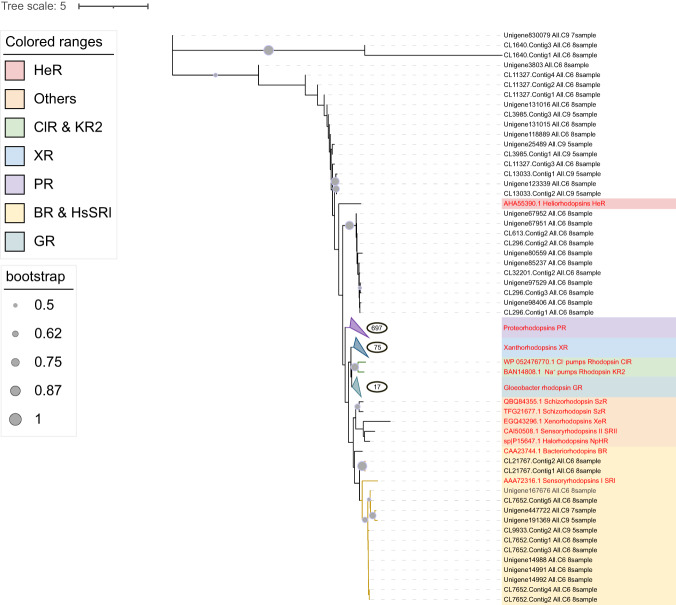
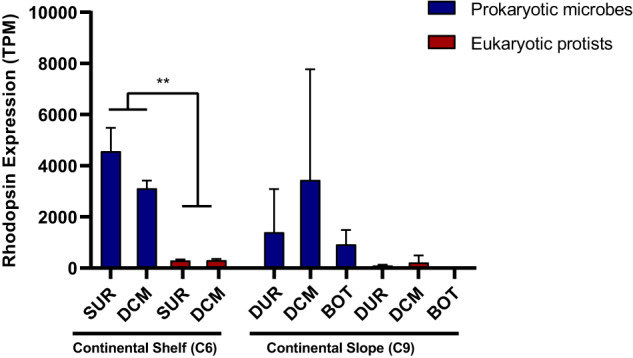
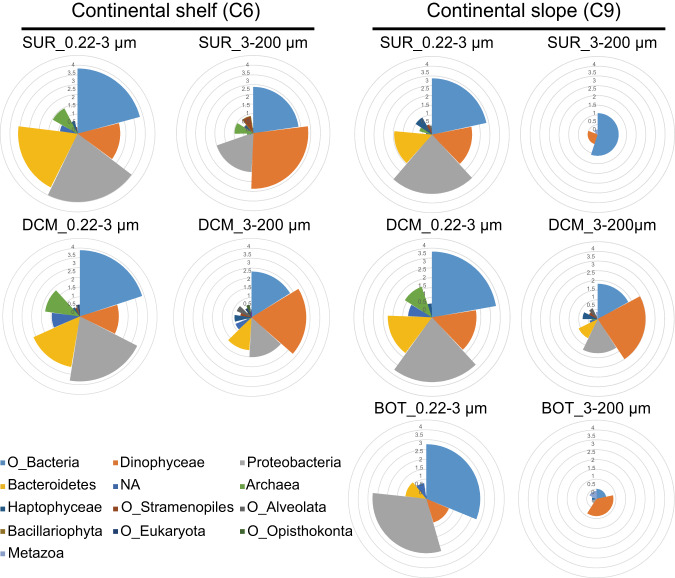
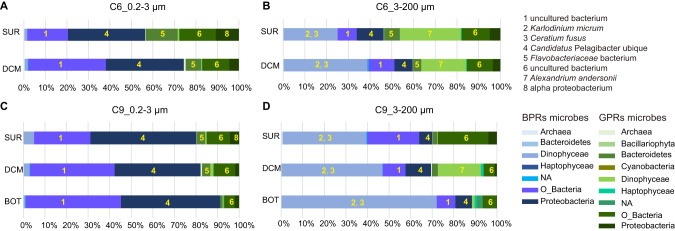
Proton-pump rhodopsin (PPR) in marine microbes can convert solar energy to bioavailable chemical energy. Whereas bacterial PPR has been extensively studied, counterparts in microeukaryotes are less explored, and the relative importance of the two groups is poorly understood. Here, we sequenced whole-assemblage metatranscriptomes and investigated the diversity and expression dynamics of PPR in microbial eukaryotes and prokaryotes at a continental shelf and a slope site in the northern South China Sea. Data showed the whole PPRs transcript pool was dominated by Proteorhodopsins and Xanthorhodopsins, followed by Bacteriorhodopsin-like proteins, dominantly contributed by prokaryotes both in the number and expression levels of PPR unigenes, although at the continental slope station, microeukaryotes and prokaryotes contributed similarly in transcript abundance. Furthermore, eukaryotic PPRs are mainly contributed by dinoflagellates and showed significant correlation with nutrient concentrations. Green light-absorbing PPRs were mainly distributed in >3 μm organisms (including microeukaryotes and their associated bacteria), especially at surface layer at the shelf station, whereas blue light-absorbing PPRs dominated the <3 μm (mainly bacterial) communities at both study sites, especially at deeper layers at the slope station. Our study portrays a comparative PPR genotype and expression landscape for prokaryotes and eukaryotes in a subtropical marginal sea, suggesting PPR's role in niche differentiation and adaptation among marine microbes.
海洋微生物中的质子泵视紫红质(PPR)能够将太阳能转化为生物可利用的化学能。尽管细菌PPR已得到广泛研究,但微型真核生物中的对应物研究较少,且对这两类生物的相对重要性了解不足。在此,我们对整个群落的宏转录组进行了测序,并研究了南海北部一个大陆架站点和一个斜坡站点中微生物真核生物和原核生物中PPR的多样性及表达动态。数据显示,整个PPR转录本库以噬盐视紫红质和黄视紫红质为主,其次是类细菌视紫红质蛋白,在PPR单基因的数量和表达水平上,原核生物的贡献占主导地位,不过在大陆斜坡站点,微型真核生物和原核生物在转录本丰度上的贡献相近。此外,真核生物PPR主要由甲藻贡献,且与营养物浓度显著相关。吸收绿光的PPR主要分布在大于3μm的生物(包括微型真核生物及其相关细菌)中,尤其是在大陆架站点的表层,而吸收蓝光的PPR在两个研究站点中均在小于3μm(主要是细菌)的群落中占主导,特别是在斜坡站点的较深层。我们的研究描绘了亚热带边缘海中原核生物和真核生物的PPR基因型及表达情况,表明PPR在海洋微生物的生态位分化和适应过程中发挥作用。