Plant Breeding Department, Justus Liebig University, Heinrich-Buff-Ring 26-32, 35392, Giessen, Germany.
Plant Breeding Department, University of Bonn, Katzenburgweg 5, 53115, Bonn, Germany.
Chromosome Res. 2023 Aug 19;31(3):22. doi: 10.1007/s10577-023-09733-9.
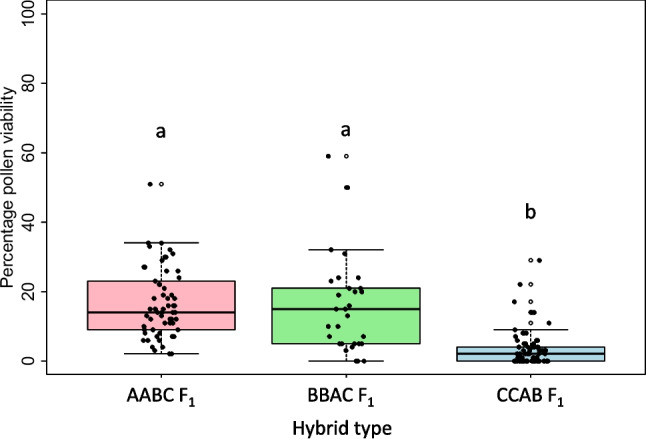
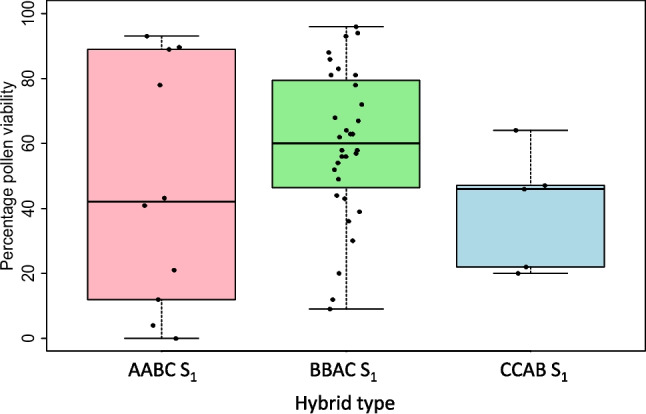
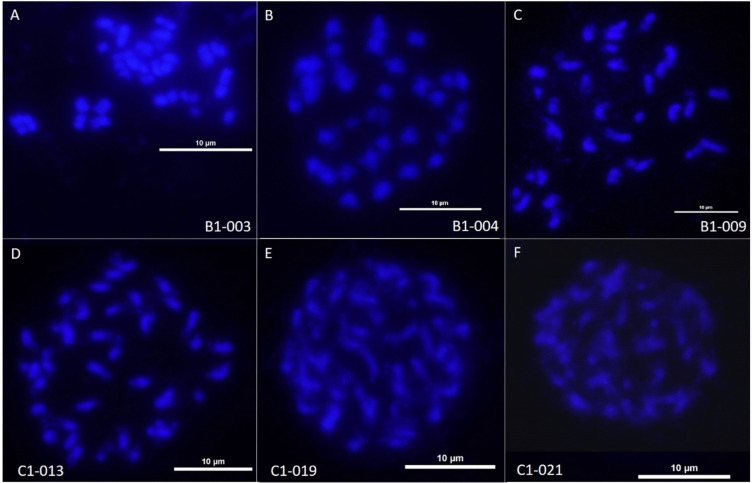
Interspecific hybridization is widespread in nature and can result in the formation of new hybrid species as well as the transfer of traits between species. However, the fate of newly formed hybrid lineages is relatively understudied. We undertook pairwise crossing between multiple genotypes of three Brassica allotetraploid species Brassica juncea (2n = AABB), Brassica carinata (2n = BBCC), and Brassica napus (2n = AACC) to generate AABC, BBAC, and CCAB interspecific hybrids and investigated chromosome inheritance and fertility in these hybrids and their self-pollinated progeny. Surprisingly, despite the presence of a complete diploid genome in all hybrids, hybrid fertility was very low. AABC and BBAC first generation (F) hybrids both averaged ~16% pollen viability compared to 3.5% in CCAB hybrids: most CCAB hybrid flowers were male-sterile. AABC and CCAB F hybrid plants averaged 5.5 and 0.5 seeds per plant, respectively, and BBAC F hybrids ~56 seeds/plant. In the second generation (S), all confirmed self-pollinated progeny resulting from CCAB hybrids were sterile, producing no self-pollinated seeds. Three AABC S hybrids putatively resulting from unreduced gametes produced 3, 14, and 182 seeds each, while other AABC S hybrids averaged 1.5 seeds/plant (0-8). BBAC S hybrids averaged 44 seeds/plant (range 0-403). We also observed strong bias towards retention rather than loss of the haploid genomes, suggesting that the subgenomes in the Brassica allotetraploids are already highly interdependent, such that loss of one subgenome is detrimental to fertility and viability. Our results suggest that relationships between subgenomes determine hybridization outcomes in these species.
种间杂交在自然界中很普遍,它可以导致新的杂交种的形成以及种间性状的转移。然而,新形成的杂交谱系的命运相对来说研究较少。我们对三个甘蓝型四倍体物种甘蓝型油菜(2n = AABB)、甘蓝型黑芥(2n = BBCC)和甘蓝型油菜(2n = AACC)的多个基因型进行了成对杂交,产生了 AABC、BBAC 和 CCAB 种间杂种,并研究了这些杂种及其自交后代的染色体遗传和育性。令人惊讶的是,尽管所有杂种都存在完整的二倍体基因组,但杂种的育性非常低。AABC 和 BBAC 第一代(F1)杂种的花粉活力平均约为 16%,而 CCAB 杂种的花粉活力为 3.5%:大多数 CCAB 杂种花是雄性不育的。AABC 和 CCAB F1 杂种植物的平均每株种子数分别为 5.5 和 0.5 粒,而 BBAC F1 杂种的种子数约为 56 粒/株。在第二代(S)中,所有来自 CCAB 杂种的经证实的自交后代都是不育的,没有产生自交种子。三个 AABC S 杂种可能是由未减数配子产生的,每个杂种产生了 3、14 和 182 粒种子,而其他 AABC S 杂种的平均每株种子数为 1.5 粒(0-8)。BBAC S 杂种的平均种子数为 44 粒/株(范围为 0-403)。我们还观察到强烈的偏向于保留而不是丢失单倍体基因组的趋势,这表明甘蓝型四倍体的亚基因组已经高度相互依存,以至于丢失一个亚基因组对育性和活力是有害的。我们的研究结果表明,亚基因组之间的关系决定了这些物种的杂交结果。