Department of Anesthesiology, Tianjin Medical University Cancer Institute & Hospital, National Clinical Research Center for Cancer, Tianjin's Clinical Research Center for Cancer, Key Laboratory of Cancer Prevention and Therapy, Tianjin, China.
Trials. 2023 Aug 19;24(1):546. doi: 10.1186/s13063-023-07575-8.
Pancreatoduodenectomy (PD) is traumatic, difficult to perform, and has a high incidence of postoperative complications and perioperative mortality. Postoperative complications and pain occur frequently and seriously affect the psychological status of patients. Esketamine, an N-methyl-D-aspartate (NMDA) receptor antagonist, has analgesic and antidepressant effects. In this study, we aim to investigate the effect of esketamine on postoperative depression and pain in patients undergoing PD.
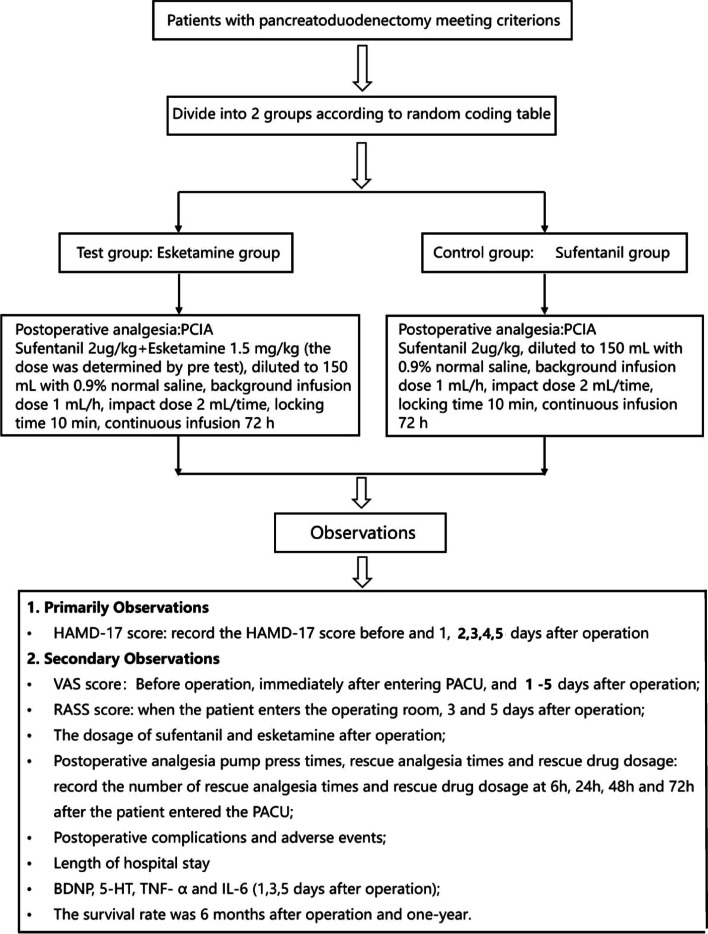
METHODS/DESIGN: This prospective, single-center, randomized control trial will include 80 patients who will undergo elective PD. The patients will be randomly assigned to two groups: the experimental group that will receive esketamine (n = 40) and the control group (n = 40). In the esketamine group, the analgesic pump will be connected immediately after surgery. A solution of esketamine 1.5 mg/kg + sufentanil 2 µg/kg, diluted to 150 mL, will be administered continuously for 72 h at the background infusion and impact doses of 1 mL/h and 2 mL/time, respectively; the locking time will be 10 min. The control group will receive sufentanil 2 µg/kg that will be administered as per the esketamine group. The primary outcome will be the Hamilton Depression Scale (HAMD-17) score on the third day post-surgery (POD3). Secondary study indicators will include (1) visual analog scale (VAS) score and HAMD-17 score prior to surgery, immediately after entering the postanesthesia care unit (PACU) and 1, 2, 3, 4, and 5 days after surgery; (2) Richmond Agitation-Sedation Scale (RASS) score at 1, 2, 3, 4, and 5 days after surgery; (3) consumed doses of sufentanil and esketamine after surgery; (4) postoperative analgesia pump effective press times, rescue analgesia times, and rescue drug dosage, recording the number of rescue analgesia and rescue drug dosage at 6, 24, 48, and 72 h after the patient enters the PACU; (5) postoperative complications and adverse events; (6) postoperative hospital stay; (7) concentrations of brain-derived neurotrophic factor (BDNP), 5-hydroxytryptamine (5-HT), tumor necrosis factor (TNF-α) and interleukin-6, at 1, 3, and, 5 days post-surgery; and (8) the patient survival rate at 6 and 12 months post-surgery.
The study hypothesis is that the postoperative HAMD-17 and VAS scores, incidence of postoperative adverse reactions, and concentration of serum markers BDNP, 5-HT, TNF-α, and IL-6 in the experimental group will be lower than those in the control group.
ClinicalTrials.gov ChiCTR2200066303. Registered on November 30, 2022.
1.0.
胰十二指肠切除术(PD)是一种创伤性手术,难度大,术后并发症和围手术期死亡率较高。术后并发症和疼痛经常发生,并严重影响患者的心理状态。氯胺酮是一种 N-甲基-D-天冬氨酸(NMDA)受体拮抗剂,具有镇痛和抗抑郁作用。在本研究中,我们旨在研究氯胺酮对接受 PD 的患者术后抑郁和疼痛的影响。
方法/设计:这是一项前瞻性、单中心、随机对照试验,将纳入 80 名择期接受 PD 的患者。患者将随机分为两组:实验组(n=40)和对照组(n=40)。实验组在手术后立即连接镇痛泵。将氯胺酮 1.5mg/kg+舒芬太尼 2μg/kg 稀释至 150mL,以背景输注和冲击剂量 1mL/h 和 2mL/次持续输注 72h;锁定时间为 10min。对照组将给予舒芬太尼 2μg/kg,给药方式与实验组相同。主要结局指标为术后第 3 天(POD3)的汉密尔顿抑郁量表(HAMD-17)评分。次要研究指标包括:(1)术前、进入麻醉后恢复室(PACU)即刻、术后 1、2、3、4 和 5 天时的视觉模拟评分(VAS)和 HAMD-17 评分;(2)术后 1、2、3、4 和 5 天时的 Richmond 躁动-镇静量表(RASS)评分;(3)术后舒芬太尼和氯胺酮的消耗量;(4)术后镇痛泵有效按压次数、解救镇痛次数和解救药物剂量,记录患者进入 PACU 后 6、24、48 和 72h 的解救镇痛次数和解救药物剂量;(5)术后并发症和不良事件;(6)术后住院时间;(7)术后 1、3 和 5 天时脑源性神经营养因子(BDNF)、5-羟色胺(5-HT)、肿瘤坏死因子(TNF-α)和白细胞介素-6(IL-6)的浓度;(8)术后 6 和 12 个月时的患者生存率。
研究假设实验组的术后 HAMD-17 和 VAS 评分、术后不良反应发生率以及血清标志物 BDNF、5-HT、TNF-α和 IL-6 的浓度均低于对照组。
ClinicalTrials.gov ChiCTR2200066303. 注册于 2022 年 11 月 30 日。
1.0.