Department of Anesthesiology, Pain and Perioperative Medicine, The First Affiliated Hospital of Zhengzhou University, Zhengzhou, Henan, China.
Division of Clinical Neuroscience, Chiba University Center for Forensic Mental Health, Chiba, Japan.
JAMA Netw Open. 2022 Dec 1;5(12):e2244514. doi: 10.1001/jamanetworkopen.2022.44514.
Postoperative sleep disturbance (PSD) is common in patients after surgery.
To examine the effect of intraoperative esketamine infusion on the incidence of PSD in patients who underwent gynecological laparoscopic surgery.
DESIGN, SETTING, AND PARTICIPANTS: This single-center, double-blind, placebo-controlled randomized clinical trial was conducted from August 2021 to April 2022 in the First Affiliated Hospital of Zhengzhou University in China. Participants included patients aged 18 to 65 years with an American Society of Anesthesiologist Physical Status classification of I to III (with I indicating a healthy patient, II a patient with mild systemic disease, and III a patient with severe systemic disease) who underwent gynecological laparoscopic surgery. Patients were randomly assigned to either the esketamine group or control group. Data were analyzed using the per protocol principle.
Patients in the esketamine group received a continuous infusion of esketamine, 0.3 mg/kg/h, intraoperatively. Patients in the control group received an equivalent volume of saline.
The primary outcome was the incidence of PSD on postoperative days (PODs) 1 and 3. Postoperative sleep disturbance was defined as a numeric rating scale score of 6 or higher or an Athens Insomnia Scale score of 6 points or higher. The secondary outcomes included postoperative anxiety and depression scores using the Hospital Anxiety and Depression Scale, postoperative pain using the visual analog scale, postoperative hydromorphone consumption, and risk factors associated with PSD.
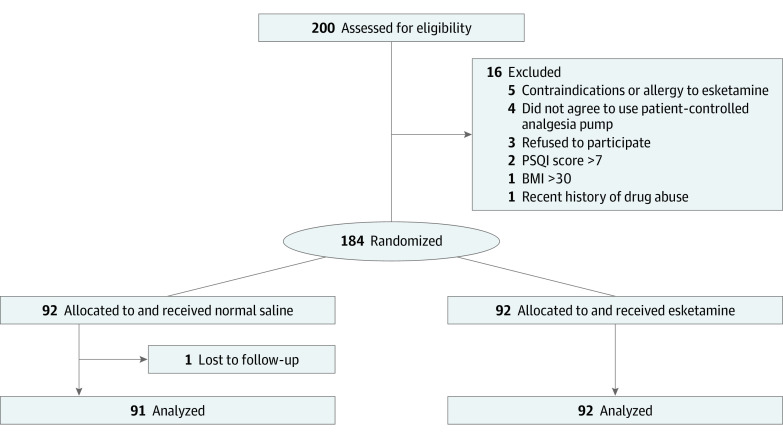
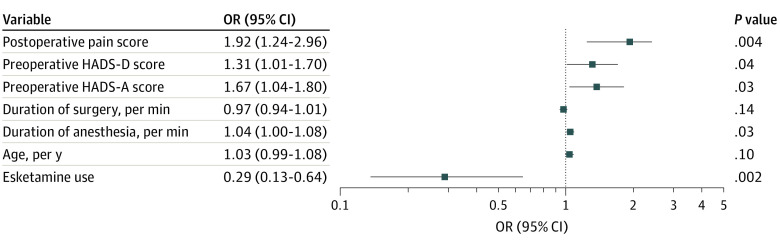
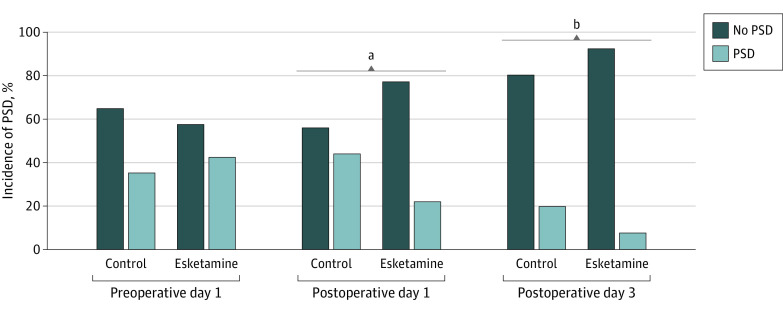
A total of 183 female patients were randomized to the control group (n = 91; median [IQR] age, 45 [35-49] years) and the esketamine group (n = 92; median [IQR] age, 43 [32-49] years). The incidence of PSD in the esketamine group was significantly lower than in the control group on POD 1 (22.8% vs 44.0%; odds ratio [OR], 0.38 [95% CI, 0.20-0.72]; P = .002) and POD 3 (7.6% vs 19.8%; OR, 0.33 [95% CI, 0.13-0.84]; P = .02). There were no differences in postoperative depression and anxiety scores between the 2 groups. Postoperative hydromorphone consumption in the first 24 hours (3.0 [range, 2.8-3.3] mg vs 3.2 [range, 2.9-3.4] mg; P = .04) and pain scores on movement (3 [3-4] vs 4 [3-5] points; P < .001) were significantly lower in the esketamine group than in the control group. On multivariable logistic regression, preoperative depression (OR, 1.31; 95% CI, 1.01-1.70) and anxiety (OR, 1.67; 95% CI, 1.04-1.80) scores, duration of anesthesia (OR, 1.04; 95% CI, 1.00-1.08), and postoperative pain score (OR, 1.92; 95% CI, 1.24-2.96) were identified as risk factors associated with PSD.
Results of this trial showed the prophylactic effect of intraoperative esketamine infusion on the incidence of PSD in patients who underwent gynecological laparoscopic surgery. Further studies are needed to confirm these results.
Chinese Clinical Trial Registry Identifier: ChiCTR2100048587.
重要性:术后睡眠障碍(PSD)在手术后患者中很常见。
目的:研究术中给予 Esketamine 输注对妇科腹腔镜手术患者 PSD 发生率的影响。
设计、地点和参与者:这是一项在中国郑州大学第一附属医院进行的单中心、双盲、安慰剂对照随机临床试验。参与者包括年龄在 18 至 65 岁之间、ASA 身体状况分类为 I 至 III 级(I 级表示健康患者,II 级表示患有轻度系统性疾病的患者,III 级表示患有严重系统性疾病的患者)的患者,他们接受妇科腹腔镜手术。患者被随机分配到 Esketamine 组或对照组。使用方案原则进行数据分析。
干预措施:Esketamine 组患者术中接受持续输注 Esketamine,剂量为 0.3mg/kg/h。对照组患者接受等量生理盐水。
主要结果和措施:主要结局是术后第 1 天(POD1)和第 3 天(POD3)的 PSD 发生率。术后睡眠障碍定义为数字评分量表评分≥6 分或 Athens 失眠量表评分≥6 分。次要结局包括使用医院焦虑抑郁量表评估的术后焦虑和抑郁评分、使用视觉模拟评分评估的术后疼痛、术后氢吗啡酮消耗量以及与 PSD 相关的风险因素。
结果:共有 183 名女性患者被随机分配至对照组(n=91;中位[IQR]年龄,45[35-49]岁)和 Esketamine 组(n=92;中位[IQR]年龄,43[32-49]岁)。Esketamine 组 PSD 的发生率在 POD1(22.8%比 44.0%;比值比[OR],0.38[95%CI,0.20-0.72];P=0.002)和 POD3(7.6%比 19.8%;OR,0.33[95%CI,0.13-0.84];P=0.02)时显著低于对照组。两组间术后抑郁和焦虑评分无差异。Esketamine 组术后 24 小时内氢吗啡酮消耗量(3.0[范围,2.8-3.3]mg 比 3.2[范围,2.9-3.4]mg;P=0.04)和运动时疼痛评分(3[3-4]分比 4[3-5]分;P<0.001)均显著低于对照组。多变量逻辑回归显示,术前抑郁(OR,1.31;95%CI,1.01-1.70)和焦虑(OR,1.67;95%CI,1.04-1.80)评分、麻醉持续时间(OR,1.04;95%CI,1.00-1.08)和术后疼痛评分(OR,1.92;95%CI,1.24-2.96)是与 PSD 相关的风险因素。
结论和相关性:该试验结果表明,术中给予 Esketamine 输注可预防妇科腹腔镜手术患者 PSD 的发生。需要进一步的研究来证实这些结果。
试验注册:中国临床试验注册中心标识符:ChiCTR2100048587。