Zoology Department Faculty of Science, Cairo University, Giza, Egypt.
Faculty of Biotechnology, October University for Modern Sciences and Arts, 6th of October City, Egypt.
Sci Rep. 2023 Aug 19;13(1):13523. doi: 10.1038/s41598-023-40676-7.
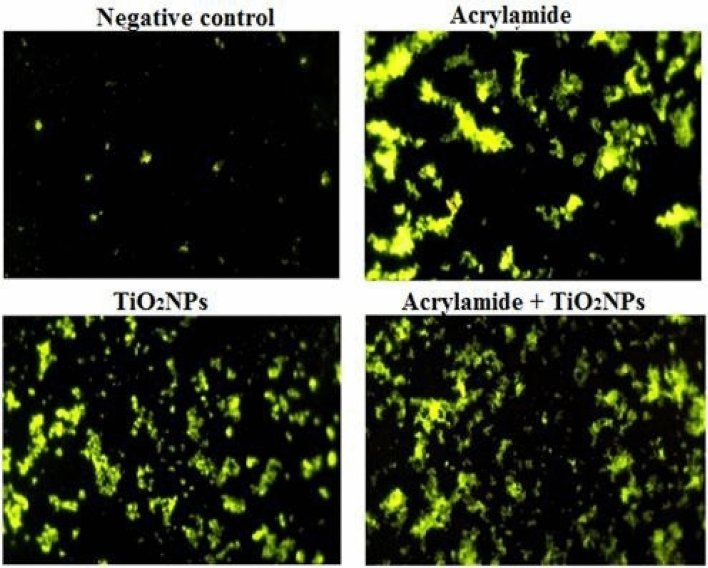
The Kidneys remove toxins from the blood and move waste products into the urine. However, the accumulation of toxins and fluids in the body leads to kidney failure. For example, the overuse of acrylamide and titanium dioxide nanoparticles (TiONPs) in many food and consumer products increases human exposure and risks; however, there are almost no studies available on the effect of TiONPs coadministration with acrylamide on the integrity of genomic and mitochondrial DNA. Accordingly, this study was conducted to estimate the integrity of genomic and mitochondrial DNA in the renal tissue of mice given acrylamide and TiONPs. To achieve this goal, mice were administrated orally TiONPs or/and acrylamide at the exposure dose levels (5 mg/kg b.w) and (3 mg/kg b.w), respectively, five times per week for two consecutive weeks. Concurrent oral administration of TiONPs with acrylamide caused remarkable elevations in the tail length, %DNA in tail and tail moment with higher fragmentation incidence of genomic DNA compared to those detected in the renal tissue of mice given TiONPs alone. Simultaneous coadministration of TiONPs with acrylamide also caused markedly high elevations in the reactive oxygen species (ROS) production and p53 expression level along with a loss of mitochondrial membrane potential and high decreases in the number of mitochondrial DNA copies and expression level of β catenin gene. Therefore, from these findings, we concluded that concurrent coadministration of acrylamide with TiONPs augmented TiONPs induced genomic DNA damage and mitochondrial dysfunction through increasing intracellular ROS generation, decreasing mitochondrial DNA Copy, loss of mitochondrial membrane potential and altered p53 and β catenin genes expression. Therefore, further studies are recommended to understand the biological and toxic effects resulting from TiONPs with acrylamide coadministration.
肾脏从血液中清除毒素,并将废物排入尿液中。然而,毒素和体液在体内的积累会导致肾衰竭。例如,丙烯酰胺和钛氧化物纳米颗粒(TiONPs)在许多食品和消费品中的过度使用增加了人类的暴露和风险;然而,几乎没有研究可用,关于 TiONPs 与丙烯酰胺共同给药对基因组和线粒体 DNA 完整性的影响。因此,本研究旨在评估给予丙烯酰胺和 TiONPs 的小鼠肾脏组织中基因组和线粒体 DNA 的完整性。为了实现这一目标,将 TiONPs 或/和丙烯酰胺以暴露剂量水平(5mg/kg b.w)和(3mg/kg b.w)分别口服给予小鼠,每周 5 次,连续 2 周。TiONPs 与丙烯酰胺同时口服给药会导致尾部长度、尾部 DNA 的%和尾部矩显著升高,与仅给予 TiONPs 的小鼠肾脏组织中检测到的相比,基因组 DNA 的碎片化发生率更高。TiONPs 与丙烯酰胺同时给药还会导致活性氧(ROS)产生和 p53 表达水平显著升高,同时线粒体膜电位丧失,线粒体 DNA 拷贝数和β连环蛋白基因表达水平显著降低。因此,从这些发现中,我们得出结论,丙烯酰胺与 TiONPs 同时给药通过增加细胞内 ROS 的产生、降低线粒体 DNA 拷贝数、丧失线粒体膜电位和改变 p53 和β连环蛋白基因的表达,增强了 TiONPs 诱导的基因组 DNA 损伤和线粒体功能障碍。因此,建议进行进一步的研究,以了解 TiONPs 与丙烯酰胺共同给药产生的生物学和毒性效应。