Liao Jingqiu, Guo Xiaodong, Li Shaoting, Anupoju Sai Manohar Balu, Cheng Rachel A, Weller Daniel L, Sullivan Genevieve, Zhang Hailong, Deng Xiangyu, Wiedmann Martin
Department of Food Science, Cornell University, Ithaca, NY, USA.
Department of Civil and Environmental Engineering, Virginia Tech, Blacksburg, VA, USA.
ISME Commun. 2023 Aug 19;3(1):85. doi: 10.1038/s43705-023-00293-x.
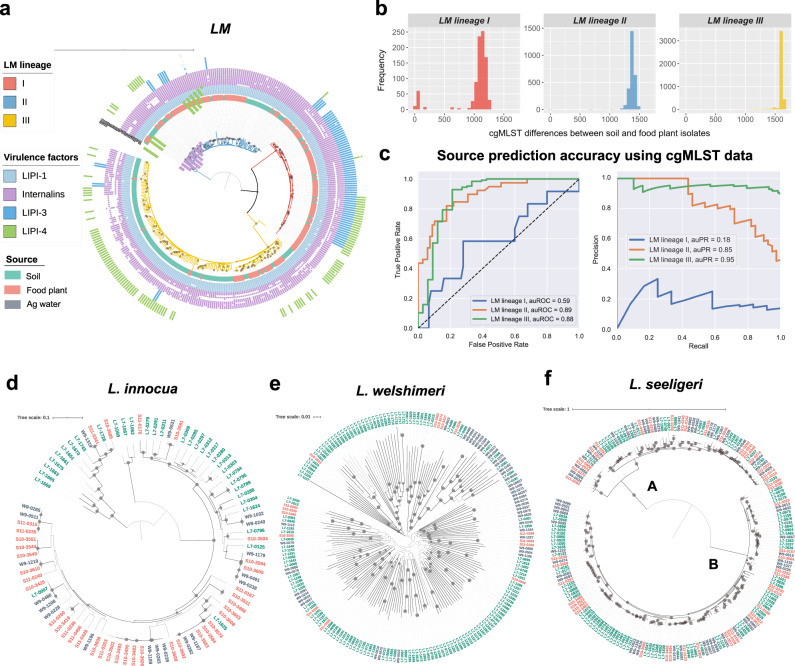
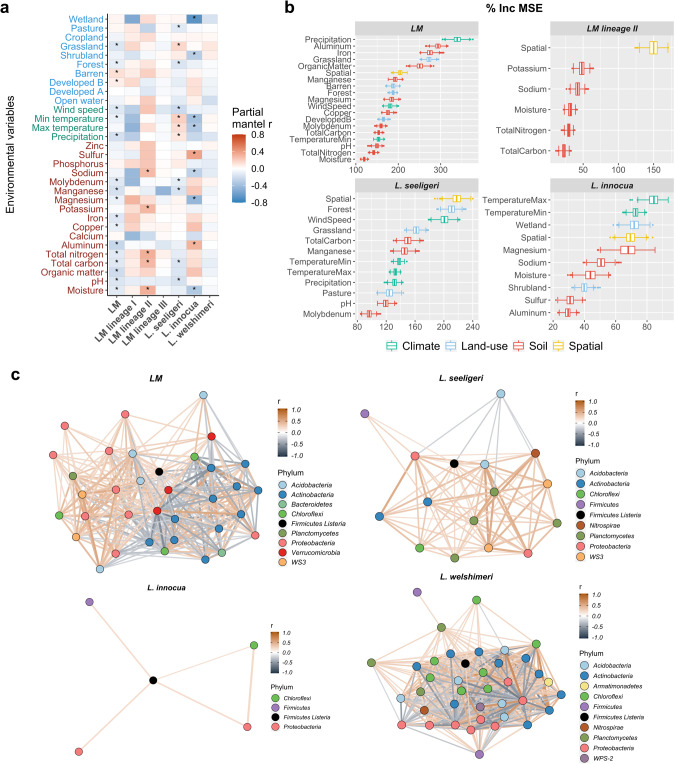
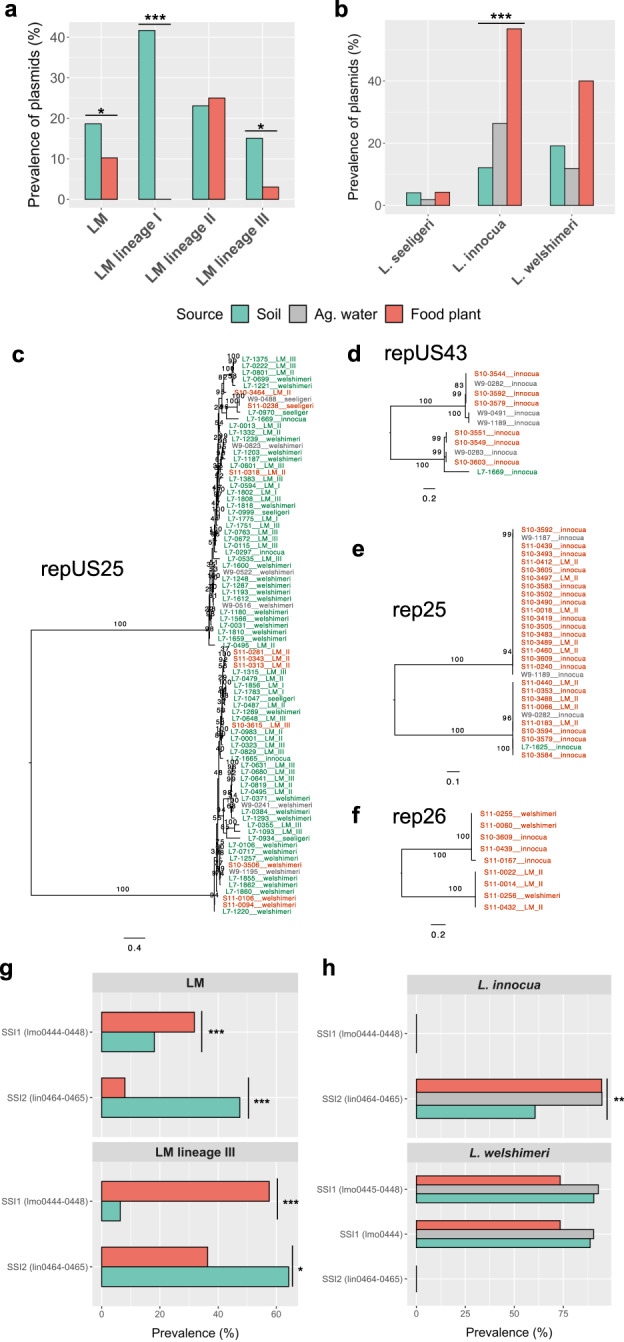
Comprehending bacterial genomic variation linked to distinct environments can yield novel insights into mechanisms underlying differential adaptation and transmission of microbes across environments. Gaining such insights is particularly crucial for pathogens as it benefits public health surveillance. However, the understanding of bacterial genomic variation is limited by a scarcity of investigations in genomic variation coupled with different ecological contexts. To address this limitation, we focused on Listeria, an important bacterial genus for food safety that includes the human pathogen L. monocytogenes, and analyzed a large-scale genomic dataset collected by us from natural and food-associated environments across the United States. Through comparative genomics analyses on 449 isolates from the soil and 390 isolates from agricultural water and produce processing facilities representing L. monocytogenes, L. seeligeri, L. innocua, and L. welshimeri, we find that the genomic profiles strongly differ by environments within each species. This is supported by the environment-associated subclades and differential presence of plasmids, stress islands, and accessory genes involved in cell envelope biogenesis and carbohydrate transport and metabolism. Core genomes of Listeria species are also strongly associated with environments and can accurately predict isolation sources at the lineage level in L. monocytogenes using machine learning. We find that the large environment-associated genomic variation in Listeria appears to be jointly driven by soil property, climate, land use, and accompanying bacterial species, chiefly representing Actinobacteria and Proteobacteria. Collectively, our data suggest that populations of Listeria species have genetically adapted to different environments, which may limit their transmission from natural to food-associated environments.
理解与不同环境相关的细菌基因组变异,能够为微生物在不同环境中的差异适应和传播机制带来新的见解。对于病原体而言,获得这些见解尤为关键,因为这有利于公共卫生监测。然而,由于在基因组变异以及不同生态背景方面的研究匮乏,对细菌基因组变异的理解受到了限制。为解决这一限制,我们聚焦于李斯特菌属,这是一个对食品安全至关重要的细菌属,其中包括人类病原体单核细胞增生李斯特菌,并分析了我们从美国各地自然环境和与食品相关的环境中收集的大规模基因组数据集。通过对来自土壤的449株分离株以及来自农业用水和农产品加工设施的390株分离株(分别代表单核细胞增生李斯特菌、斯氏李斯特菌、无害李斯特菌和威氏李斯特菌)进行比较基因组学分析,我们发现每个物种内的基因组图谱因环境不同而有很大差异。这得到了与环境相关的亚分支以及质粒、应激岛和参与细胞壁生物合成、碳水化合物运输及代谢的辅助基因的差异存在的支持。李斯特菌属的核心基因组也与环境密切相关,并且可以使用机器学习在单核细胞增生李斯特菌的谱系水平上准确预测分离来源。我们发现,李斯特菌属中与环境相关的大量基因组变异似乎是由土壤性质、气候、土地利用以及伴随的细菌物种共同驱动的,这些伴随细菌主要是放线菌和变形菌。总体而言,我们的数据表明,李斯特菌属种群已在基因上适应了不同环境,这可能会限制它们从自然环境传播到与食品相关的环境。