Slomp Margo, Koekkoek Laura L, Mutersbaugh Michael, Linville Ian, Luquet Serge H, la Fleur Susanne E
Endocrinology Laboratory, Department of Laboratory Medicine, Amsterdam UMC, Location University of Amsterdam, Amsterdam, Netherlands.
Amsterdam Neuroscience, Cellular and Molecular Mechanisms, Amsterdam, Netherlands.
Front Neurosci. 2023 Aug 3;17:1219569. doi: 10.3389/fnins.2023.1219569. eCollection 2023.
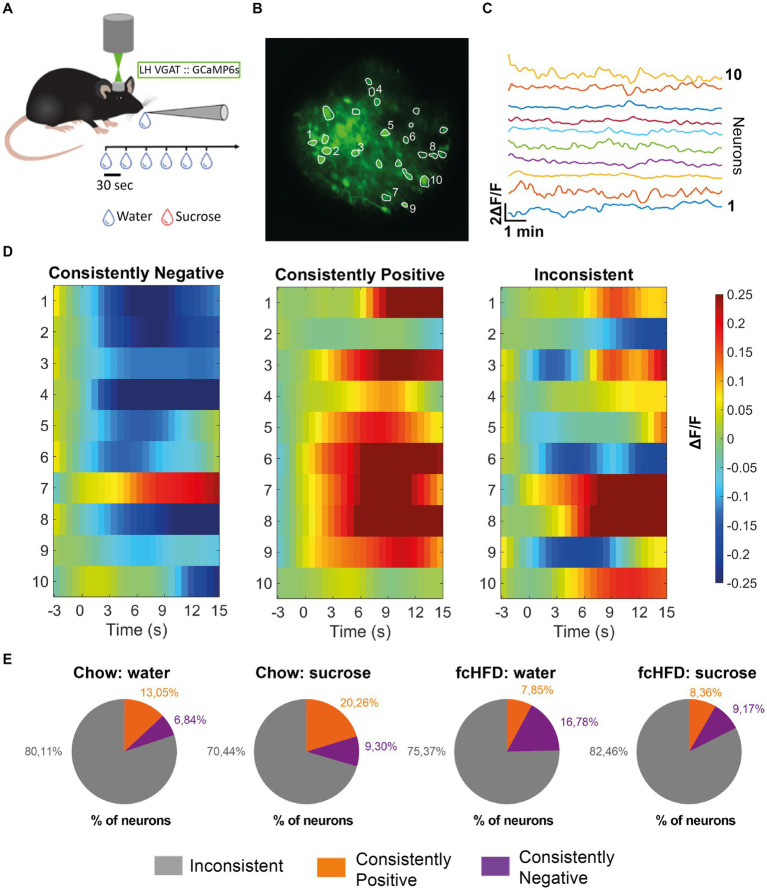
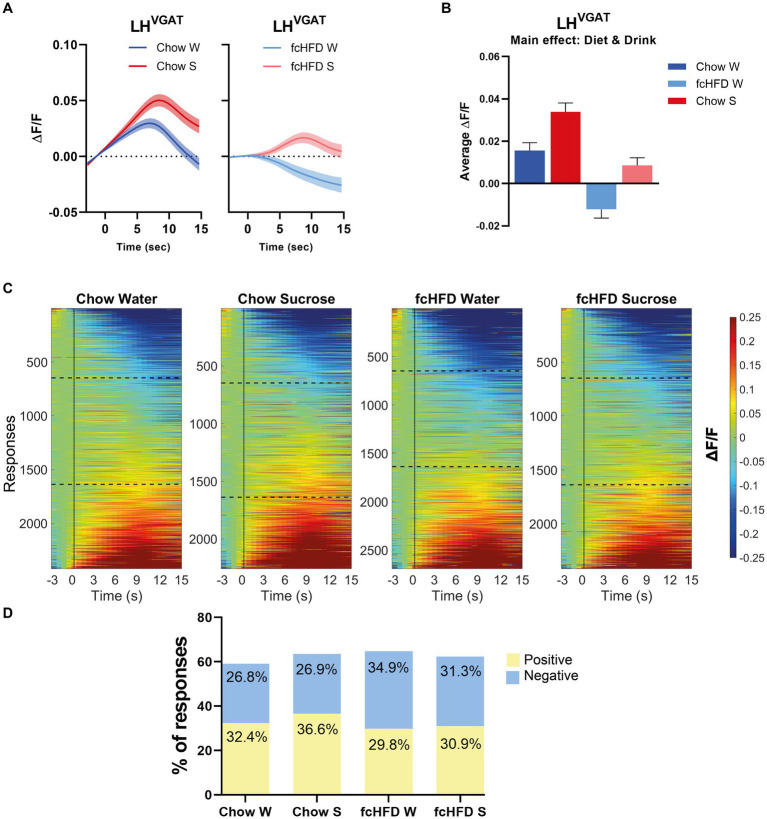
Nutrition can influence the brain and affect its regulation of food intake, especially that of high-palatable foods. We hypothesize that fat and sugar have interacting effects on the brain, and the lateral hypothalamus (LH) is a prime candidate to be involved in this interaction. The LH is a heterogeneous area, crucial for regulating consummatory behaviors, and integrating homeostatic and hedonic needs. GABAergic LH neurons stimulate feeding when activated, and are responsive to consummatory behavior while encoding sucrose palatability. Previously, we have shown that glutamatergic LH neurons reduce their activity in response to sugar drinking and that this response is disturbed by a free-choice high-fat diet (fcHFD). Whether GABAergic LH neurons, and their response to sugar, is affected by a fcHFD is yet unknown. Using head-fixed two-photon microscopy, we analyzed activity changes in LH neuronal activity in chow or fcHFD-fed mice in response to water or sucrose drinking. A fcHFD decreased overall LH neuronal activity, without disrupting the sucrose-induced increase. When focusing on the response per unique neuron, a vast majority of neurons respond inconsistently over time. Thus, a fcHFD dampens overall LH GABAergic activity, while it does not disturb the response to sucrose. The inconsistent responding over time suggests that it is not one specific subpopulation of LH GABAergic neurons that is driving these behaviors, but rather a result of the integrative properties of a complex neural network. Further research should focus on determining how this dampening of LH GABAergic activity contributes to hyperphagia and the development of obesity.
营养可影响大脑并影响其对食物摄入的调节,尤其是对高适口性食物的调节。我们假设脂肪和糖对大脑有相互作用,而下丘脑外侧区(LH)是参与这种相互作用的主要候选区域。LH是一个异质性区域,对调节进食行为以及整合内稳态和享乐需求至关重要。GABA能LH神经元激活时会刺激进食,并且在编码蔗糖适口性时对进食行为有反应。此前,我们已经表明谷氨酸能LH神经元会因饮用糖水而降低其活性,并且这种反应会受到自由选择高脂饮食(fcHFD)的干扰。尚不清楚GABA能LH神经元及其对糖的反应是否会受到fcHFD的影响。我们使用头部固定双光子显微镜,分析了喂食普通饲料或fcHFD的小鼠在饮用清水或蔗糖时LH神经元活动的变化。fcHFD降低了LH神经元的整体活性,但并未破坏蔗糖诱导的活性增加。当关注每个独特神经元的反应时,绝大多数神经元随时间的反应不一致。因此,fcHFD会抑制LH的整体GABA能活性,同时又不会干扰对蔗糖的反应。随时间的不一致反应表明,驱动这些行为的不是LH GABA能神经元的一个特定亚群,而是复杂神经网络整合特性的结果。进一步的研究应集中于确定LH GABA能活性的这种抑制如何导致食欲亢进和肥胖的发展。