Saha Sourav, Pommier Yves
Developmental Therapeutics Branch & Laboratory of Molecular Pharmacology, Center for Cancer Research, National Cancer Institute, NIH, Bethesda, MD 20892, USA.
NAR Cancer. 2023 Mar 3;5(1):zcad013. doi: 10.1093/narcan/zcad013. eCollection 2023 Mar.
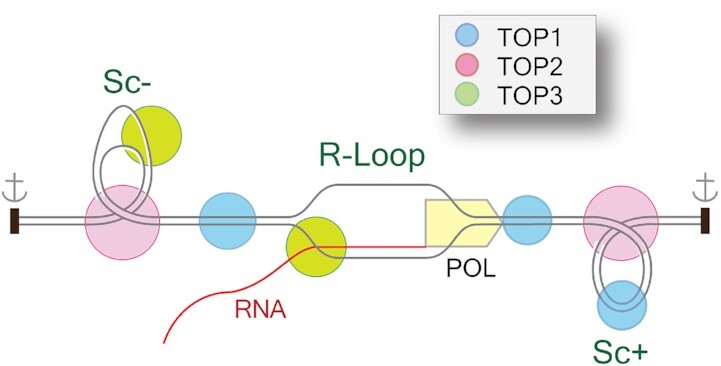
R-loops are abundant and dynamic structures ubiquitously present in human cells both in the nuclear and mitochondrial genomes. They form in in the wake of transcription complexes and in apart from transcription complexes. In this review, we focus on the relationship between R-loops and topoisomerases, and cancer genomics and therapies. We summarize the topological parameters associated with the formation and resolution of R-loops, which absorb and release high levels of genomic negative supercoiling (Sc-). We review the deleterious consequences of excessive R-loops and rationalize how human type IA (TOP3B) and type IB (TOP1) topoisomerases regulate and resolve R-loops in coordination with helicase and RNase H enzymes. We also review the drugs (topoisomerase inhibitors, splicing inhibitors, G4 stabilizing ligands) and cancer predisposing genes (BRCA1/2, transcription, and splicing genes) known to induce R-loops, and whether stabilizing R-loops and thereby inducing genomic damage can be viewed as a strategy for cancer treatment.
R环是丰富且动态的结构,在人类细胞的核基因组和线粒体基因组中普遍存在。它们在转录复合物之后形成,也在转录复合物之外形成。在本综述中,我们聚焦于R环与拓扑异构酶、癌症基因组学及治疗之间的关系。我们总结了与R环形成和解决相关的拓扑参数,这些参数吸收和释放高水平的基因组负超螺旋(Sc-)。我们回顾了过量R环的有害后果,并阐述了人类IA型(TOP3B)和IB型(TOP1)拓扑异构酶如何与解旋酶和核糖核酸酶H酶协同调节和解决R环。我们还回顾了已知可诱导R环的药物(拓扑异构酶抑制剂、剪接抑制剂、G4稳定配体)和癌症易感基因(BRCA1/2、转录和剪接基因),以及稳定R环从而诱导基因组损伤是否可被视为一种癌症治疗策略。