Eckelt Johannes, Hobohm Lukas, Merten Marie C, Pagel Charlotta F, Eggers Ann-Sophie, Lerchbaumer Markus H, Stangl Karl, Hasenfuß Gerd, Konstantinides Stavros, Schmidtmann Irene, Lankeit Mareike, Ebner Matthias
Clinic of Cardiology and Pneumology, University Medical Center Göttingen, Göttingen, Germany.
Center for Thrombosis and Hemostasis (CTH), University Medical Center Mainz, Mainz, Germany.
Res Pract Thromb Haemost. 2023 Jun 14;7(5):100280. doi: 10.1016/j.rpth.2023.100280. eCollection 2023 Jul.
While numerous studies have investigated short-term outcomes after pulmonary embolism (PE), long-term mortality remains insufficiently studied.
To investigate long-term outcomes in an unselected cohort of patients with PE.
A total of 896 consecutive patients with PE enrolled in a single-center registry between May 2005 and December 2017 were followed up for up to 14 years. The observed mortality rate was compared with the expected rate in the general population.
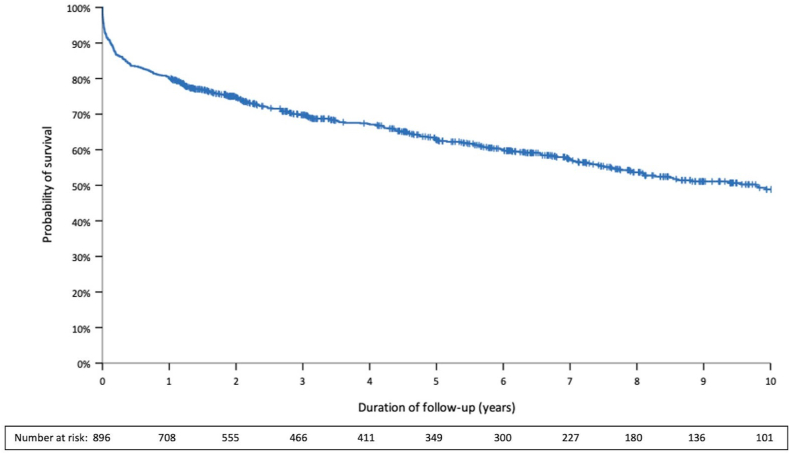
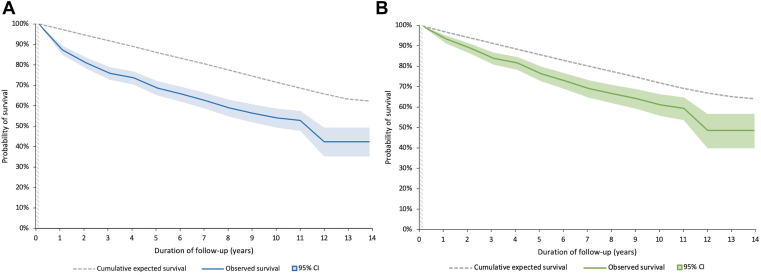
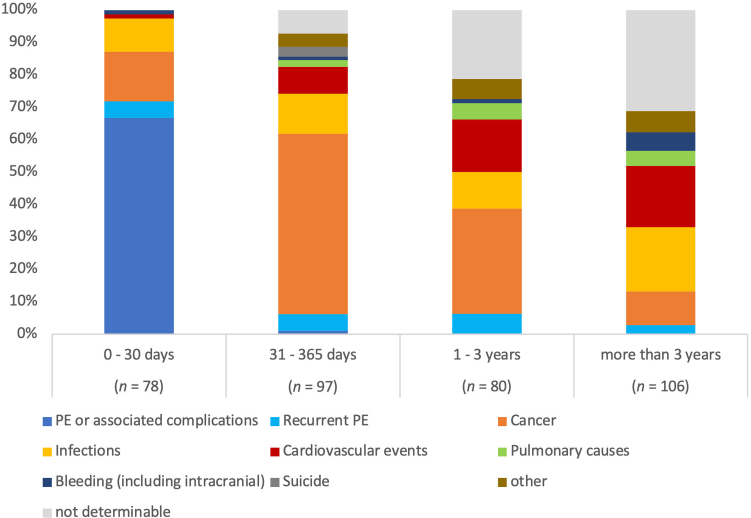
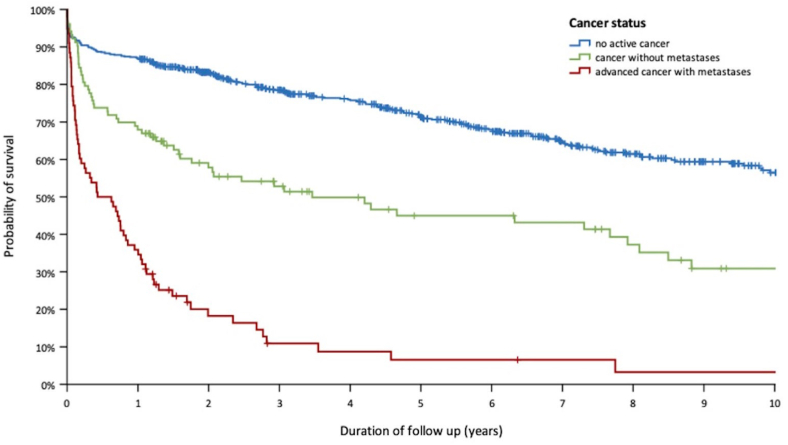
The total follow-up time was 3908 patient-years (median, 3.1 years). The 1- and 5-year mortality rates were 19.7% (95% CI, 17.2%-22.4%) and 37.1% (95% CI, 33.6%-40.5%), respectively. The most frequent causes of death were cancer (28.5%), PE (19.4%), infections (13.9%), and cardiovascular events (11.6%). Late mortality (after >30 days) was more frequent than expected in the general population, a finding that was consistent in patients without cancer (the 5-year standardized mortality ratios were 2.77 [95% CI, 2.41-3.16] and 1.80 [95% CI, 1.50-2.14], respectively). Active cancer was the strongest risk factor for death between 30 days and 3 years (hazard ratio [HR], 6.51; 95% CI, 4.67-9.08) but was not associated with later mortality. Death after >3 years was predicted by age (HR, 1.86; 95% CI, 1.51-2.29 per decade), chronic heart failure (HR, 1.66; 95% CI, 1.02-2.70), and anemia (HR, 1.62; 95% CI, 1.09-2.41).
The risk of mortality in patients with PE remained elevated compared with that in the general population throughout the follow-up period. The main driver of long-term mortality during the first 3 years was cancer. After that, mortality was predicted by age, chronic heart failure, and anemia.
虽然众多研究已调查了肺栓塞(PE)后的短期结局,但长期死亡率仍研究不足。
调查未经选择的PE患者队列的长期结局。
对2005年5月至2017年12月期间纳入单中心登记处的896例连续PE患者进行了长达14年的随访。将观察到的死亡率与一般人群的预期死亡率进行比较。
总随访时间为3908患者年(中位数为3.1年)。1年和5年死亡率分别为19.7%(95%CI,17.2%-22.4%)和37.1%(95%CI,33.6%-40.5%)。最常见的死亡原因是癌症(28.5%)、PE(19.4%)、感染(13.9%)和心血管事件(11.6%)。晚期死亡率(>30天后)高于一般人群的预期,这一发现在无癌症患者中一致(5年标准化死亡率分别为2.77[95%CI,2.41-3.16]和1.80[95%CI,1.50-2.14])。活动性癌症是30天至3年期间死亡的最强危险因素(风险比[HR],6.51;95%CI,4.67-9.08),但与后期死亡率无关。年龄(HR,1.86;95%CI,每十年1.51-2.29)、慢性心力衰竭(HR,1.66;95%CI,1.02-2.70)和贫血(HR,1.62;95%CI,1.09-2.41)可预测3年后的死亡。
在整个随访期间,PE患者的死亡风险仍高于一般人群。前3年长期死亡率的主要驱动因素是癌症。此后,死亡率由年龄、慢性心力衰竭和贫血预测。