Andishmand Abbas, Sharifi Leila, Namayandeh Seyedeh Mahdieh
Yazd Cardiovascular Research Center, Shahid Sadoughi University of Medical Sciences, Yazd, Iran.
Arch Iran Med. 2024 Dec 1;27(12):667-673. doi: 10.34172/aim.31907.
Pulmonary embolism (PE) is a significant public health concern. This retrospective cohort study examines the clinical profiles and outcomes of patients diagnosed with PE at a medical center in central Iran, aiming to identify mortality predictors during hospitalization and follow-up.
Data from 109 patients diagnosed with PE were analyzed, with a median follow-up of 23 months. The collected information included demographic and clinical characteristics, laboratory findings, treatment protocols, and outcomes. Logistic regression and Kaplan-Meier survival analysis were used to identify independent mortality predictors and assess survival impact.
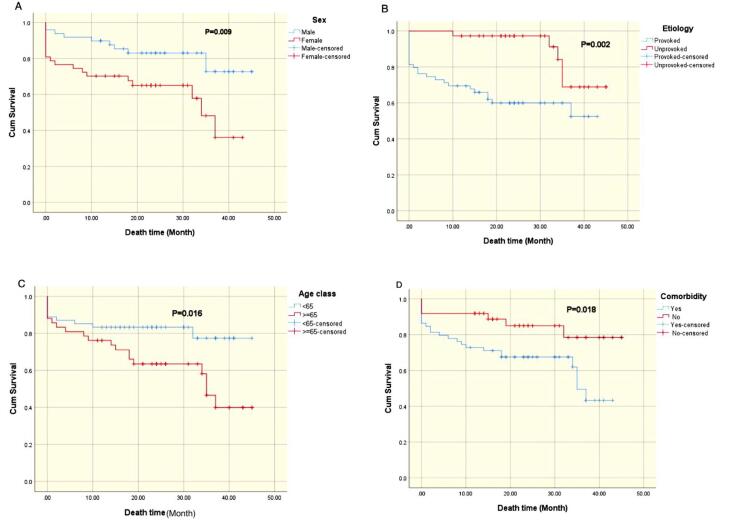
The mean age was 59.2 years (±19.7), with 51.4% male. Common symptoms included dyspnea (86%) and chest pain (53%), with non-massive PE being the most prevalent (63%). Independent mortality predictors identified were age (odds ratio [OR] 1.065 per year, <0.001), female sex (OR 4.421, =0.009), and PE severity (OR 0.262, =0.023). Kaplan-Meier analysis showed reduced survival probabilities in females (=0.009), those with provoked PE (=0.002), patients over 65 (=0.016), and individuals with comorbidities (=0.018). In-hospital mortality was 10.1%, linked to provoked massive PE, absence of thrombolytic therapy, and reduced left ventricular ejection fraction (LVEF).
In this cohort, age, sex, and PE severity were significant mortality predictors, while provoked PE, advanced age, and comorbidities were associated with lower mid-term survival probabilities.
肺栓塞(PE)是一个重大的公共卫生问题。这项回顾性队列研究调查了伊朗中部一家医疗中心诊断为PE的患者的临床特征和预后,旨在确定住院期间及随访期间的死亡预测因素。
分析了109例诊断为PE的患者的数据,中位随访时间为23个月。收集的信息包括人口统计学和临床特征、实验室检查结果、治疗方案及预后。采用逻辑回归和Kaplan-Meier生存分析来确定独立的死亡预测因素并评估生存影响。
平均年龄为59.2岁(±19.7),男性占51.4%。常见症状包括呼吸困难(86%)和胸痛(53%),非大面积PE最为常见(63%)。确定的独立死亡预测因素为年龄(每年的比值比[OR]为1.065,<0.001)、女性(OR为4.421,=0.009)和PE严重程度(OR为0.262,=0.023)。Kaplan-Meier分析显示,女性(=0.009)、诱因性PE患者(=0.002)、65岁以上患者(=0.016)和合并症患者(=0.018)的生存概率降低。住院死亡率为10.1%,与诱因性大面积PE、未进行溶栓治疗及左心室射血分数(LVEF)降低有关。
在该队列中,年龄、性别和PE严重程度是重要的死亡预测因素,而诱因性PE、高龄和合并症与中期较低的生存概率相关。