Zhang Ziyue, Hui Yangyang, Yang Wanting, Guo Gaoyue, Cui Binxin, Li Chaoqun, Wang Xiaoyu, Fan Xiaofei, Sun Chao
Department of Otorhinolaryngology Head and Neck Surgery, Tianjin First Central Hospital, Nankai District, Tianjin, China.
Institute of Otolaryngology of Tianjin, China.
Ther Adv Chronic Dis. 2023 Aug 18;14:20406223231192829. doi: 10.1177/20406223231192829. eCollection 2023.
Sleep disturbance and trace elements imbalance are common features in patients with decompensated cirrhosis, partially sharing similar mechanistic contributors and linking to adverse outcomes. However, there is a paucity of data concerning their relationship.
To investigate the association between serum trace elements levels and sleep quality in the context of cirrhosis.
Cross-sectional study.
We consecutively enrolled 160 patients with decompensated cirrhosis. The sleep disturbance was determined by the Pittsburgh Sleep Quality Index (PSQI > 5). Serum trace elements [magnesium, calcium, iron, copper (Cu), zinc (Zn), lead, and manganese] was measured by inductively coupled plasma mass spectrometry. Association of examined trace elements levels and sleep disturbance was analyzed by multiple linear (global PSQI scores) and multivariate logistic (dichotomized PSQI categories) regression models, respectively.
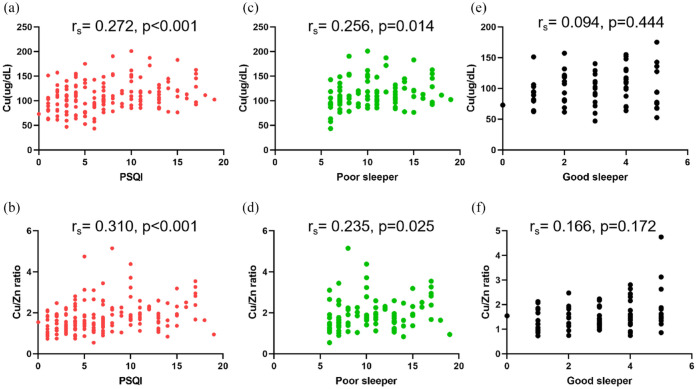
In total, 91 patients (56.88%) represented PSQI-defined sleep disturbance, characterized by female preponderance, lower body mass index levels, and higher serum Cu levels (all < 0.05). Looking into its clinical relevance with debilitating conditions, we showed that Cu/Zn ratio (CZr) is significantly higher in cirrhosis with poor sleep quality (1.77 1.48, = 0.003). Diagnostic performance analysis indicated CZr > 1.62 to exhibit better discrimination relative to respective Cu. Both multiple linear (β = 0.355, < 0.001) and multivariate logistic regression (odds ratio = 2.364, = 0.019) identified higher CZr as an independent risk factor associated with sleep disturbance.
Our findings implied an association between higher CZr and the presence of sleep disturbance in patients with decompensated cirrhosis.
睡眠障碍和微量元素失衡是失代偿期肝硬化患者的常见特征,部分具有相似的机制因素并与不良预后相关。然而,关于它们之间关系的数据较少。
在肝硬化背景下研究血清微量元素水平与睡眠质量之间的关联。
横断面研究。
我们连续纳入了160例失代偿期肝硬化患者。通过匹兹堡睡眠质量指数(PSQI>5)确定睡眠障碍。采用电感耦合等离子体质谱法测定血清微量元素[镁、钙、铁、铜(Cu)、锌(Zn)、铅和锰]。分别通过多元线性(总体PSQI评分)和多因素逻辑回归(二分法PSQI类别)模型分析所检测的微量元素水平与睡眠障碍之间的关联。
总共91例患者(56.88%)存在PSQI定义的睡眠障碍,其特征为女性占优势、体重指数水平较低以及血清铜水平较高(均P<0.05)。研究其与衰弱状况的临床相关性时,我们发现睡眠质量差的肝硬化患者铜/锌比值(CZr)显著更高(1.77比1.48,P = 0.003)。诊断性能分析表明,CZr>1.62相对于各自的铜具有更好的辨别能力。多元线性回归(β = 0.355,P<0.001)和多因素逻辑回归(比值比 = 2.364,P = 0.019)均确定较高的CZr是与睡眠障碍相关的独立危险因素。
我们的研究结果表明,失代偿期肝硬化患者中较高的CZr与睡眠障碍的存在之间存在关联。