• 文献检索
  • 文档翻译
  • 深度研究
  • 学术资讯
  • Suppr Zotero 插件Zotero 插件
  • 邀请有礼
  • 套餐&价格
  • 历史记录
应用&插件
Suppr Zotero 插件Zotero 插件浏览器插件Mac 客户端Windows 客户端微信小程序
定价
高级版会员购买积分包购买API积分包
服务
文献检索文档翻译深度研究API 文档MCP 服务
关于我们
关于 Suppr公司介绍联系我们用户协议隐私条款
关注我们

Suppr 超能文献

核心技术专利:CN118964589B侵权必究
粤ICP备2023148730 号-1Suppr @ 2026

文献检索

告别复杂PubMed语法,用中文像聊天一样搜索,搜遍4000万医学文献。AI智能推荐,让科研检索更轻松。

立即免费搜索

文件翻译

保留排版,准确专业,支持PDF/Word/PPT等文件格式,支持 12+语言互译。

免费翻译文档

深度研究

AI帮你快速写综述,25分钟生成高质量综述,智能提取关键信息,辅助科研写作。

立即免费体验

基于细胞嵌入的深度神经网络分类器,用于有监督的细胞类型识别。

LIDER: cell embedding based deep neural network classifier for supervised cell type identification.

机构信息

Hefei University of Technology, Hefei, China.

出版信息

PeerJ. 2023 Aug 16;11:e15862. doi: 10.7717/peerj.15862. eCollection 2023.

DOI:10.7717/peerj.15862
PMID:37601262
原文链接:https://pmc.ncbi.nlm.nih.gov/articles/PMC10439717/
Abstract

BACKGROUND

Automatic cell type identification has been an urgent task for the rapid development of single-cell RNA-seq techniques. Generally, the current approach for cell type identification is to generate cell clusters by unsupervised clustering and later assign labels to each cell cluster with manual annotation.

METHODS

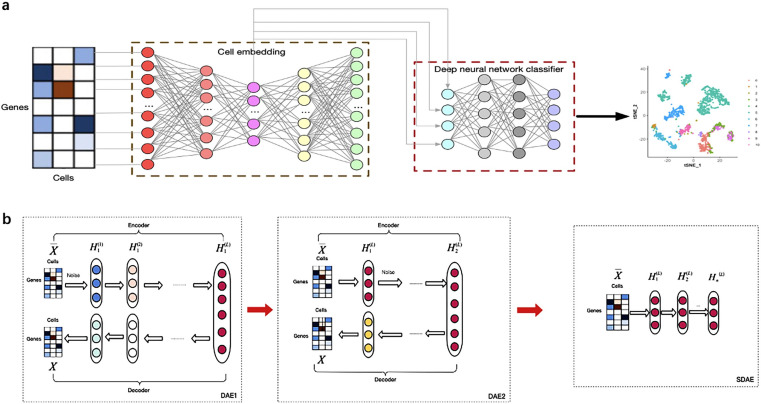
Here, we introduce LIDER (celL embeddIng based Deep nEural netwoRk classifier), a deep supervised learning method that combines cell embedding and deep neural network classifier for automatic cell type identification. Based on a stacked denoising autoencoder with a tailored and reconstructed loss function, LIDER identifies cell embedding and predicts cell types with a deep neural network classifier. LIDER was developed upon a stacked denoising autoencoder to learn encoder-decoder structures for identifying cell embedding.

RESULTS

LIDER accurately identifies cell types by using stacked denoising autoencoder. Benchmarking against state-of-the-art methods across eight types of single-cell data, LIDER achieves comparable or even superior enhancement performance. Moreover, LIDER suggests comparable robust to batch effects. Our results show a potential in deep supervised learning for automatic cell type identification of single-cell RNA-seq data. The LIDER codes are available at https://github.com/ShiMGLab/LIDER.

摘要

背景

单细胞 RNA-seq 技术的快速发展使得自动细胞类型识别成为一项紧迫的任务。通常,目前的细胞类型识别方法是通过无监督聚类生成细胞簇,然后通过手动注释为每个细胞簇分配标签。

方法

在这里,我们介绍了 LIDER(基于细胞嵌入的深度神经网络分类器),这是一种深度监督学习方法,它将细胞嵌入和深度神经网络分类器结合起来用于自动细胞类型识别。基于具有定制和重构损失函数的堆叠去噪自动编码器,LIDER 识别细胞嵌入并使用深度神经网络分类器预测细胞类型。LIDER 是在堆叠去噪自动编码器的基础上开发的,用于学习用于识别细胞嵌入的编码器-解码器结构。

结果

LIDER 通过堆叠去噪自动编码器准确地识别细胞类型。在八种单细胞数据类型的最新方法基准测试中,LIDER 实现了可比甚至更好的增强性能。此外,LIDER 还表现出对批次效应的稳健性。我们的结果表明,深度监督学习在单细胞 RNA-seq 数据的自动细胞类型识别方面具有潜力。LIDER 代码可在 https://github.com/ShiMGLab/LIDER 上获得。
https://cdn.ncbi.nlm.nih.gov/pmc/blobs/adc3/10439717/31a1b3884109/peerj-11-15862-g005.jpg
https://cdn.ncbi.nlm.nih.gov/pmc/blobs/adc3/10439717/4e9308a6183a/peerj-11-15862-g001.jpg
https://cdn.ncbi.nlm.nih.gov/pmc/blobs/adc3/10439717/f4a86608c96b/peerj-11-15862-g002.jpg
https://cdn.ncbi.nlm.nih.gov/pmc/blobs/adc3/10439717/b0be4c3c36f3/peerj-11-15862-g003.jpg
https://cdn.ncbi.nlm.nih.gov/pmc/blobs/adc3/10439717/508af3ed8f79/peerj-11-15862-g004.jpg
https://cdn.ncbi.nlm.nih.gov/pmc/blobs/adc3/10439717/31a1b3884109/peerj-11-15862-g005.jpg
https://cdn.ncbi.nlm.nih.gov/pmc/blobs/adc3/10439717/4e9308a6183a/peerj-11-15862-g001.jpg
https://cdn.ncbi.nlm.nih.gov/pmc/blobs/adc3/10439717/f4a86608c96b/peerj-11-15862-g002.jpg
https://cdn.ncbi.nlm.nih.gov/pmc/blobs/adc3/10439717/b0be4c3c36f3/peerj-11-15862-g003.jpg
https://cdn.ncbi.nlm.nih.gov/pmc/blobs/adc3/10439717/508af3ed8f79/peerj-11-15862-g004.jpg
https://cdn.ncbi.nlm.nih.gov/pmc/blobs/adc3/10439717/31a1b3884109/peerj-11-15862-g005.jpg

相似文献

1
LIDER: cell embedding based deep neural network classifier for supervised cell type identification.基于细胞嵌入的深度神经网络分类器,用于有监督的细胞类型识别。
PeerJ. 2023 Aug 16;11:e15862. doi: 10.7717/peerj.15862. eCollection 2023.
2
Deep structural clustering for single-cell RNA-seq data jointly through autoencoder and graph neural network.基于自动编码器和图神经网络的单细胞 RNA-seq 数据深度结构聚类。
Brief Bioinform. 2022 Mar 10;23(2). doi: 10.1093/bib/bbac018.
3
scBGEDA: deep single-cell clustering analysis via a dual denoising autoencoder with bipartite graph ensemble clustering.scBGEDA:基于双分图集成分聚类的对偶去噪自动编码器的单细胞聚类分析。
Bioinformatics. 2023 Feb 14;39(2). doi: 10.1093/bioinformatics/btad075.
4
STGNNks: Identifying cell types in spatial transcriptomics data based on graph neural network, denoising auto-encoder, and k-sums clustering.基于图神经网络、去噪自编码器和 k-sums 聚类的空间转录组学数据中的细胞类型识别。
Comput Biol Med. 2023 Nov;166:107440. doi: 10.1016/j.compbiomed.2023.107440. Epub 2023 Sep 9.
5
Autoencoder-based cluster ensembles for single-cell RNA-seq data analysis.基于自动编码器的单细胞 RNA-seq 数据分析聚类集成。
BMC Bioinformatics. 2019 Dec 24;20(Suppl 19):660. doi: 10.1186/s12859-019-3179-5.
6
Solo: Doublet Identification in Single-Cell RNA-Seq via Semi-Supervised Deep Learning.单细胞 RNA-Seq 中的对偶识别:基于半监督深度学习的方法
Cell Syst. 2020 Jul 22;11(1):95-101.e5. doi: 10.1016/j.cels.2020.05.010. Epub 2020 Jun 26.
7
Learning low-dose CT degradation from unpaired data with flow-based model.基于流的模型从非配对数据中学习低剂量 CT 衰减
Med Phys. 2022 Dec;49(12):7516-7530. doi: 10.1002/mp.15886. Epub 2022 Aug 8.
8
scGAD: a new task and end-to-end framework for generalized cell type annotation and discovery.scGAD:用于广义细胞类型注释和发现的新任务和端到端框架。
Brief Bioinform. 2023 Mar 19;24(2). doi: 10.1093/bib/bbad045.
9
scAMAC: self-supervised clustering of scRNA-seq data based on adaptive multi-scale autoencoder.scAMAC:基于自适应多尺度自动编码器的 scRNA-seq 数据的无监督聚类。
Brief Bioinform. 2024 Jan 22;25(2). doi: 10.1093/bib/bbae068.
10
ScCAEs: deep clustering of single-cell RNA-seq via convolutional autoencoder embedding and soft K-means.ScCAEs:基于卷积自动编码器嵌入和软 K-means 的单细胞 RNA-seq 深度聚类。
Brief Bioinform. 2022 Jan 17;23(1). doi: 10.1093/bib/bbab321.

本文引用的文献

1
CIForm as a Transformer-based model for cell-type annotation of large-scale single-cell RNA-seq data.CIForm 作为一种基于 Transformer 的模型,用于大规模单细胞 RNA-seq 数据的细胞类型注释。
Brief Bioinform. 2023 Jul 20;24(4). doi: 10.1093/bib/bbad195.
2
TransCluster: A Cell-Type Identification Method for single-cell RNA-Seq data using deep learning based on transformer.TransCluster:一种基于Transformer深度学习的单细胞RNA测序数据细胞类型识别方法。
Front Genet. 2022 Oct 11;13:1038919. doi: 10.3389/fgene.2022.1038919. eCollection 2022.
3
Single-Cell Transcriptome Analysis Reveals Mesenchymal Stem Cells in Cavernous Hemangioma.
单细胞转录组分析揭示海绵状血管瘤中的间充质干细胞。
Front Cell Dev Biol. 2022 Jul 5;10:916045. doi: 10.3389/fcell.2022.916045. eCollection 2022.
4
NanoCaller for accurate detection of SNPs and indels in difficult-to-map regions from long-read sequencing by haplotype-aware deep neural networks.利用基于单倍型感知的深度神经网络,从长读测序中对难以映射区域中的 SNPs 和 indels 进行精确检测的 NanoCaller。
Genome Biol. 2021 Sep 6;22(1):261. doi: 10.1186/s13059-021-02472-2.
5
Chromatin interaction neural network (ChINN): a machine learning-based method for predicting chromatin interactions from DNA sequences.染色质相互作用神经网络(ChINN):一种基于机器学习的方法,用于从 DNA 序列预测染色质相互作用。
Genome Biol. 2021 Aug 16;22(1):226. doi: 10.1186/s13059-021-02453-5.
6
Prediction of drug efficacy from transcriptional profiles with deep learning.利用深度学习从转录谱预测药物疗效。
Nat Biotechnol. 2021 Nov;39(11):1444-1452. doi: 10.1038/s41587-021-00946-z. Epub 2021 Jun 17.
7
nnU-Net: a self-configuring method for deep learning-based biomedical image segmentation.nnU-Net:一种基于深度学习的生物医学图像分割的自配置方法。
Nat Methods. 2021 Feb;18(2):203-211. doi: 10.1038/s41592-020-01008-z. Epub 2020 Dec 7.
8
scVAE: variational auto-encoders for single-cell gene expression data.scVAE:用于单细胞基因表达数据的变分自动编码器。
Bioinformatics. 2020 Aug 15;36(16):4415-4422. doi: 10.1093/bioinformatics/btaa293.
9
Single-Cell RNA Sequencing Maps Endothelial Metabolic Plasticity in Pathological Angiogenesis.单细胞 RNA 测序描绘病理性血管生成中的内皮代谢可塑性。
Cell Metab. 2020 Apr 7;31(4):862-877.e14. doi: 10.1016/j.cmet.2020.03.009.
10
Uncovering axes of variation among single-cell cancer specimens.揭示单细胞癌症样本中的变异轴。
Nat Methods. 2020 Mar;17(3):302-310. doi: 10.1038/s41592-019-0689-z. Epub 2020 Jan 13.