Kumar Abhishek, Rithesh Lellapalli, Kumar Vikash, Raghuvanshi Nikhil, Chaudhary Kautilya, Pandey Abhay K
Department of Plant Pathology, Chaudhary Charan Singh Haryana Agricultural University, Hisar, Haryana, India.
Department of Agriculture, Maharishi Markandeshwar (Deemed to be University), Mullana, Ambala, Haryana, India.
Front Microbiol. 2023 Aug 3;14:1214680. doi: 10.3389/fmicb.2023.1214680. eCollection 2023.
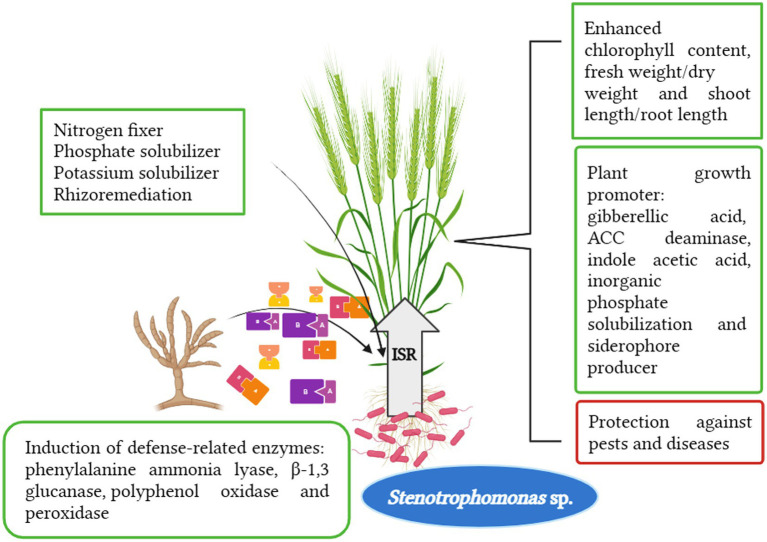
In the current scenario, the use of synthetic fertilizers is at its peak, which is an expensive affair, possesses harmful effects to the environment, negatively affecting soil fertility and beneficial soil microfauna as well as human health. Because of this, the demand for natural, chemical-free, and organic foods is increasing day by day. Therefore, in the present circumstances use of biofertilizers for plant growth-promotion and microbe-based biopesticides against biotic stresses are alternative options to reduce the risk of both synthetic fertilizers and pesticides. The plant growth promoting rhizobacteria (PGPR) and microbial biocontrol agents are ecologically safe and effective. Owning their beneficial properties on plant systems without harming the ecosystem, they are catching the widespread interest of researchers, agriculturists, and industrialists. In this context, the genus is an emerging potential source of both biofertilizer and biopesticide. This genus is particularly known for producing osmoprotective substances which play a key role in cellular functions, i.e., DNA replication, DNA-protein interactions, and cellular metabolism to regulate the osmotic balance, and also acts as effective stabilizers of enzymes. Moreover, few species of this genus are disease causing agents in humans that is why; it has become an emerging field of research in the present scenario. In the past, many studies were conducted on exploring the different applications of in various fields, however, further researches are required to explore the various functions of in plant growth promotion and management of pests and diseases under diverse growth conditions and to demonstrate its interaction with plant and soil systems. The present review discusses various plant growth and biocontrol attributes of the genus in various food crops along with knowledge gaps. Additionally, the potential risks and challenges associated with the use of in agriculture systems have also been discussed along with a call for further research in this area.
在当前情况下,合成肥料的使用达到了顶峰,这是一项昂贵的事情,对环境具有有害影响,会对土壤肥力、有益土壤微生物群以及人类健康产生负面影响。因此,对天然、无化学物质的有机食品的需求日益增加。所以,在目前的情况下,使用生物肥料促进植物生长以及基于微生物的生物农药抵御生物胁迫是减少合成肥料和农药风险的替代选择。植物促生根际细菌(PGPR)和微生物生物防治剂在生态上是安全且有效的。由于它们在不损害生态系统的情况下对植物系统具有有益特性,因此正引起研究人员、农学家和实业家的广泛关注。在这种背景下,[具体属名]属是生物肥料和生物农药的一个新兴潜在来源。该属尤其以产生渗透保护物质而闻名,这些物质在细胞功能中起关键作用,即DNA复制、DNA - 蛋白质相互作用以及调节渗透平衡的细胞代谢,并且还充当酶的有效稳定剂。此外,该属的少数物种是人类致病因子,这就是为什么在当前情况下它已成为一个新兴的研究领域。过去,人们进行了许多研究来探索[具体属名]在各个领域的不同应用,然而,还需要进一步研究来探索[具体属名]在不同生长条件下促进植物生长以及病虫害管理中的各种功能,并证明其与植物和土壤系统的相互作用。本综述讨论了[具体属名]属在各种粮食作物中的各种植物生长和生物防治特性以及知识空白。此外,还讨论了在农业系统中使用[具体属名]相关的潜在风险和挑战,并呼吁在该领域进行进一步研究。