Linder Kathleen A, Miceli Marisa H
Division of Infectious Diseases, University of Michigan, Ann Arbor, Michigan, USA.
Department of Internal Medicine, Infectious Diseases Section, VA Ann Arbor Healthcare System, Ann Arbor, Michigan, USA.
Open Forum Infect Dis. 2023 Jul 24;10(8):ofad385. doi: 10.1093/ofid/ofad385. eCollection 2023 Aug.
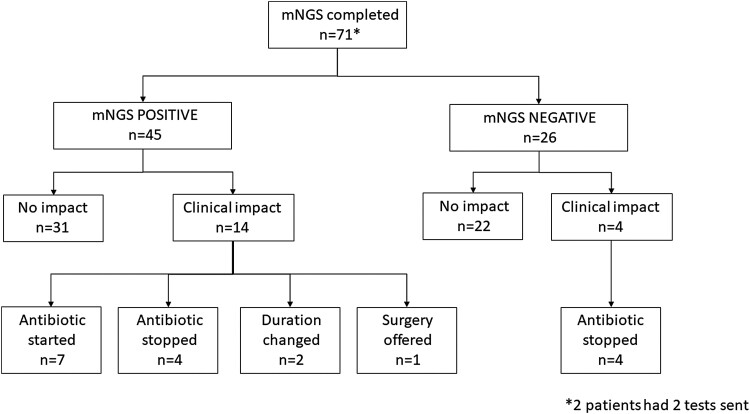
Metagenomic next-generation sequencing (mNGS) of cell-free DNA is an emerging modality for the diagnosis of infectious diseases, but studies on its clinical utility are limited. We conducted a retrospective single-center study including all patients who had plasma mNGS sent at the University of Michigan between 1 January 2021 and 25 July 2022. Test results were assessed for clinical impact. A total of 71 tests were sent on 69 patients; the mean ± SD age was 52 ± 19 years; and 35% of patients were immunocompromised. Forty-five (63%) mNGS test results were positive and 14 (31%) had clinical impact-from starting new antimicrobials (n = 7), discontinuing antimicrobials (n = 4), or changing antimicrobial duration (n = 2) or by affecting surgical decision making (n = 1). Twenty-six (37%) mNGS test results were negative and only 4 (15%) were impactful, leading to discontinuation of antimicrobials. Overall, just 25% of mNGS tests were clinically relevant. There was no significant difference in the proportion of tests that were clinically relevant between negative and positive results ( = .16) or if patients were immunocompromised ( = .57). Plasma mNGS was most frequently impactful (in 50% of patients) when included in the diagnostic workup of cardiovascular infection but less impactful in other clinical syndromes, including fever of unknown origin and pulmonary infection. Our findings underscore the need to further study this testing modality, particularly with prospective research including negative controls, before it is considered for widespread use.
游离DNA的宏基因组下一代测序(mNGS)是一种新兴的传染病诊断方法,但关于其临床应用的研究有限。我们进行了一项回顾性单中心研究,纳入了2021年1月1日至2022年7月25日期间在密歇根大学进行血浆mNGS检测的所有患者。评估检测结果的临床影响。共对69例患者进行了71次检测;平均年龄±标准差为52±19岁;35%的患者免疫功能低下。45项(63%)mNGS检测结果为阳性,14项(31%)具有临床影响——开始使用新的抗菌药物(n = 7)、停用抗菌药物(n = 4)、改变抗菌药物使用时长(n = 2)或影响手术决策(n = 1)。26项(37%)mNGS检测结果为阴性,只有4项(15%)具有影响,导致停用抗菌药物。总体而言,只有25%的mNGS检测具有临床相关性。阴性和阳性结果之间具有临床相关性的检测比例没有显著差异(P = 0.16),免疫功能低下患者与非免疫功能低下患者之间也没有显著差异(P = 0.57)。当血浆mNGS用于心血管感染的诊断检查时,其影响最为常见(50%的患者),但在其他临床综合征中影响较小,包括不明原因发热和肺部感染。我们的研究结果强调,在考虑广泛使用这种检测方法之前,需要进一步研究,特别是进行包括阴性对照的前瞻性研究。