Department of Cardiology, Cardiovascular Center, Henan Key Laboratory of Hereditary Cardiovascular Diseases, The First Affiliated Hospital of Zhengzhou University, Zhengzhou, Henan, China.
Front Cell Infect Microbiol. 2023 Feb 3;13:1107170. doi: 10.3389/fcimb.2023.1107170. eCollection 2023.
Metagenomic next-generation sequencing (mNGS) technology is helpful for the early diagnosis of infective endocarditis, especially culture-negative infective endocarditis, which may guide clinical treatment. The purpose of this study was to compare the presence of culture-negative infective endocarditis pathogens versus culture-positive ones, and whether mNGS test results could influence treatment regimens for patients with routine culture-negative infective endocarditis.
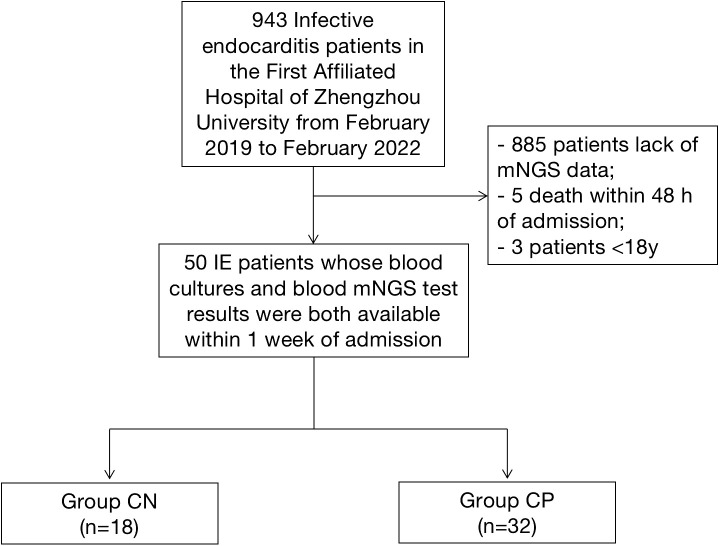
The present study enrolled patients diagnosed with infective endocarditis and tested for mNGS in the First Affiliated Hospital of Zhengzhou University from February 2019 to February 2022 continuously. According to the culture results, patients were divided into culture-negative group (Group CN, n=18) and culture-positive group (Group CP, n=32). The baseline characteristics, clinical data, pathogens, 30 day mortality and treatment regimen of 50 patients with infective endocarditis were recorded and analyzed.
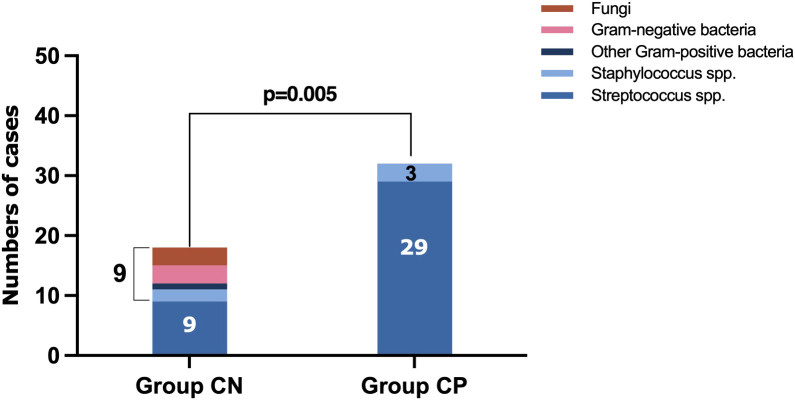
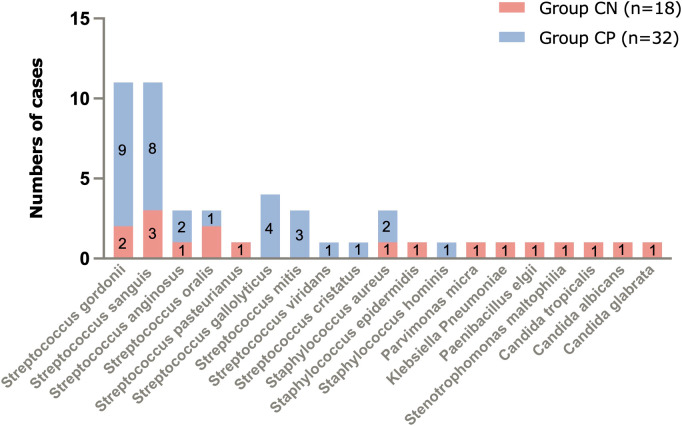
Except for higher levels of PCT in the Group CN [0.33 (0.16-2.74) ng/ml . 0.23 (0.12-0.49) ng/ml, P=0.042], there were no significant differences in the basic clinical data and laboratory examinations between the two groups (all P>0.05). The aortic valve and mitral valve were the most involved valves in patients with infective endocarditis (aortic valve involved: Group CN 10, Group CP 16; mitral valve involved: Group CN 8, Group CP 21; P>0.05) while 9 patients had multiple valves involved (Group CN 2, Group CP 7; P>0.05). The detection rate of non-streptococci infections in the Group CN was significantly higher than that in the Group CP (9/18 . 3/32, P=0.004). There was no significant difference in patients with heart failure hospitalization and all-cause death at 30 days after discharge (3 in Group CN . 4 in Group CP, P>0.05). It is worth noting that 10 patients with culture-negative infective endocarditis had their antibiotic regimen optimized after the blood mNGS.
Culture-negative infective endocarditis should be tested for mNGS for early diagnosis and to guide clinical antibiotic regimen.
宏基因组下一代测序(mNGS)技术有助于感染性心内膜炎的早期诊断,尤其是对培养阴性的感染性心内膜炎,这可能有助于指导临床治疗。本研究旨在比较培养阴性与培养阳性感染性心内膜炎患者的病原体,以及 mNGS 检测结果是否会影响常规培养阴性感染性心内膜炎患者的治疗方案。
本研究连续纳入 2019 年 2 月至 2022 年 2 月在郑州大学第一附属医院诊断为感染性心内膜炎并接受 mNGS 检测的患者。根据培养结果,患者分为培养阴性组(Group CN,n=18)和培养阳性组(Group CP,n=32)。记录并分析 50 例感染性心内膜炎患者的基线特征、临床资料、病原体、30 天死亡率和治疗方案。
除培养阴性组患者降钙素原(PCT)水平更高[0.33(0.16-2.74)ng/ml 比 0.23(0.12-0.49)ng/ml,P=0.042]外,两组患者基本临床资料和实验室检查差异均无统计学意义(均 P>0.05)。感染性心内膜炎患者最常受累的瓣膜为主动脉瓣和二尖瓣(主动脉瓣受累:Group CN 10 例,Group CP 16 例;二尖瓣受累:Group CN 8 例,Group CP 21 例;均 P>0.05),9 例患者多瓣膜受累(Group CN 2 例,Group CP 7 例;均 P>0.05)。培养阴性组非链球菌感染的检出率明显高于培养阳性组(9/18 比 3/32,P=0.004)。两组患者出院后 30 天心力衰竭住院和全因死亡的发生率差异均无统计学意义(Group CN 3 例,Group CP 4 例;均 P>0.05)。值得注意的是,10 例培养阴性感染性心内膜炎患者的抗生素方案在血液 mNGS 检测后得到了优化。
对于疑似感染性心内膜炎患者,尤其是培养阴性的患者,应进行 mNGS 检测以早期诊断并指导临床抗生素方案。