Das Sumana M, Roy Niladri, Singh Dharmendra, Sardar Pritam Kumar, Das Siddhartha
Department of Radiotherapy, Radha Gobinda (RG) Kar Medical College and Hospital, Kolkata, IND.
Department of Radiotherapy, Medical College and Hospital, Kolkata, IND.
Cureus. 2023 Jul 20;15(7):e42206. doi: 10.7759/cureus.42206. eCollection 2023 Jul.
The established standard treatment for locally advanced head and neck squamous cell carcinoma is concurrent chemoradiotherapy, but the optimum radiotherapy schedule for best disease control and acceptable toxicity is still evolving. Tumor control probability decreases with each day's prolongation of treatment time. Shortening the overall treatment time of radiation by pure accelerated radiotherapy may be a good option.
One hundred and sixty-five patients with histopathologically proven squamous cell carcinoma of the head and neck were included in the study and were assigned into two groups from January 2017 to June 2019. The total dose of 70 Gy was given, 2 Gy/fraction/day. Treatment was given five days a week (conventional radiotherapy) and six days a week (pure accelerated radiotherapy). Both groups received weekly concurrent injections of cisplatin.
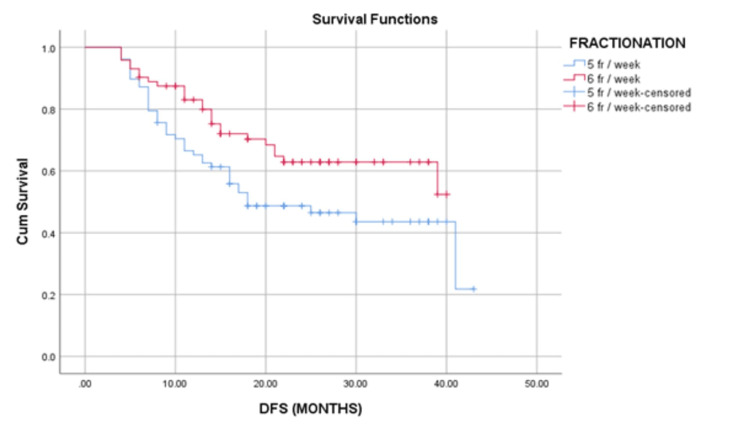
The stage (p=0.006) and fractionation of radiation (p=0.018) were the independent factors affecting disease-free survival (DFS). There was a statistically significant difference (p=0.019) in the recurrence of patients in different fractionation schedules. The median DFS was 39 months with a 95% CI of 31.44 - 46.55. One- and three-year DFS was 51% and 8.5% respectively in the five fractions/week schedule arm while 54.5% and 9.5% respectively in the six fractions/week schedule group.
Pure accelerated radiotherapy is more efficacious in terms of disease control with comparable mildly increased acute side effects.
局部晚期头颈部鳞状细胞癌既定的标准治疗方法是同步放化疗,但对于实现最佳疾病控制和可接受毒性的最佳放疗方案仍在不断发展。随着治疗时间的延长,肿瘤控制概率会降低。通过单纯加速放疗缩短放疗总时间可能是一个不错的选择。
2017年1月至2019年6月,165例经组织病理学证实为头颈部鳞状细胞癌的患者纳入本研究,并分为两组。给予总剂量70 Gy,每次分割剂量2 Gy/天。治疗为每周5天(常规放疗)和每周6天(单纯加速放疗)。两组均每周同步注射顺铂。
分期(p = 0.006)和放疗分割方式(p = 0.018)是影响无病生存期(DFS)的独立因素。不同分割方案患者的复发情况存在统计学显著差异(p = 0.019)。DFS中位数为39个月,95%置信区间为31.44 - 46.55。每周5次分割方案组1年和3年DFS分别为51%和8.5%,而每周6次分割方案组分别为54.5%和9.5%。
单纯加速放疗在疾病控制方面更有效,同时急性副作用轻度增加且相当。