Bhandari Vinaya, Bril Vera
Ellen and Martin Prosserman Centre for Neuromuscular Diseases, Toronto General Hospital, University Health Network, University of Toronto, Toronto, ON, Canada.
Front Neurol. 2023 Aug 4;14:1229112. doi: 10.3389/fneur.2023.1229112. eCollection 2023.
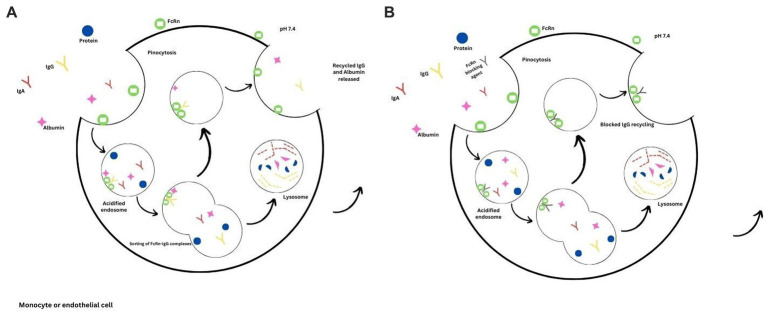
Myasthenia gravis (MG) is an autoimmune disorder characterized by autoantibodies specifically directed against proteins located within the postsynaptic membrane of the neuromuscular junction. These pathogenic autoantibodies can be reduced by therapies such as plasma exchange, IVIG infusions and other immunosuppressive agents. However, there are significant side effects associated with most of these therapies. Since there is a better understanding of the molecular structure and the biological properties of the neonatal Fc receptors (FcRn), it possesses an attractive profile in treating myasthenia gravis. FcRn receptors prevent the catabolism of IgG by impeding their lysosomal degradation and facilitating their extracellular release at physiological pH, consequently extending the IgG half-life. Thus, the catabolism of IgG can be enhanced by blocking the FcRn, leading to outcomes similar to those achieved through plasma exchange with no significant safety concerns. The available studies suggest that FcRn holds promise as a versatile therapeutic intervention, capable of delivering beneficial outcomes in patients with distinct characteristics and varying degrees of MG severity. Efgartigimod is already approved for the treatment of generalized MG, rozanolixizumab is under review by health authorities, and phase 3 trials of nipocalimab and batoclimab are underway. Here, we will review the available data on FcRn therapeutic agents in the management of MG.
重症肌无力(MG)是一种自身免疫性疾病,其特征是自身抗体特异性地针对位于神经肌肉接头突触后膜内的蛋白质。这些致病性自身抗体可通过血浆置换、静脉注射免疫球蛋白(IVIG)输注和其他免疫抑制剂等疗法减少。然而,这些疗法大多都有显著的副作用。由于对新生儿Fc受体(FcRn)的分子结构和生物学特性有了更好的了解,它在治疗重症肌无力方面具有吸引人的特点。FcRn受体通过阻止IgG的溶酶体降解并促进其在生理pH值下的细胞外释放来防止IgG的分解代谢,从而延长IgG的半衰期。因此,通过阻断FcRn可以增强IgG的分解代谢,产生与血浆置换相似的效果,且无重大安全问题。现有研究表明,FcRn有望成为一种通用的治疗干预手段,能够为具有不同特征和不同重症肌无力严重程度的患者带来有益的结果。艾加莫德已被批准用于治疗全身型重症肌无力,罗扎诺利昔单抗正在接受卫生当局的审查,尼泊卡利单抗和巴托利单抗的3期试验正在进行。在此,我们将回顾关于FcRn治疗药物在重症肌无力管理中的现有数据。