Department of Plant Pathology, Faculty of Agriculture, Kasetsart University, Bangkok, 10900, Thailand.
Center for Agricultural Biotechnology, Kasetsart University, Kamphaengsaen Campus, Nakhon Pathom, 73140, Thailand.
Sci Rep. 2023 Aug 21;13(1):13610. doi: 10.1038/s41598-023-40874-3.
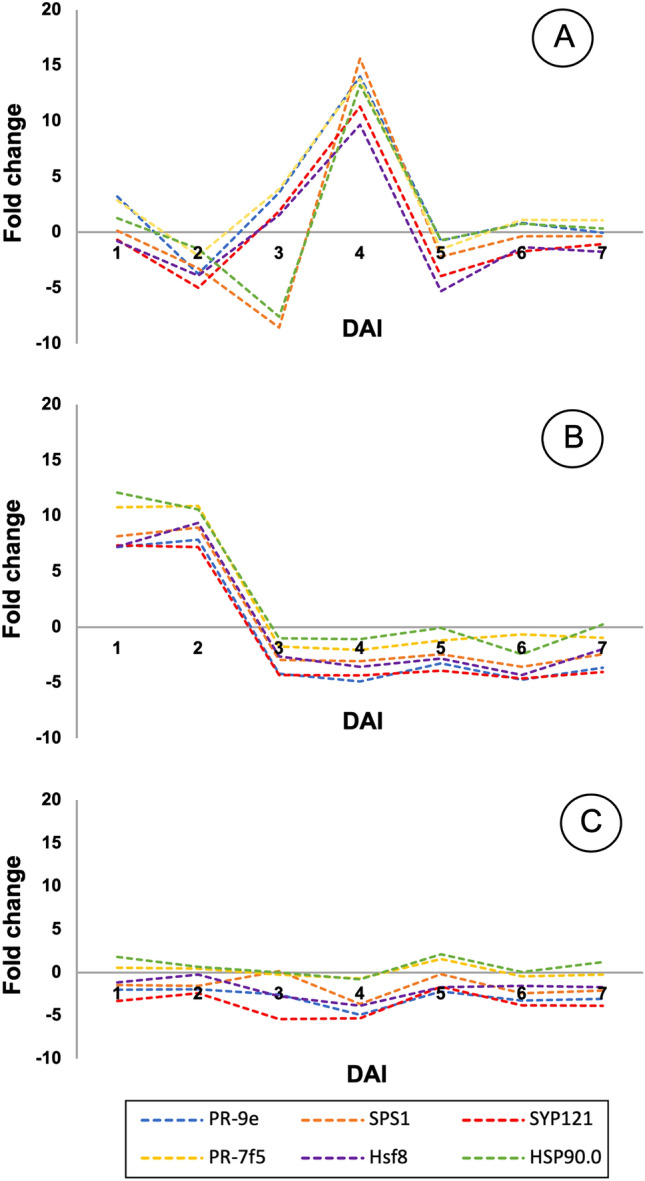
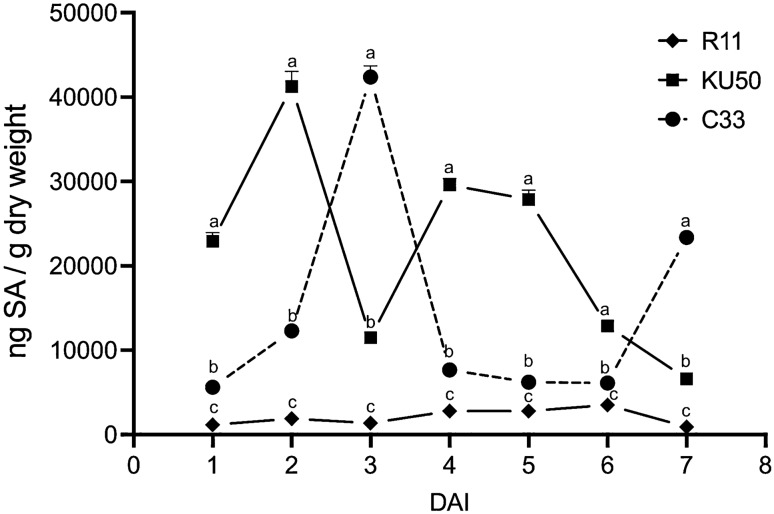
Sri Lankan cassava mosaic virus (SLCMV), the primary pathogen responsible for cassava mosaic disease in cassava plantations, is transmitted via infected cutting stems and the whitefly vector, Bemisia tabaci. To obtain better insights into the defense mechanism of cassava against SLCMV, whiteflies were used to induce SLCMV infection for activating the salicylic acid (SA) signaling pathway, which triggers the innate immune system. The study aimed to investigate the specific interactions between viruliferous whiteflies and SA accumulation in resistant (C33), tolerant (Kasetsart 50; KU50), and susceptible (Rayong 11) cassava cultivars by infecting with SLCMV. Leaf samples were collected at various time points, from 1 to 7 days after inoculation (dai). The SA levels were quantified by gas chromatography-mass spectrometry and validated by quantitative reverse transcription polymerase chain reaction. The SA levels increased in KU50 and C33 plants at 2 and 3 dai, respectively, but remained undetected in Rayong11 plants. The expression of PR-9e, PR-7f5, SPS1, SYP121, Hsf8, and HSP90 increased in infected C33 plants at 4 dai, whereas that of KU50 plants decreased immediately at 2 dai, and that of Rayong11 plants increased at 1 dai but gradually decreased thereafter. These findings strongly indicate that SA plays a crucial role in regulating antiviral defense mechanisms, especially in SLCMV-resistant plants. Altogether, the findings provide valuable insights into the mechanisms underlying the activation of SA-mediated anti-SLCMV defense pathways, and the resistance, tolerance, and susceptibility of cassava, which can aid future breeding programs aimed at enhancing SLCMV resistance.
斯里兰卡木薯花叶病毒(SLCMV)是导致木薯植株发生花叶病的主要病原体,通过感染的扦插茎和粉虱介体烟粉虱传播。为了更好地了解木薯对 SLCMV 的防御机制,利用粉虱诱导 SLCMV 感染以激活水杨酸(SA)信号通路,从而触发先天免疫系统。本研究旨在通过接种 SLCMV 来研究带毒粉虱与抗性(C33)、耐病(Kasetsart 50;KU50)和感病(Rayong 11)木薯品种中 SA 积累之间的特定相互作用。在接种后 1 至 7 天( dai)的不同时间点采集叶片样本。通过气相色谱-质谱联用仪定量 SA 水平,并通过定量逆转录聚合酶链反应进行验证。KU50 和 C33 植株中的 SA 水平分别在 2 dai 和 3 dai 时增加,但在 Rayong11 植株中未检测到。感染的 C33 植株中 PR-9e、PR-7f5、SPS1、SYP121、Hsf8 和 HSP90 的表达在 4 dai 时增加,而 KU50 植株的表达在 2 dai 时立即下降,Rayong11 植株的表达在 1 dai 时增加但随后逐渐下降。这些发现强烈表明 SA 在调节抗病毒防御机制中起着关键作用,特别是在抗 SLCMV 的植物中。总之,这些发现为激活 SA 介导的抗 SLCMV 防御途径以及木薯的抗性、耐病性和感病性的机制提供了有价值的见解,这有助于未来旨在提高 SLCMV 抗性的育种计划。