Institute for Mental Health Policy Research, Centre for Addiction and Mental Health (CAMH), Toronto, ON, Canada.
Campbell Family Mental Health Research Institute, Centre for Addiction and Mental Health (CAMH), Toronto, ON, Canada.
BMC Public Health. 2023 Aug 22;23(1):1591. doi: 10.1186/s12889-023-16178-6.
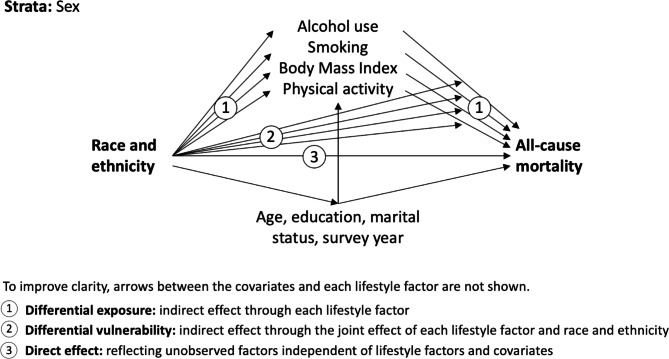
Racial and ethnic inequalities in all-cause mortality exist, and individual-level lifestyle factors have been proposed to contribute to these inequalities. In this study, we evaluate the extent to which the association between race and ethnicity and all-cause mortality can be explained by differences in the exposure and vulnerability to harmful effects of different lifestyle factors.
The 1997-2014 cross-sectional, annual US National Health Interview Survey (NHIS) linked to the 2015 National Death Index was used. NHIS reported on race and ethnicity (non-Hispanic White, non-Hispanic Black, and Hispanic/Latinx), lifestyle factors (alcohol use, smoking, body mass index, physical activity), and covariates (sex, age, education, marital status, survey year). Causal mediation using an additive hazard and marginal structural approach was used.
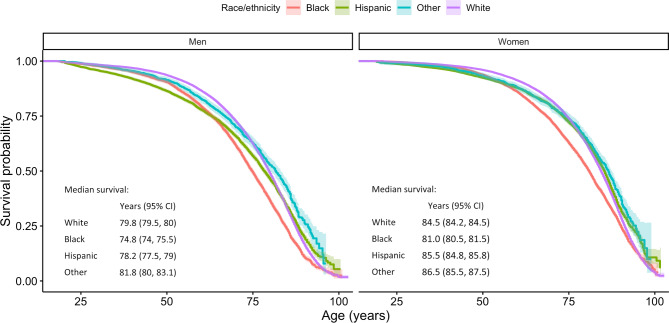
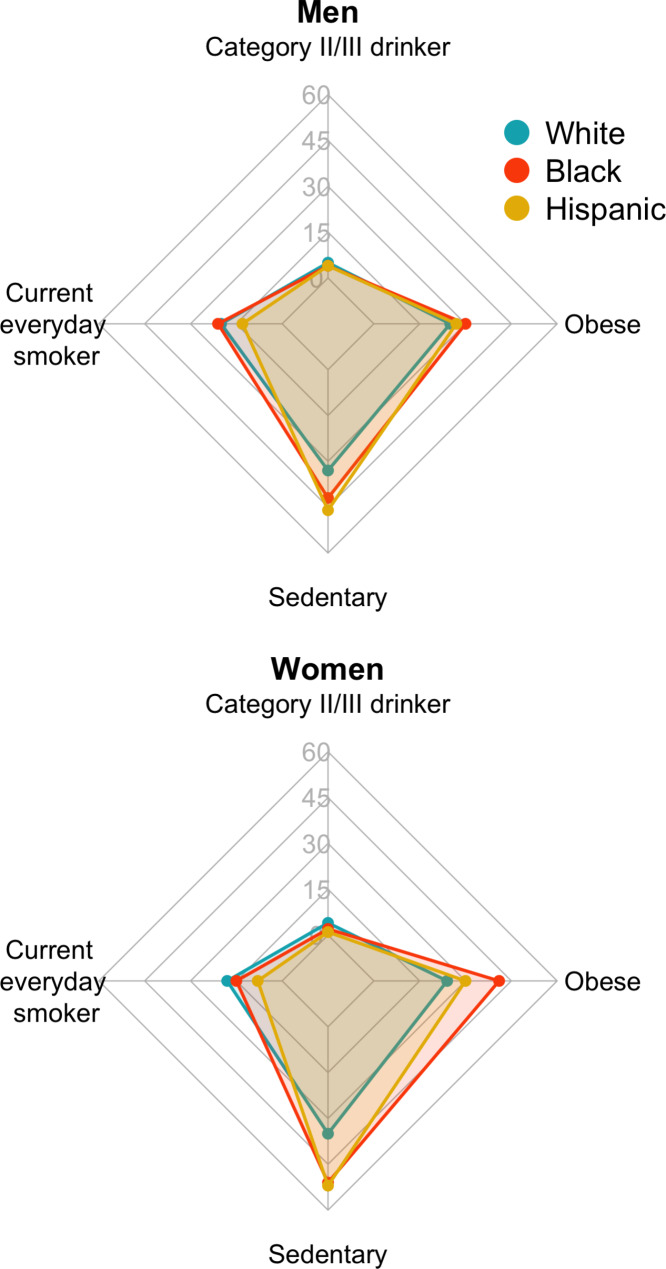
465,073 adults (18-85 years) were followed 8.9 years (SD: 5.3); 49,804 deaths were observed. Relative to White adults, Black adults experienced 21.7 (men; 95%CI: 19.9, 23.5) and 11.5 (women; 95%CI: 10.1, 12.9) additional deaths per 10,000 person-years whereas Hispanic/Latinx women experienced 9.3 (95%CI: 8.1, 10.5) fewer deaths per 10,000 person-years; no statistically significant differences were identified between White and Hispanic/Latinx men. Notably, these differences in mortality were partially explained by both differential exposure and differential vulnerability to the lifestyle factors among Black women, while different effects of individual lifestyle factors canceled each other out among Black men and Hispanic/Latinx women.
Lifestyle factors provide some explanation for racial and ethnic inequalities in all-cause mortality. Greater attention to structural, life course, healthcare, and other factors is needed to understand determinants of inequalities in mortality and to advance health equity.
全因死亡率存在种族和民族不平等现象,有人提出个体生活方式因素可能导致这种不平等。本研究评估了种族和民族与全因死亡率之间的关联在多大程度上可以通过不同生活方式因素的暴露和易感性差异来解释。
使用了 1997 年至 2014 年美国国家健康访谈调查(NHIS)的横断面、年度数据,该调查与 2015 年国家死亡指数相关联。NHIS 报告了种族和民族(非西班牙裔白人、非西班牙裔黑人、西班牙裔/拉丁裔)、生活方式因素(饮酒、吸烟、体重指数、身体活动)和协变量(性别、年龄、教育程度、婚姻状况、调查年份)。使用加性危害和边缘结构方法进行因果中介分析。
465073 名(18-85 岁)成年人随访 8.9 年(SD:5.3);观察到 49804 例死亡。与白人成年人相比,黑人成年人每 10000 人年多死亡 21.7(男性;95%CI:19.9,23.5)和 11.5(女性;95%CI:10.1,12.9)人,而西班牙裔/拉丁裔女性每 10000 人年少死亡 9.3(95%CI:8.1,10.5)人;未发现白人男性与西班牙裔/拉丁裔男性之间存在统计学上的显著差异。值得注意的是,这些死亡率差异部分可以通过黑人女性对生活方式因素的差异暴露和易感性来解释,而黑人男性和西班牙裔/拉丁裔女性的个别生活方式因素的不同影响则相互抵消。
生活方式因素为全因死亡率的种族和民族不平等现象提供了一些解释。需要更加关注结构性、生命历程、医疗保健和其他因素,以了解死亡率不平等的决定因素,并促进健康公平。