Ammons Dylan, Hopkins Leone, Cronise Kathryn, Kurihara Jade, Regan Daniel, Dow Steven
Colorado State University.
Res Sq. 2023 Aug 9:rs.3.rs-3232360. doi: 10.21203/rs.3.rs-3232360/v1.
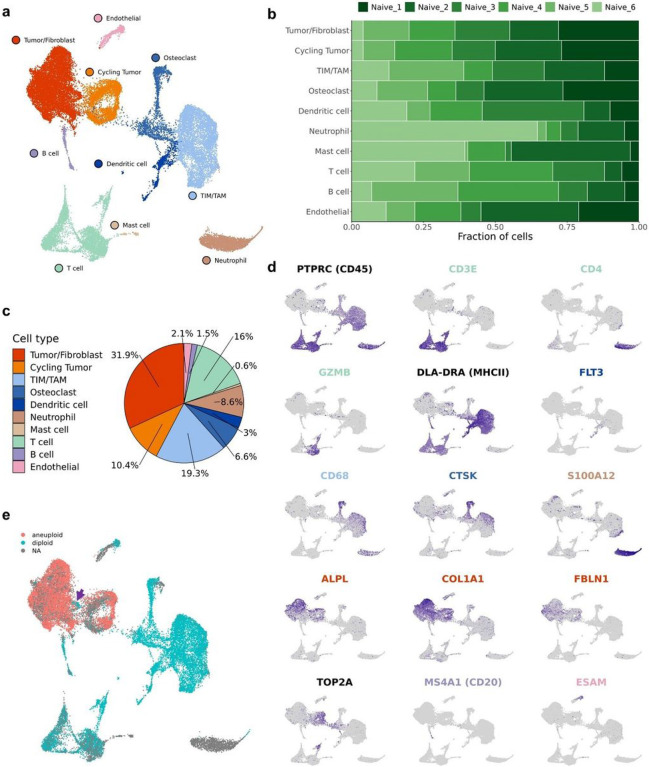
Osteosarcoma (OS) is a heterogeneous, aggressive malignancy of the bone that disproportionally affects children and adolescents. Therapeutic interventions for OS are limited, which is in part due to the complex tumor microenvironment (TME) that has proven to be refractory to immunotherapies. Thus, there is a need to better define the complexity of the OS TME. To address this need, we used single-cell RNA sequencing (scRNA-seq) to describe the cellular and molecular composition of the TME in 6 treatment-naïve dogs with spontaneously occurring primary OS. Through analysis of 35,310 cells, we identified 30 distinct immune cell types, 9 unique tumor populations, 1 cluster of fibroblasts, and 1 cluster of endothelial cells. Independent reclustering of major cell types revealed the presence of follicular helper T cells, mature regulatory dendritic cells (mregDCs), and 8 transcriptomically distinct macrophage/monocyte populations. Cell-cell interaction inference analysis predicted that mregDCs and tumor-associated macrophages (TAMs) play key roles in modulating T cell mediate immunity. Furthermore, we used publicly available human OS scRNA-seq data to complete a cross-species cell type gene signature homology analysis. The analysis revealed a high degree of cell type gene signature homology between species, suggesting the cellular composition of OS is largely conserved between humans and dogs. Our findings provide key new insights into the biology of canine OS and highlight the conserved features of OS across species. Generally, the data presented here acts as a cellular and molecular roadmap of canine OS which can be applied to advance the translational immuno-oncology research field.
骨肉瘤(OS)是一种异质性、侵袭性的骨恶性肿瘤,对儿童和青少年的影响尤为严重。骨肉瘤的治疗干预措施有限,部分原因是复杂的肿瘤微环境(TME)已被证明对免疫疗法具有抗性。因此,有必要更好地界定骨肉瘤肿瘤微环境的复杂性。为满足这一需求,我们使用单细胞RNA测序(scRNA-seq)来描述6只未经治疗的自发原发性骨肉瘤犬的肿瘤微环境的细胞和分子组成。通过对35310个细胞的分析,我们鉴定出30种不同的免疫细胞类型、9种独特的肿瘤群体、1个成纤维细胞簇和1个内皮细胞簇。对主要细胞类型进行独立重新聚类分析,发现存在滤泡辅助性T细胞、成熟调节性树突状细胞(mregDCs)以及8个转录组不同的巨噬细胞/单核细胞群体。细胞-细胞相互作用推断分析预测,mregDCs和肿瘤相关巨噬细胞(TAMs)在调节T细胞介导的免疫中起关键作用。此外,我们使用公开可用的人类骨肉瘤scRNA-seq数据完成了跨物种细胞类型基因特征同源性分析。分析结果显示不同物种之间细胞类型基因特征具有高度同源性,这表明人类和犬类骨肉瘤的细胞组成在很大程度上是保守的。我们的研究结果为犬类骨肉瘤的生物学特性提供了重要的新见解,并突出了骨肉瘤在不同物种间的保守特征。总体而言,本文所呈现的数据是犬类骨肉瘤的细胞和分子路线图,可用于推动转化免疫肿瘤学研究领域的发展。