Torres Fernanda de Figueiredo, Ramalho Bia Lima, Rodrigues Marcelle Ribeiro, Schmaedeke Ana Carolina, Moraes Victor Hugo, Reilly Karen T, Carvalho Raquel de Paula, Vargas Claudia D
Laboratory of Neurobiology of Movement, Institute of Biophysics Carlos Chagas Filho, Federal University of Rio de Janeiro, Rio de Janeiro, Brazil.
Laboratory of Neuroscience and Rehabilitation, Institute of Neurology Deolindo Couto, Federal University of Rio de Janeiro, Rio de Janeiro, Brazil.
Front Neurosci. 2023 Aug 7;17:1221777. doi: 10.3389/fnins.2023.1221777. eCollection 2023.
Interactions between the somatosensory and motor cortices are of fundamental importance for motor control. Although physically distant, face and hand representations are side by side in the sensorimotor cortex and interact functionally. Traumatic brachial plexus injury (TBPI) interferes with upper limb sensorimotor function, causes bilateral cortical reorganization, and is associated with chronic pain. Thus, TBPI may affect sensorimotor interactions between face and hand representations.
The aim of this study was to investigate changes in hand-hand and face-hand sensorimotor integration in TBPI patients using an afferent inhibition (AI) paradigm.
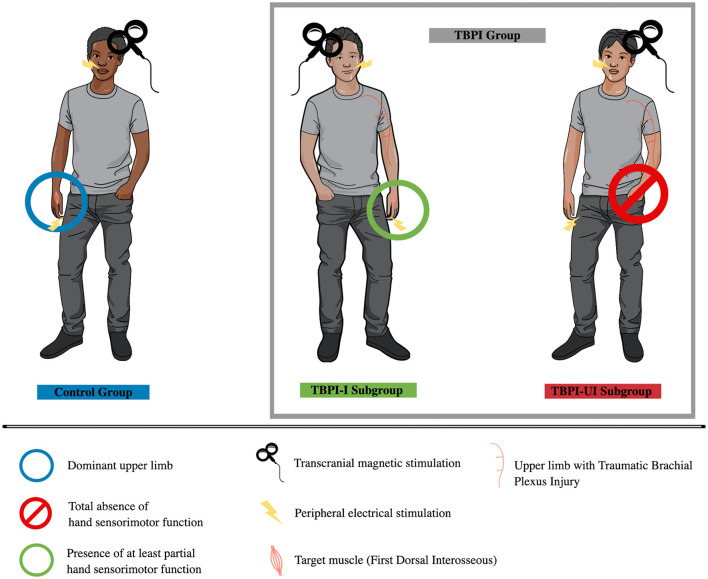
The experimental design consisted of electrical stimulation (ES) applied to the hand or face followed by transcranial magnetic stimulation (TMS) to the primary motor cortex to activate a hand muscle representation. In the AI paradigm, the motor evoked potential (MEP) in a target muscle is significantly reduced when preceded by an ES at short-latency (SAI) or long-latency (LAI) interstimulus intervals. We tested 18 healthy adults (control group, CG), evaluated on the dominant upper limb, and nine TBPI patients, evaluated on the injured or the uninjured limb. A detailed clinical evaluation complemented the physiological investigation.
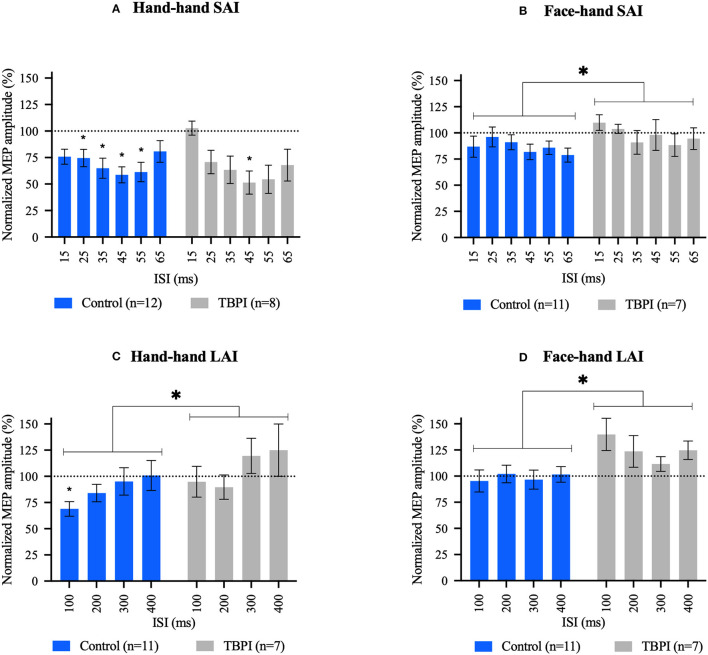
Although hand-hand SAI was present in both the CG and the TBPI groups, hand-hand LAI was present in the CG only. Moreover, less AI was observed in TBPI patients than the CG both for face-hand SAI and LAI.
Our results indicate that sensorimotor integration involving both hand and face sensorimotor representations is affected by TBPI.
体感皮层与运动皮层之间的相互作用对运动控制至关重要。尽管在物理距离上较远,但面部和手部的表征在感觉运动皮层中是相邻的,并且在功能上相互作用。创伤性臂丛神经损伤(TBPI)会干扰上肢感觉运动功能,导致双侧皮层重组,并与慢性疼痛相关。因此,TBPI可能会影响面部和手部表征之间的感觉运动相互作用。
本研究的目的是使用传入抑制(AI)范式研究TBPI患者手-手和脸-手感觉运动整合的变化。
实验设计包括对手部或面部施加电刺激(ES),然后对初级运动皮层进行经颅磁刺激(TMS)以激活手部肌肉表征。在AI范式中,当在短潜伏期(SAI)或长潜伏期(LAI)的刺激间隔下,在目标肌肉的运动诱发电位(MEP)之前施加ES时,其会显著降低。我们测试了18名健康成年人(对照组,CG),评估其优势上肢,以及9名TBPI患者,评估其受伤或未受伤的肢体。详细的临床评估补充了生理研究。
尽管CG组和TBPI组均存在手-手SAI,但仅CG组存在手-手LAI。此外,在TBPI患者中观察到的脸-手SAI和LAI的AI均低于CG组。
我们的结果表明,涉及手部和面部感觉运动表征的感觉运动整合受到TBPI的影响。