Karkhah Samad, Pourshaikhian Majid, Ghorbani Vajargah Pooyan, Zaboli Mahdiabadi Morteza, Mollaei Amirabbas, Maroufizadeh Saman, Hosseini Seyed Javad, Osuji Joseph, Moghadamnia Mohammad Taghi
Department of Medical-Surgical Nursing, School of Nursing and Midwifery, Guilan University of Medical Sciences, Rasht, Iran.
Burn and Regenerative Medicine Research Center, Guilan University of Medical Sciences, Rasht, Iran.
Arch Acad Emerg Med. 2023 May 20;11(1):e39. doi: 10.22037/aaem.v11i1.1943. eCollection 2023.
This systematic review and meta-analysis aimed to summarize the evidence regarding the impact of needle direction and distance of arteriovenous fistula (AVF) cannulation on KT/V (where k is the dialyzer urea clearance, t, the duration of dialysis, and V, the volume of distribution of urea) and access recirculation (AR) as hemodialysis (HD) adequacy criteria.
A comprehensive systematic search was performed on international and domestic electronic databases from the earliest to June 4, 2022 using keywords. Analysis was performed in STATA software v.14.
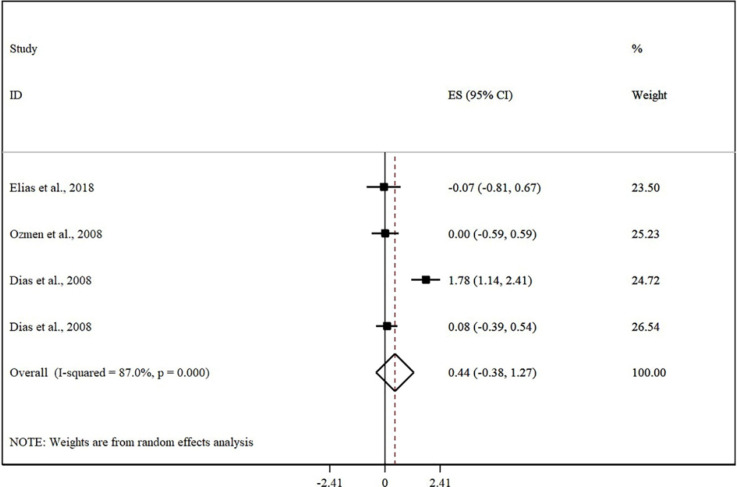
Three randomized control trials (RCTs) and four non-RCT articles were included in the final review. Six studies reported the effects of direction, while four mentioned the effects of distances of AVF cannulation on outcomes of HD adequacy based on KT/V or AR. Results of three non-RCT studies showed that retrograde direction decreased KT/V more than antegrade direction (ES: 0.44, 95% CI: -0.38 to 1.27). Two non-RCT studies showed that antegrade decreased AR compared to the retrograde direction (ES: -0.64, 95%CI: -1.94 to 0.67). However, the results of two RCTs indicated uncertainty about this issue. Two of the four studies suggested that a distance of 5 cm or more in arterial and venous needles had greater adequacy than a distance of less than 5 cm. However, other studies did not confirm this finding.
Overall comparison of the results qualitatively and quantitatively indicated uncertainty about the effects of direction and distance of AVF cannulation on HD adequacy outcomes. More studies with high-quality designs, such as RCTs, are required to better understand and adjudicate the effects of needle direction and distance of AVF cannulation on HD adequacy outcomes.
本系统评价和荟萃分析旨在总结有关动静脉内瘘(AVF)穿刺的进针方向和距离对KT/V(其中k为透析器尿素清除率,t为透析时长,V为尿素分布容积)及通路再循环(AR)的影响的证据,将其作为血液透析(HD)充分性的标准。
使用关键词对国际和国内电子数据库从建库至2022年6月4日进行全面的系统检索。在STATA软件v.14中进行分析。
最终综述纳入了三项随机对照试验(RCT)和四篇非RCT文章。六项研究报告了进针方向的影响,四项研究提到了AVF穿刺距离对基于KT/V或AR的HD充分性结局的影响。三项非RCT研究结果显示,逆行方向比顺行方向更能降低KT/V(效应量:0.44,95%置信区间:-0.38至1.27)。两项非RCT研究显示,与逆行方向相比,顺行方向可降低AR(效应量:-0.64,95%置信区间:-1.94至0.67)。然而,两项RCT的结果表明该问题存在不确定性。四项研究中的两项表明,动静脉穿刺针距离5 cm或以上比小于5 cm具有更高的充分性。然而,其他研究并未证实这一发现。
对结果进行定性和定量的总体比较表明,AVF穿刺的进针方向和距离对HD充分性结局的影响存在不确定性。需要更多高质量设计的研究,如RCT,以更好地理解和判定AVF穿刺的进针方向和距离对HD充分性结局的影响。