Department I - General Pediatrics, Hematology/Oncology, University Children's Hospital, Eberhard Karls University Tuebingen, Tuebingen, Germany.
Department of Pediatric Surgery and Pediatric Urology, University Children's Hospital, Eberhard Karls University Tuebingen, Tuebingen, Germany.
Cancer Immunol Immunother. 2023 Nov;72(11):3621-3634. doi: 10.1007/s00262-023-03512-5. Epub 2023 Aug 23.
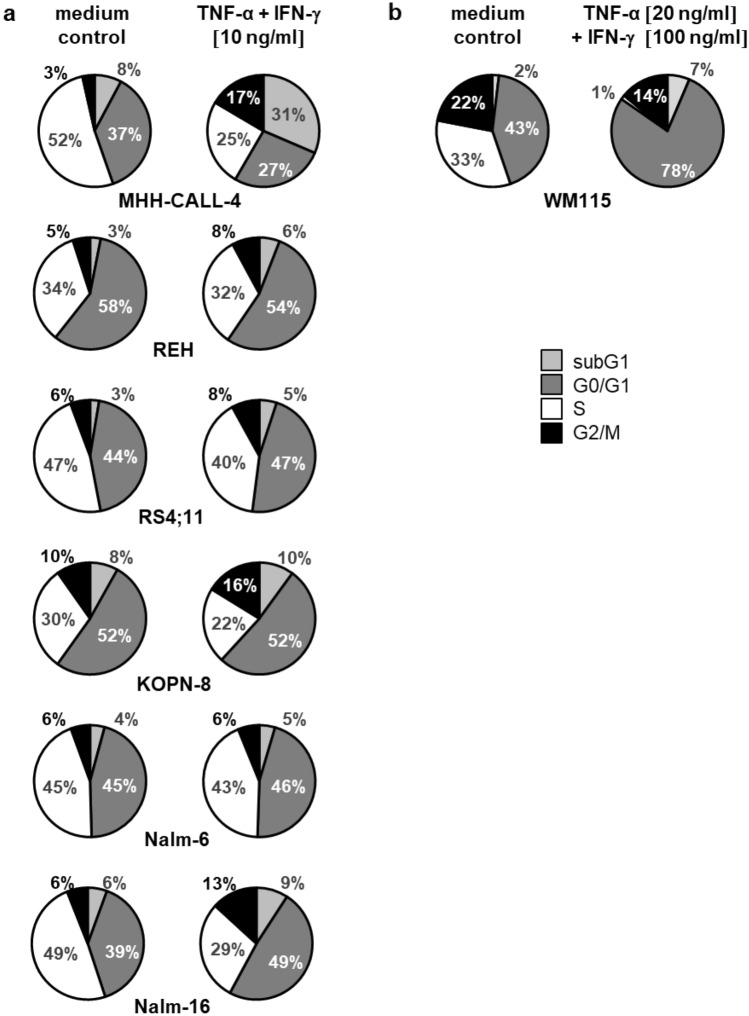
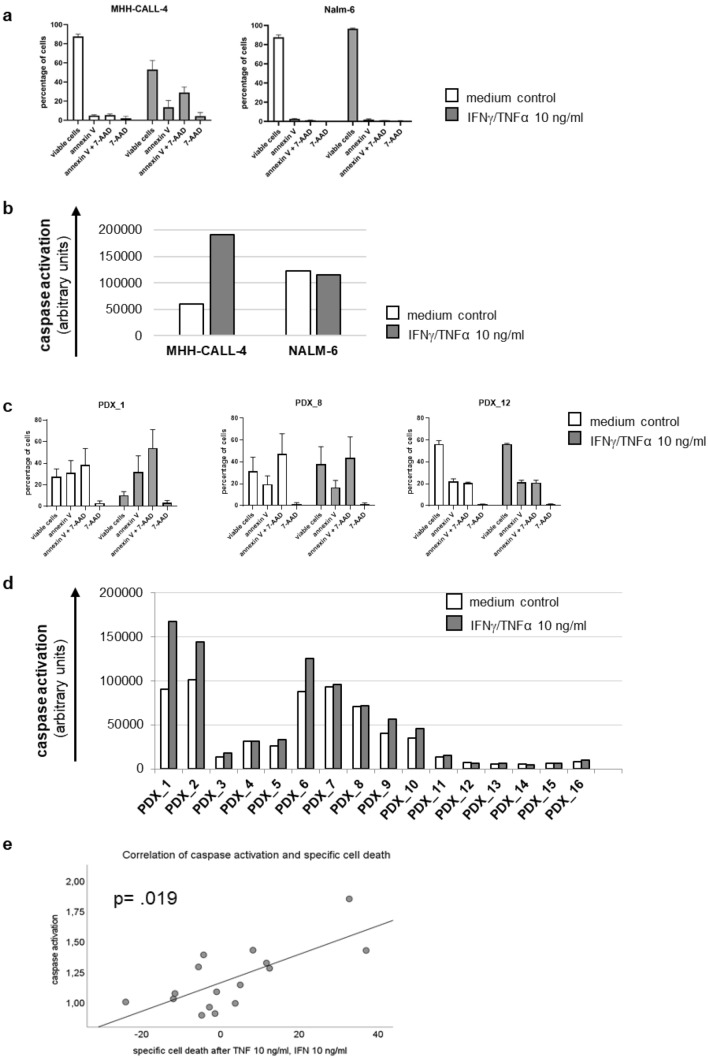
Immune milieus play an important role in various types of cancer. The present study focuses on the effect of Th1 cytokines on pediatric acute lymphoblastic leukemia (ALL). The reaction of ALL cell lines and patient-derived xenografts (PDX) to the most important Th1 cytokines TNF-α (tumor necrosis factor alpha) and IFN-γ (interferon gamma) is analyzed and correlated with the respective cytokine receptors and the intracellular signaling molecules. ALL cell lines and ALL PDX display a great heterogeneity in cell death after incubation with TNF-α and IFN-γ. Several samples show a dose-dependent and additive induction of cell death by both cytokines; others do not react at all or even display an increased viability. Apoptosis is the main type of cell death induced by Th1 cytokines in ALL cells. Over all leukemia cells analyzed, IFN-γ receptor (IFNGR) shows a higher expression than both TNF-receptors, resulting in higher phosphorylation of STAT1 (signal transducer and activator of transcription) compared to phosphorylation of NF-κB (nuclear factor kappa-light-chain-enhancer of activated B-cells) in the TNF pathway. The activation of STAT1 correlates with the amount of cell death after stimulation with Th1 cytokines. TNF-α and IFN-γ lead to heterogeneous reactions in ALL cell lines and ALL PDX but are able to induce cell death by apoptosis in the majority of ALL blasts. The correlation of a high expression of IFNGR and following activation of STAT1 with cell death indicates an important role for IFN-γ signaling in this setting.
免疫微环境在各种类型的癌症中起着重要作用。本研究重点关注 Th1 细胞因子对小儿急性淋巴细胞白血病(ALL)的影响。分析 ALL 细胞系和患者来源异种移植(PDX)对最重要的 Th1 细胞因子 TNF-α(肿瘤坏死因子-α)和 IFN-γ(干扰素-γ)的反应,并将其与各自的细胞因子受体和细胞内信号分子相关联。ALL 细胞系和 ALL PDX 在孵育 TNF-α和 IFN-γ后细胞死亡反应表现出很大的异质性。一些样本显示两种细胞因子的剂量依赖性和相加诱导细胞死亡;其他样本则根本不反应,甚至显示出更高的活力。细胞凋亡是 Th1 细胞因子诱导 ALL 细胞死亡的主要类型。在所有分析的白血病细胞中,IFN-γ受体(IFNGR)的表达高于两种 TNF 受体,导致 STAT1(信号转导和转录激活因子)的磷酸化水平高于 TNF 途径中 NF-κB(核因子 kappa 轻链增强子的激活 B 细胞)的磷酸化水平。STAT1 的激活与 Th1 细胞因子刺激后的细胞死亡量相关。TNF-α和 IFN-γ在 ALL 细胞系和 ALL PDX 中引起异质性反应,但能够诱导大多数 ALL blasts 通过细胞凋亡死亡。IFNGR 高表达和随后的 STAT1 激活与细胞死亡相关表明 IFN-γ 信号在这种情况下起着重要作用。