Department of Psychiatry, National Clinical Research Center for Mental Disorders and National Center for Mental Disorders, The Second Xiangya Hospital of Central South University, Changsha, Hunan, China.
Mental Health Institute of Central South University, China National Technology Institute on Mental Disorders, Hunan Technology Institute of Psychiatry, Hunan Key Laboratory of Psychiatry and Mental Health, Hunan Medical Center for Mental Health, Changsha, Hunan, China.
Front Public Health. 2023 Aug 8;11:1061617. doi: 10.3389/fpubh.2023.1061617. eCollection 2023.
Though researchers and scholars have greatly emphasized addressing the influencing factors of vaccination hesitancy, little attention has been paid to patients with celiac disease. Addressing the variables hampering attitudes might help direct appropriate patient advocacy and doctor-patient communication endeavors to encourage vaccination among celiac disease patients. The present investigation seeks to explore the coverage against vaccine-preventable diseases, vaccination attitudes, and related possible factors among celiac disease patients in the Pakistani setting.
A self-reported online survey was conducted in Islamabad, Pakistan, for celiac disease patients aged 18 and above. The questionnaire was completed by 226 participants, with a response rate of 43.8%. The influencing variables for vaccination hesitancy were examined, and 95% confidence intervals for the crude and adjusted odds ratios were computed.
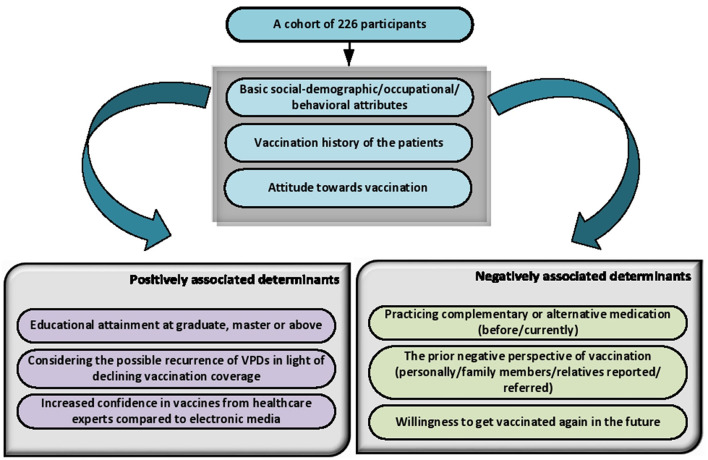
Among the study population, the majority were females, with a ratio of 75.66%. A prominent proportion of 69.03% was observed for influenza vaccination, while 39.82% were unable to recall all of the vaccinations they had previously received. Only 7% of the patients were considered to have a negative attitude toward vaccination, compared to an estimated 76% who were in favor of it. The significantly positive influencing factors observed toward vaccination were being well-educated (graduate, master, or above), possible recurrence of vaccine-preventable diseases with declining vaccination coverage (adjusted OR: 13.36), and increased confidence in vaccines from health care experts compared to electronic media (: 8.41). Contrarily, practicing complementary and alternative medicines (: 5.59), willingness to get vaccinated again in the future (: 15.59), and prior negative perspectives (: 1.01) were the determinants with a significant negative association.
In conclusion, the outcomes of the current work raise the possibility that health practitioners may be accountable for inappropriately prescribing vaccines to this demographic since 77% of the participants had a favorable attitude toward vaccination. These findings could serve as a springboard for creating targeted immunization efforts to raise vaccination coverage against vaccine-preventive diseases among celiac disease patients.
尽管研究人员和学者非常强调解决疫苗犹豫的影响因素,但对乳糜泻患者关注甚少。解决阻碍态度的变量可能有助于指导适当的患者宣传和医患沟通努力,鼓励乳糜泻患者接种疫苗。本研究旨在探讨巴基斯坦乳糜泻患者的疫苗可预防疾病覆盖率、疫苗接种态度和相关可能因素。
在巴基斯坦伊斯兰堡进行了一项自我报告的在线调查,调查对象为年龄在 18 岁及以上的乳糜泻患者。共有 226 名参与者完成了问卷,应答率为 43.8%。检查了疫苗犹豫的影响因素,并计算了粗和调整后的优势比的 95%置信区间。
在研究人群中,大多数是女性,占 75.66%。观察到 69.03%的人接种了流感疫苗,而 39.82%的人无法回忆起他们以前接种过的所有疫苗。只有 7%的患者被认为对疫苗接种持否定态度,而估计有 76%的患者赞成接种疫苗。观察到的对疫苗接种有显著积极影响的因素是受过良好教育(研究生、硕士或以上)、疫苗可预防疾病的发病率可能随着疫苗接种覆盖率的下降而上升(调整后的优势比:13.36),以及与电子媒体相比,对医疗保健专家的疫苗更有信心(8.41)。相反,服用补充和替代药物(5.59)、未来愿意再次接种疫苗(15.59)和之前的负面观点(1.01)是与显著负相关的决定因素。
总之,当前工作的结果表明,由于 77%的参与者对疫苗接种持积极态度,医疗保健从业者可能对向这一人群不当开具疫苗负责。这些发现可以作为制定有针对性的免疫计划的起点,以提高乳糜泻患者对疫苗可预防疾病的疫苗接种覆盖率。