Li W, Baddour N, Lemaire E D
Department of Mechanical Engineering, University of Ottawa, Ottawa, Canada.
Department of Medicine, Faculty of Medicine, University of Ottawa, Ottawa, Canada.
Can Prosthet Orthot J. 2022 Dec 18;5(2):38802. doi: 10.33137/cpoj.v5i2.38802. eCollection 2022.
A posterior dynamic element ankle-foot orthosis (PDEAFO) uses a stiff carbon fibre strut to store and release energy during various mobility tasks, with the strut securely attached to the foot and shank-cuff sections. A design that allows the user to swap struts for specific activities could improve mobility by varying PDEAFO stiffness, but current approaches where bolts securely connect the strut to the orthosis make quick strut swapping time-consuming and impractical.
Design a novel quick release AFO (QRAFO) that can enable daily living strut-swapping and thereby enable better ankle biomechanics for the person's chosen activity.
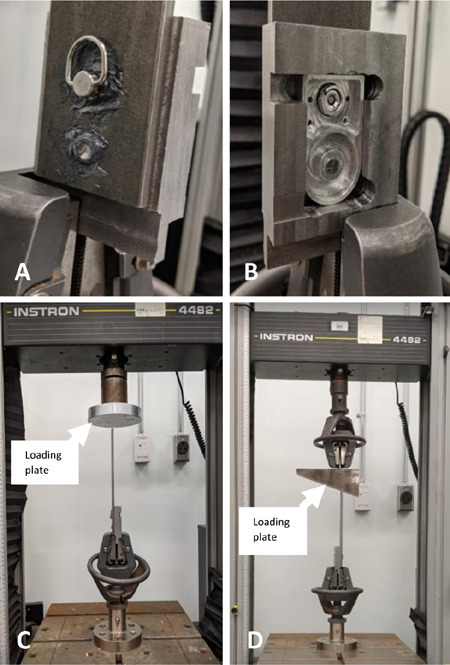
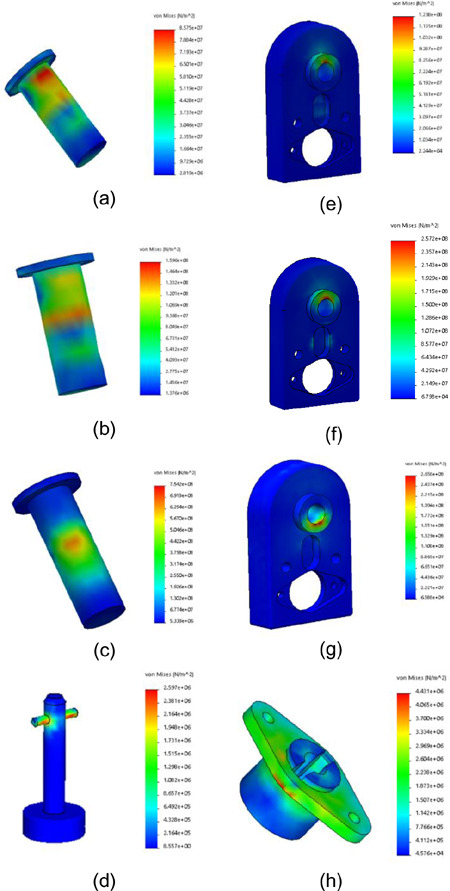
The novel QRAFO enables device stiffness changes through a quick release mechanism that includes a quick-release key, weight-bearing pin, receptacle anchor, and immobilization pin. A prototype was modelled and simulated with SolidWorks. Mechanical tests were performed with an Instron 4482 machine to evaluate quick release mechanism strength with running and 20° slope downhill walking loads. Quick release efficiency was then evaluated via two quick release functional tests, with four participants wearing a 3D printed QRAFO.
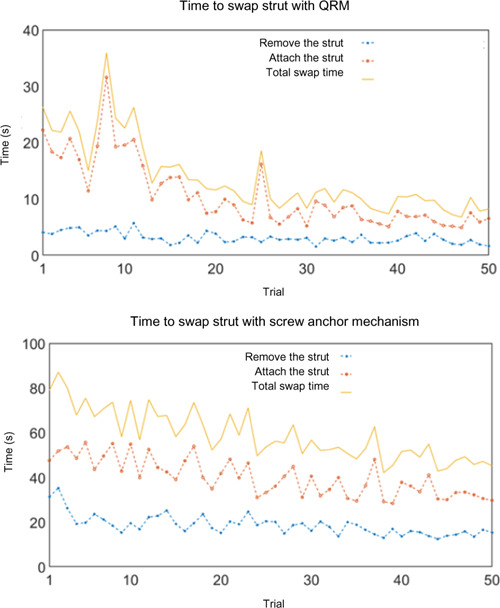
Simulated stress on the weight bearing pin, anchor, and surrounding carbon fibre structure under running and downhill walking loads did not exceed the yielding stress. Mechanical tests verified the simulation results. Four participants successfully swapped the strut within 25.01 ± 3.66 seconds, outperforming the 60.48 ± 10.88 seconds result for the hand-tightened bolted strut. A learning evaluation with one participant showed that, after approximately 30 swapping iterations, swap time was consistently below 10 seconds.
The quick release mechanism accommodated running and slope walking loads, and allowed easy and fast strut removal and attachment, greatly reducing strut swap time compared to screw-anchor connections. Overall, the novel quick release AFO improved strut-swapping time without sacrificing device strength, thereby enabling people to use the most appropriate AFO stiffness for their current activity and hence improve mobility and quality of life.
后动态元件踝足矫形器(PDEAFO)使用刚性碳纤维支柱在各种活动任务中储存和释放能量,该支柱牢固地连接到足部和小腿袖带部分。一种允许用户为特定活动更换支柱的设计可以通过改变PDEAFO的刚度来改善活动能力,但目前通过螺栓将支柱牢固连接到矫形器的方法使得快速更换支柱既耗时又不切实际。
设计一种新型快速释放踝足矫形器(QRAFO),使其能够在日常生活中更换支柱,从而为个人选择的活动实现更好的踝关节生物力学。
新型QRAFO通过一种快速释放机制实现设备刚度的变化,该机制包括快速释放键、承重销、插座锚和固定销。使用SolidWorks对原型进行建模和模拟。使用Instron 4482机器进行机械测试,以评估在跑步和20°下坡行走负荷下快速释放机制的强度。然后通过两项快速释放功能测试评估快速释放效率,四名参与者佩戴3D打印的QRAFO。
在跑步和下坡行走负荷下,承重销、锚和周围碳纤维结构的模拟应力未超过屈服应力。机械测试验证了模拟结果。四名参与者在25.01±3.66秒内成功更换了支柱,优于手动拧紧螺栓支柱的60.48±10.88秒的结果。对一名参与者的学习评估表明,经过大约30次更换迭代后,更换时间始终低于10秒。
快速释放机制能够承受跑步和斜坡行走负荷,并允许轻松快速地拆卸和安装支柱,与螺丝锚连接相比,大大减少了支柱更换时间。总体而言,新型快速释放踝足矫形器在不牺牲设备强度的情况下改善了支柱更换时间,从而使人们能够为当前活动使用最合适的踝足矫形器刚度,进而提高活动能力和生活质量。