Department of Drug Design and Pharmacology, University of Copenhagen, Copenhagen, Denmark.
School of Computer Science and Mathematics, Kingston University, Surrey, United Kingdom.
PLoS One. 2023 Aug 24;18(8):e0290278. doi: 10.1371/journal.pone.0290278. eCollection 2023.
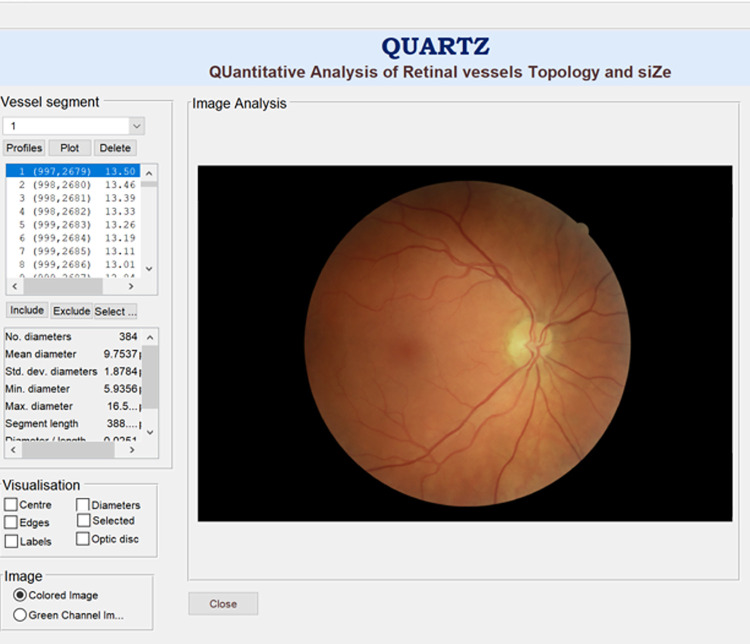
To evaluate the test performance of the QUARTZ (QUantitative Analysis of Retinal vessel Topology and siZe) software in detecting retinal features from retinal images captured by health care professionals in a Danish high street optician chain, compared with test performance from other large population studies (i.e., UK Biobank) where retinal images were captured by non-experts.
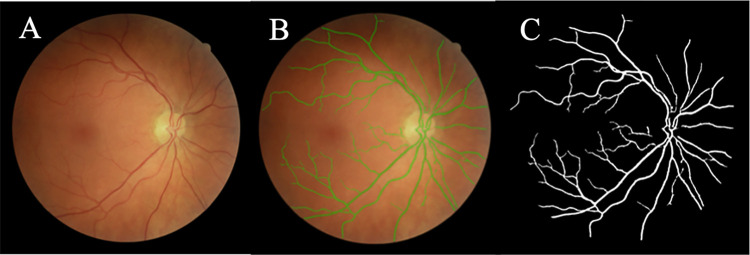
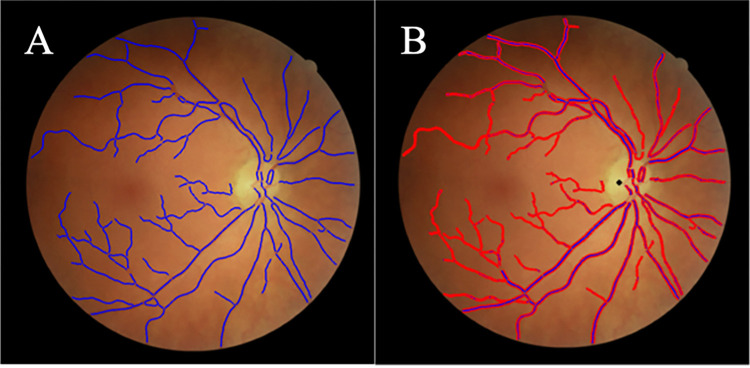
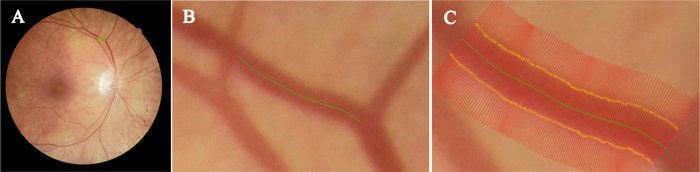
The dataset FOREVERP (Finding Ophthalmic Risk and Evaluating the Value of Eye exams and their predictive Reliability, Pilot) contains retinal images obtained from a Danish high street optician chain. The QUARTZ algorithm utilizes both image processing and machine learning methods to determine retinal image quality, vessel segmentation, vessel width, vessel classification (arterioles or venules), and optic disc localization. Outcomes were evaluated by metrics including sensitivity, specificity, and accuracy and compared to human expert ground truths.
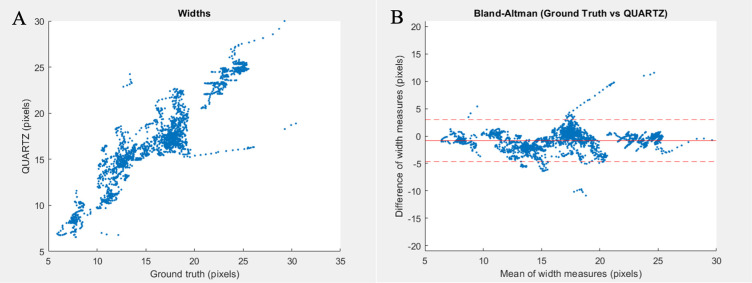
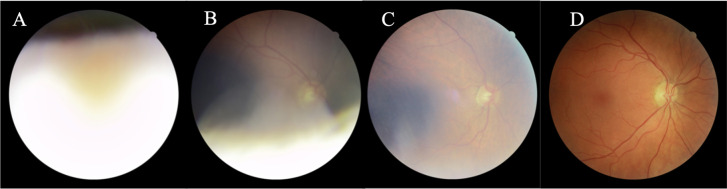
QUARTZ's performance was evaluated on a subset of 3,682 images from the FOREVERP database. 80.55% of the FOREVERP images were labelled as being of adequate quality compared to 71.53% of UK Biobank images, with a vessel segmentation sensitivity of 74.64% and specificity of 98.41% (FOREVERP) compared with a sensitivity of 69.12% and specificity of 98.88% (UK Biobank). The mean (± standard deviation) vessel width of the ground truth was 16.21 (4.73) pixels compared to that predicted by QUARTZ of 17.01 (4.49) pixels, resulting in a difference of -0.8 (1.96) pixels. The differences were stable across a range of vessels. The detection rate for optic disc localisation was similar for the two datasets.
QUARTZ showed high performance when evaluated on the FOREVERP dataset, and demonstrated robustness across datasets, providing validity to direct comparisons and pooling of retinal feature measures across data sources.
评估 QUARTZ(视网膜血管拓扑和大小的定量分析)软件在检测丹麦高街配镜师连锁店中医疗保健专业人员拍摄的视网膜图像中的视网膜特征的测试性能,与其他大型人群研究(即英国生物库)的测试性能进行比较,这些研究中的视网膜图像是由非专业人员拍摄的。
FOREVERP(发现眼科风险并评估眼部检查及其预测可靠性、试点)数据集包含从丹麦高街配镜师连锁店获得的视网膜图像。QUARTZ 算法利用图像处理和机器学习方法来确定视网膜图像质量、血管分割、血管宽度、血管分类(小动脉或小静脉)和视盘定位。通过包括敏感性、特异性和准确性在内的指标来评估结果,并与人类专家的真实情况进行比较。
QUARTZ 的性能在 FOREVERP 数据库的一个子集中进行了评估。与 71.53%的英国生物库图像相比,FOREVERP 图像中有 80.55%被标记为具有足够质量,血管分割敏感性为 74.64%,特异性为 98.41%(FOREVERP),而敏感性为 69.12%,特异性为 98.88%(英国生物库)。地面真实的平均(±标准偏差)血管宽度为 16.21(4.73)像素,而 QUARTZ 预测的血管宽度为 17.01(4.49)像素,差值为-0.8(1.96)像素。差异在各种血管中均保持稳定。两个数据集的视盘定位检测率相似。
QUARTZ 在 FOREVERP 数据集上的评估表现出了很高的性能,并且在数据集之间表现出了稳健性,为直接比较和跨数据源的视网膜特征测量值的汇总提供了有效性。