Zhao Yuan, Huang Tao, Wang Han, Geng Jing
Faculty of Artificial Intelligence in Education, Central China Normal University, Wuhan 430079, China.
Faculty of Education, Jiujiang University, Jiujiang 332005, China.
Behav Sci (Basel). 2023 Aug 8;13(8):660. doi: 10.3390/bs13080660.
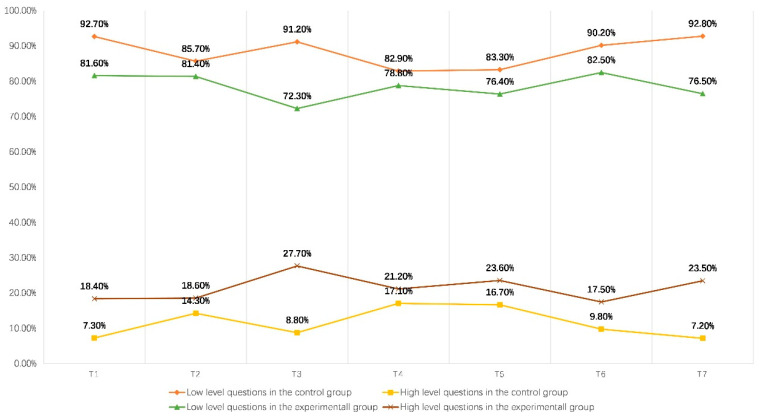
Personalized education has been a widely shared goal pursued by Chinese and foreign educators. As the primary method of teacher-student interaction, the importance of personalized questioning is self-evident. Due to a lack of technical support, teachers rely on their teaching experience to ask questions without considering the learning situation of learners. This results in teaching questioning being unable to support learners' learning. These questions are relatively shallow and cannot promote the construction and transfer of learners' knowledge. Cognitive diagnostic technology could diagnose learners' cognitive states and provide services for personalized teaching. Therefore, a personalized teaching questioning strategy based on learners' cognitive structure diagnosis was proposed in this study. Firstly, we diagnosed learners' cognitive structure through usability, distinguishability, and stability. Secondly, we discussed the types of questions that teachers should raise when facing learners in different situations. We also discussed the application of personalized teaching questioning strategies. The experiment took place at M Primary School in Ningxia, China, with the participation of one teacher and ninety-seven fourth-grade students. Seven lessons were observed and videotaped across a range of topics. The study revealed that personalized teaching questioning strategies could improve learners' academic performance and subject literacy. They can also increase the number of teacher questioning, change the depth of teacher questioning content, and expand the scope of questioning subjects.
个性化教育一直是中外教育工作者广泛追求的目标。作为师生互动的主要方式,个性化提问的重要性不言而喻。由于缺乏技术支持,教师依靠教学经验提问,而不考虑学习者的学习情况。这导致教学提问无法支持学习者的学习。这些问题相对浅显,无法促进学习者知识的构建和迁移。认知诊断技术可以诊断学习者的认知状态,为个性化教学提供服务。因此,本研究提出了一种基于学习者认知结构诊断的个性化教学提问策略。首先,我们通过可用性、区分性和稳定性来诊断学习者的认知结构。其次,我们讨论了教师在面对不同情况的学习者时应提出的问题类型。我们还讨论了个性化教学提问策略的应用。实验在中国宁夏的M小学进行,有一位教师和九十七名四年级学生参与。观察并录制了七节涵盖一系列主题的课程。研究表明,个性化教学提问策略可以提高学习者的学业成绩和学科素养。它们还可以增加教师提问的次数,改变教师提问内容的深度,并扩大提问主题的范围。