Makisha Nikolay
Research and Education Centre "Water Supply and Wastewater Treatment", Moscow State University of Civil Engineering, 26, Yaroslaskoye Highway, 129337 Moscow, Russia.
Membranes (Basel). 2023 Aug 21;13(8):746. doi: 10.3390/membranes13080746.
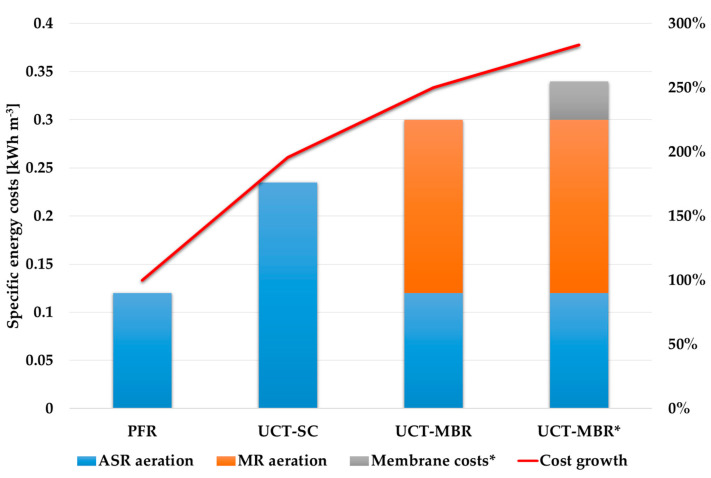
Modernization of wastewater treatment plants is usually caused by their significant wear and changes in the flow rate and concentration of pollutants. If there is no initial data on the flow or pollution, their determination by calculation is required, which may lead to an increase in concentration. Within the study, the modernization of treatment facilities was estimated under conditions of reduced flow and increased pollution concentration. Calculations were carried out both manually and using the CapdetWorks software package. The focus was on secondary treatment facilities as the main element of the municipal wastewater treatment plant within their upgrade from only organic pollutants removal (plug-flow reactor) to removal of both organic pollutants and nutrients (technology of the University of Cape Town). The calculations of tank volumes have shown that the concentration of pollutants has a much greater impact on them than the change in flow, especially when improvement in the treatment quality is required. The study revealed that membrane sludge separation allows tanks to be reduced in volume by 1.5-2.5 times (depending on the value of mixed liquor suspended solids) in comparison with gravity separation, which means smaller capital costs. However, membrane application requires significant energy costs for membrane aeration. For the initial data of the study, the specific energy costs for aeration before the upgrade, after the upgrade (gravity separation), and after the upgrade (membrane separation) were 0.12 kWh/m, 0.235 kWh/m, and 0.3 kWh/m, respectively. If the membrane lifetime is 10 years, membrane costs were determined to be 10-15% of the energy costs for aeration.
污水处理厂的现代化改造通常是由其严重磨损以及污染物流量和浓度的变化引起的。如果没有关于流量或污染的初始数据,就需要通过计算来确定,这可能会导致浓度增加。在该研究中,在流量减少和污染浓度增加的条件下对处理设施的现代化改造进行了评估。计算既通过手动进行,也使用了CapdetWorks软件包。重点是二级处理设施,它是城市污水处理厂的主要组成部分,其升级过程从仅去除有机污染物(推流式反应器)到同时去除有机污染物和营养物质(开普敦大学技术)。罐体容积的计算表明,污染物浓度对其影响远大于流量变化,尤其是在需要提高处理质量时。研究表明,与重力分离相比,膜污泥分离可使罐体体积减小1.5至2.5倍(取决于混合液悬浮固体的值),这意味着资本成本更低。然而,膜的应用需要大量的膜曝气能源成本。对于该研究的初始数据,升级前、升级后(重力分离)和升级后(膜分离)的曝气比能量成本分别为0.12 kWh/m、0.235 kWh/m和0.3 kWh/m。如果膜的使用寿命为10年,膜成本确定为曝气能源成本的10%至15%。