
术前血液学和炎症指标在犬附肢骨肉瘤中的预后作用
The Prognostic Role of Preoperative Hematological and Inflammatory Indices in Canine Appendicular Osteosarcoma.
作者信息
Rigas Konstantinos, Tanis Jean-Benoit, Morello Emanuela, Polton Gerry, Marconato Laura, Carroll Marlon, Ciriano Cerda EstelLa, Ramos Sofia, Baker Charlotte, Finotello Riccardo
机构信息
Department of Small Animal Clinical Sciences, Institute of Veterinary Science, University of Liverpool, Neston CH64 7TE, UK.
Southfields Veterinary Specialists, Basildon SS14 3AP, UK.
出版信息
Vet Sci. 2023 Aug 1;10(8):495. doi: 10.3390/vetsci10080495.
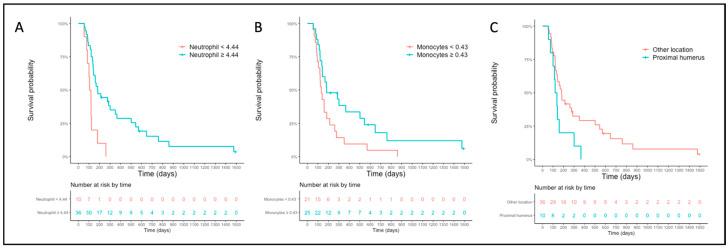
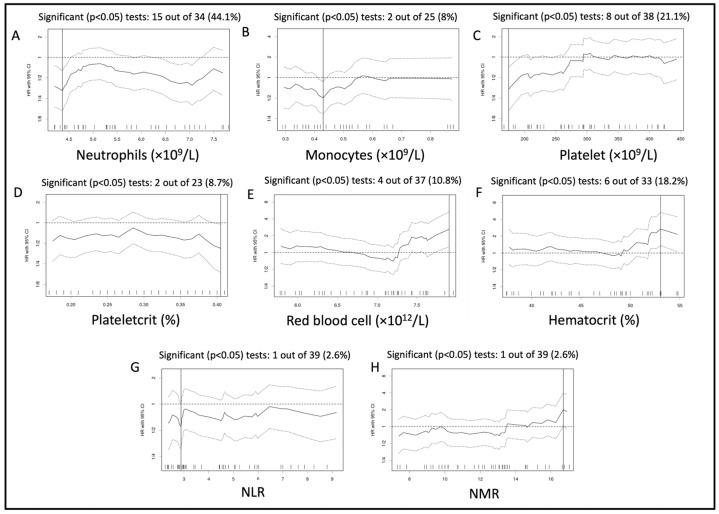
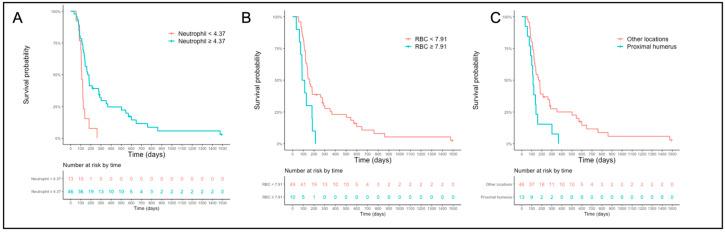
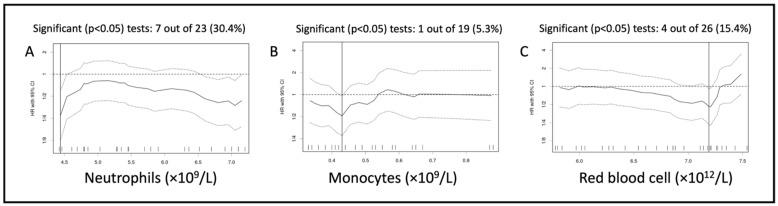
Hematological indices play a prognostic role in human osteosarcoma (OSA), but data are limited in dogs. The aim of this retrospective multicentric cohort study was to investigate the prognostic significance of pre-operative hematological/inflammatory indices in a cohort of client-owned dogs with appendicular OSA receiving standardized treatment. Cut-offs associated with progression-free survival (PFS) for pre-operative hematological values/ratios were established using the minimal -value approach. Historical prognostic factors were also assessed. Statistical analyses were performed for the whole population and after the exclusion of sighthounds. Fifty-nine dogs were included (13 were sighthounds). Multivariable analysis revealed that a low neutrophil count (<4.37 × 10/L, HR0.28, CI 95% 0.13-0.61, = 0.001), a high red blood cell count (≥7.91, HR3.5, CI 95% 1.56-7.9, = 0.002), and a proximal humerus location (HR3.0, CI 95% 1.48-6.1, = 0.002) were associated with shorter PFS. In the sighthound-only population, only OSA location was significantly associated with PFS in univariable analysis. When sighthounds were excluded, a low neutrophil count, a low monocyte count, and a proximal humerus location were associated with shorter PFS, in multivariable analysis. Neutrophil count and possibly monocyte and red blood cell counts can be useful prognostic markers in canine OSA treated with amputation and adjuvant carboplatin. However, not all indices are appropriate in sighthounds.
血液学指标在人类骨肉瘤(OSA)中具有预后作用,但犬类相关数据有限。这项回顾性多中心队列研究的目的是调查接受标准化治疗的患附肢骨肉瘤的家养犬队列中术前血液学/炎症指标的预后意义。使用最小值法确定术前血液学值/比值与无进展生存期(PFS)相关的临界值。还评估了历史预后因素。对总体人群进行了统计分析,并在排除视觉猎犬后进行了分析。纳入了59只犬(13只为视觉猎犬)。多变量分析显示,中性粒细胞计数低(<4.37×10/L,HR0.28,95%CI 0.13 - 0.61,P = 0.001)、红细胞计数高(≥7.91,HR3.5,95%CI 1.56 - 7.9,P = 0.002)以及肱骨近端位置(HR3.0,95%CI 1.48 - 6.1,P = 0.002)与较短的PFS相关。在仅包含视觉猎犬的人群中,单变量分析中只有骨肉瘤位置与PFS显著相关。排除视觉猎犬后,多变量分析显示中性粒细胞计数低、单核细胞计数低以及肱骨近端位置与较短的PFS相关。中性粒细胞计数以及可能的单核细胞和红细胞计数可能是截肢和辅助卡铂治疗的犬骨肉瘤有用的预后标志物。然而,并非所有指标都适用于视觉猎犬。
 Zotero 插件