Department of Digital Health Research, Division of Medicine, Oslo University Hospital, Oslo, Norway.
Institute of Clinical Medicine, Faculty of Medicine, University of Oslo, Oslo, Norway.
J Med Internet Res. 2023 Aug 25;25:e47284. doi: 10.2196/47284.
Chronic pain conditions involve numerous physical and psychological challenges, and while psychosocial self-management interventions can be of benefit for people living with chronic pain, such in-person treatment is not always accessible. Digital self-management approaches could improve this disparity, potentially bolstering outreach and providing easy, relatively low-cost access to pain self-management interventions.
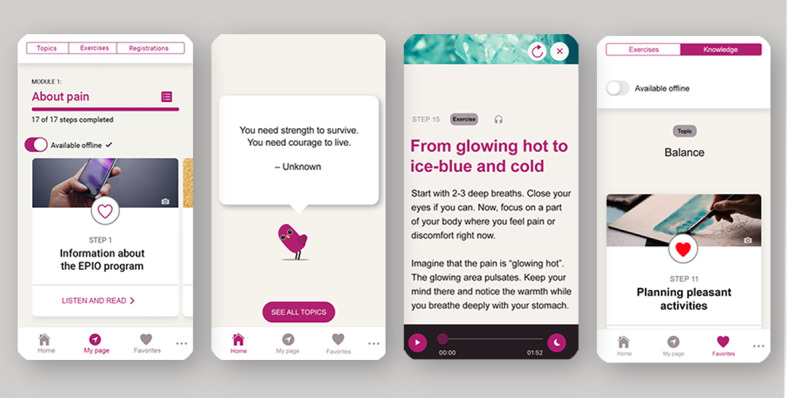
This randomized controlled trial aimed to evaluate the short-term efficacy of EPIO (ie, inspired by the Greek goddess for the soothing of pain, Epione), a digital self-management intervention, for people living with chronic pain.
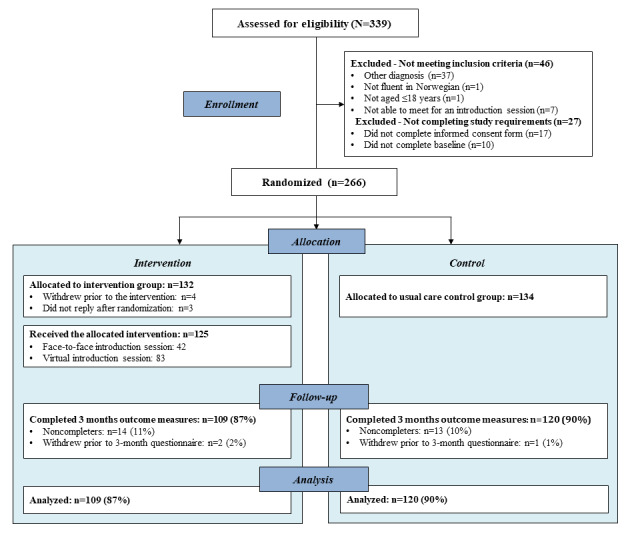
Patients (N=266) were randomly assigned to either the EPIO intervention (n=132) or a care-as-usual control group (n=134). Outcome measures included pain interference (Brief Pain Inventory; primary outcome measure), anxiety and depression (Hospital Anxiety and Depression Scale), self-regulatory fatigue (Self-Regulatory Fatigue 18 scale), health-related quality of life (SF-36 Short Form Health Survey), pain catastrophizing (Pain Catastrophizing Scale), and pain acceptance (Chronic Pain Acceptance Questionnaire). Linear regression models used change scores as the dependent variables.
The participants were primarily female (210/259, 81.1%), with a median age of 49 (range 22-78) years and a variety of pain conditions. Analyses (n=229) after 3 months revealed no statistically significant changes for the primary outcome of pain interference (P=.84), but significant reductions in the secondary outcomes of depression (mean difference -0.90; P=.03) and self-regulatory fatigue (mean difference -2.76; P=.008) in favor of the intervention group. No other statistically significant changes were observed at 3 months (all P>.05). Participants described EPIO as useful (ie, totally agree or agree; 95/109, 87.2%) and easy to use (101/109, 92.7%), with easily understandable exercises (106/109, 97.2%).
Evidence-informed, user-centered digital pain self-management interventions such as EPIO may have the potential to effectively support self-management and improve psychological functioning in the form of reduced symptoms of depression and improved capacity to regulate thoughts, feelings, and behavior for people living with chronic pain.
ClinicalTrials.gov NCT03705104; https://clinicaltrials.gov/ct2/show/NCT03705104.
慢性疼痛状况涉及众多身体和心理挑战,虽然心理社会自我管理干预措施对慢性疼痛患者有益,但这种面对面的治疗并非总是可行。数字自我管理方法可以改善这种差距,有可能扩大服务范围,并为疼痛自我管理干预措施提供便捷、相对低成本的途径。
本随机对照试验旨在评估 EPIO(灵感来自于希腊女神治疗疼痛的 Epione)这种数字自我管理干预措施对慢性疼痛患者的短期疗效。
将 266 名患者(N=266)随机分配至 EPIO 干预组(n=132)或常规护理对照组(n=134)。主要结局指标为疼痛干扰(简短疼痛量表);次要结局指标包括焦虑和抑郁(医院焦虑和抑郁量表)、自我调节疲劳(自我调节疲劳 18 量表)、健康相关生活质量(SF-36 简明健康调查问卷)、疼痛灾难化(疼痛灾难化量表)和疼痛接受(慢性疼痛接受问卷)。线性回归模型将变化分数作为因变量。
参与者主要为女性(210/259,81.1%),年龄中位数为 49(22-78)岁,患有各种疼痛疾病。3 个月后的分析(n=229)显示,疼痛干扰的主要结局没有统计学意义的变化(P=.84),但干预组的抑郁(平均差值-0.90;P=.03)和自我调节疲劳(平均差值-2.76;P=.008)的次要结局有显著降低。其他结局在 3 个月时也未观察到统计学意义的变化(均 P>.05)。参与者表示 EPIO 非常有用(即完全同意或同意;95/109,87.2%)且易于使用(101/109,92.7%),练习也很容易理解(106/109,97.2%)。
基于证据、以用户为中心的数字疼痛自我管理干预措施,如 EPIO,可能具有有效支持自我管理和改善心理功能的潜力,表现为抑郁症状减轻,以及调节思想、感觉和行为的能力提高,适用于慢性疼痛患者。
ClinicalTrials.gov NCT03705104;https://clinicaltrials.gov/ct2/show/NCT03705104。