Varsi Cecilie, Ledel Solem Ingrid Konstanse, Eide Hilde, Børøsund Elin, Kristjansdottir Olöf B, Heldal Karina, Waxenberg Lori B, Weiss Karen E, Schreurs Karlein M G, Morrison Eleshia J, Stubhaug Audun, Solberg Nes Lise
Department of Digital Health Research, Division of Medicine, Oslo University Hospital, Pb 4950 Nydalen, N-0424, Oslo, Norway.
Faculty of Health and Social Sciences, University of South-Eastern Norway, Drammen, Norway.
BMC Health Serv Res. 2021 Mar 25;21(1):275. doi: 10.1186/s12913-021-06278-7.
Chronic pain constitutes a significant burden for the individuals affected, and is a frequent reason why patients seek health care services. While in-person psychosocial interventions can be of support to people living with chronic pain, such interventions are not always accessible. eHealth interventions may provide greater accessibility, but the evidence and use of digital self-management solutions for chronic pain are still limited and the lack of health care provider input in the development process of such solutions a concern. Therefore, the aim of the current study was to investigate health care providers' experiences of treating patients with chronic pain, their attitudes towards, and use of, digital solutions in pain management, and their suggestions for content and design elements for a potential digital pain self-management intervention.
Twelve health care providers representing a variety of health care disciplines participated in semi-structured interviews. The interviews were analyzed using thematic analysis.
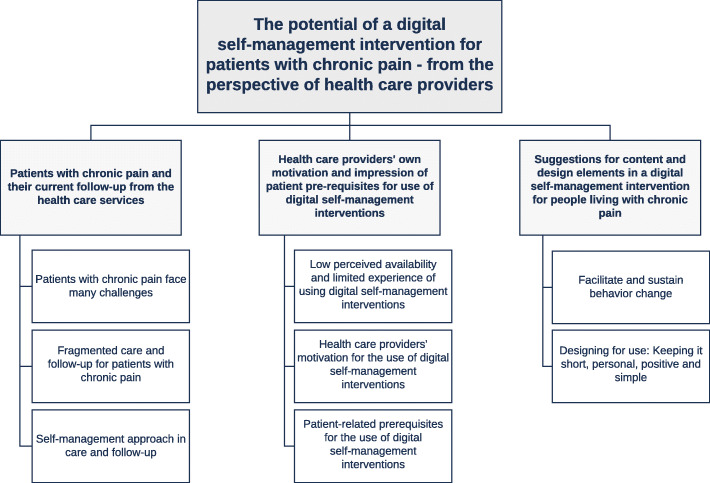
The material was analyzed into three main themes: [1] Patients with chronic pain and their current use of the health care services, [2] Health care providers' own motivation and impression of patient prerequisites for use of digital self-management interventions, and [3] Suggestions for content and design elements in a digital self-management intervention for people living with chronic pain. The challenges faced by patients living with chronic pain were described as numerous. Despite interest and positive attitudes, few of the health care providers had used or recommended eHealth solutions to their patients. A range of potential content and functionality elements were identified, including aspects of motivation and engagement and providers also emphasized the importance of easy access and positive, personal content to support existing treatment.
This study offers insights into health care providers' considerations for the potential of digital self-management interventions supporting patients living with chronic pain. Findings indicate the need for change and a more comprehensive treatment approach to pain management. eHealth solutions may contribute to such change, and providers pointed to a need for health care provider involvement, timely support and follow-up as important factors for integrating digital pain self-management interventions into clinical care.
ClinicalTrials.gov : NCT03705104.
慢性疼痛给受影响的个体带来了沉重负担,也是患者寻求医疗服务的常见原因。虽然面对面的心理社会干预可为慢性疼痛患者提供支持,但此类干预并非总能实现。电子健康干预可能具有更高的可及性,但用于慢性疼痛的数字自我管理解决方案的证据和应用仍然有限,且在这类解决方案的开发过程中缺乏医疗服务提供者的参与令人担忧。因此,本研究的目的是调查医疗服务提供者治疗慢性疼痛患者的经验、他们对疼痛管理中数字解决方案的态度和使用情况,以及他们对潜在数字疼痛自我管理干预的内容和设计元素的建议。
12名代表不同医疗学科的医疗服务提供者参与了半结构化访谈。采用主题分析法对访谈进行分析。
材料被分析为三个主要主题:[1]慢性疼痛患者及其当前对医疗服务的使用情况,[2]医疗服务提供者自身对患者使用数字自我管理干预的动机和前提条件的看法,以及[3]针对慢性疼痛患者的数字自我管理干预的内容和设计元素的建议。描述了慢性疼痛患者面临的诸多挑战。尽管有兴趣且态度积极,但很少有医疗服务提供者向患者使用或推荐过电子健康解决方案。确定了一系列潜在的内容和功能元素,包括动机和参与方面,提供者还强调了易于获取以及积极、个性化内容对支持现有治疗的重要性。
本研究深入了解了医疗服务提供者对支持慢性疼痛患者的数字自我管理干预潜力的考量。研究结果表明需要变革以及采用更全面的疼痛管理治疗方法。电子健康解决方案可能有助于这种变革,提供者指出医疗服务提供者的参与、及时支持和随访是将数字疼痛自我管理干预纳入临床护理的重要因素。
ClinicalTrials.gov:NCT03705104。