Modern Management and Information Technology, College of Arts, Media and Technology, Chiang Mai University, Chiang Mai, Thailand.
Department of Zoology, Faculty of Science, Kasetsart University, Bangkok, Thailand.
PLoS One. 2023 Aug 25;18(8):e0290538. doi: 10.1371/journal.pone.0290538. eCollection 2023.
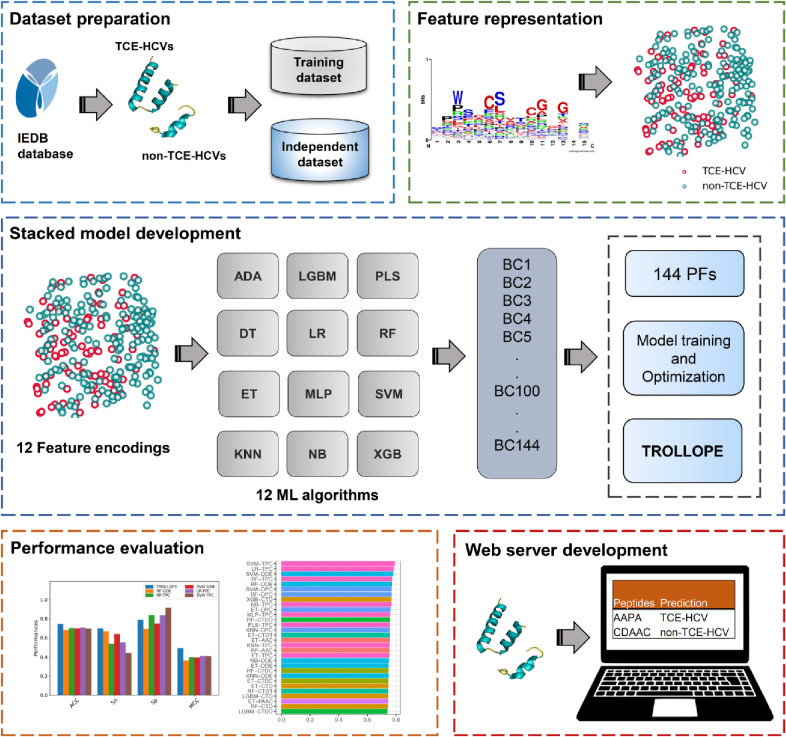
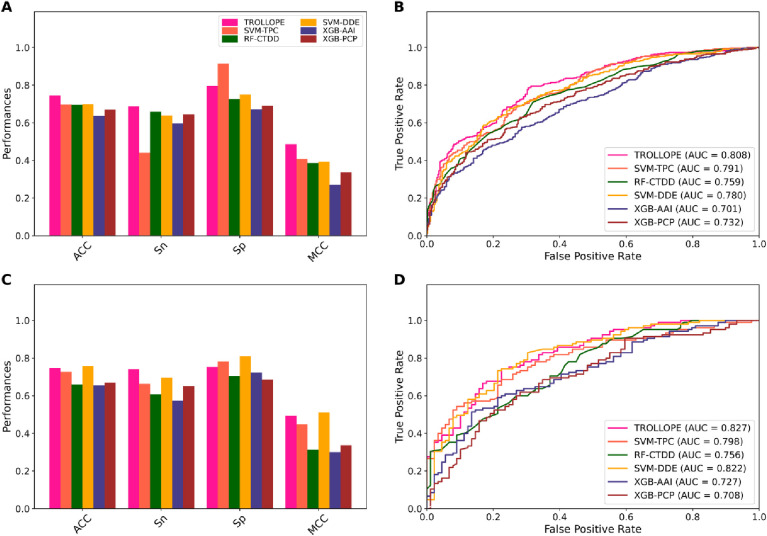
Hepatitis C virus (HCV) infection is a concerning health issue that causes chronic liver diseases. Despite many successful therapeutic outcomes, no effective HCV vaccines are currently available. Focusing on T cell activity, the primary effector for HCV clearance, T cell epitopes of HCV (TCE-HCV) are considered promising elements to accelerate HCV vaccine efficacy. Thus, accurate and rapid identification of TCE-HCVs is recommended to obtain more efficient therapy for chronic HCV infection. In this study, a novel sequence-based stacked approach, termed TROLLOPE, is proposed to accurately identify TCE-HCVs from sequence information. Specifically, we employed 12 different sequence-based feature descriptors from heterogeneous perspectives, such as physicochemical properties, composition-transition-distribution information and composition information. These descriptors were used in cooperation with 12 popular machine learning (ML) algorithms to create 144 base-classifiers. To maximize the utility of these base-classifiers, we used a feature selection strategy to determine a collection of potential base-classifiers and integrated them to develop the meta-classifier. Comprehensive experiments based on both cross-validation and independent tests demonstrated the superior predictive performance of TROLLOPE compared with conventional ML classifiers, with cross-validation and independent test accuracies of 0.745 and 0.747, respectively. Finally, a user-friendly online web server of TROLLOPE (http://pmlabqsar.pythonanywhere.com/TROLLOPE) has been developed to serve research efforts in the large-scale identification of potential TCE-HCVs for follow-up experimental verification.
丙型肝炎病毒 (HCV) 感染是一个令人担忧的健康问题,可导致慢性肝病。尽管有许多成功的治疗结果,但目前尚无有效的 HCV 疫苗。针对 HCV 清除的主要效应器 T 细胞活性,HCV 的 T 细胞表位 (TCE-HCV) 被认为是加速 HCV 疫苗疗效的有希望的要素。因此,建议准确快速地识别 TCE-HCV,以获得更有效的慢性 HCV 感染治疗方法。在这项研究中,提出了一种新的基于序列的堆叠方法,称为 TROLLOPE,用于从序列信息中准确识别 TCE-HCV。具体来说,我们从异构角度采用了 12 种不同的基于序列的特征描述符,如理化性质、组成-转移-分布信息和组成信息。这些描述符与 12 种流行的机器学习 (ML) 算法一起使用,创建了 144 个基本分类器。为了最大限度地利用这些基本分类器,我们使用特征选择策略来确定一组潜在的基本分类器,并将它们集成起来开发元分类器。基于交叉验证和独立测试的综合实验表明,与传统的 ML 分类器相比,TROLLOPE 具有优越的预测性能,交叉验证和独立测试的准确率分别为 0.745 和 0.747。最后,我们开发了一个易于使用的 TROLLOPE 在线网络服务器(http://pmlabqsar.pythonanywhere.com/TROLLOPE),以服务于大规模识别潜在 TCE-HCV 的研究工作,以便进行后续的实验验证。