Department of Pediatrics, Aflac Cancer and Blood Disorders Center, Children's Healthcare of Atlanta, Emory University School of Medicine, Atlanta, GA.
Department of Pathology, Children's Healthcare of Atlanta, Atlanta, GA.
Blood. 2023 Dec 7;142(23):1972-1984. doi: 10.1182/blood.2023020426.
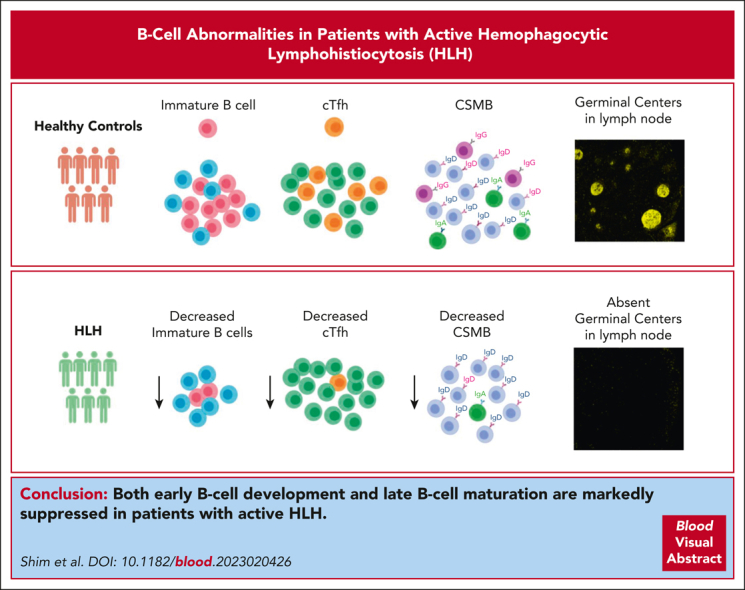
Hemophagocytic lymphohistiocytosis (HLH) is characterized by hyperinflammation and multiorgan dysfunction. Infections, including the reactivation of viruses, contribute to significant disease mortality in HLH. Although T-cell and natural killer cell-driven immune activation and dysregulation are well described, limited data exist on the status of B-cell compartment and humoral immune function in HLH. We noted marked suppression of early B-cell development in patients with active HLH. In vitro B-cell differentiation studies after exposure to HLH-defining cytokines, such as interferon gamma (IFN-γ) and tumor necrosis factor, recapitulated B-cell development arrest. Messenger RNA sequencing of human CD34+ cells exposed to IFN-γ demonstrated changes in genes and pathways affecting B-cell development and maturation. In addition, patients with active HLH exhibited a marked decrease in class-switched memory B (CSMB) cells and a decrease in bone marrow plasmablast/plasma cell compartments. The decrease in CSMB cells was associated with a decrease in circulating T follicular helper (cTfh) cells. Finally, lymph node and spleen evaluation in a patient with HLH revealed absent germinal center formation and hemophagocytosis with associated lymphopenia. Reassuringly, the frequency of CSMB and cTfh improved with the control of T-cell activation. Taken together, in patients with active HLH, these changes in B cells may affect the humoral immune response; however, further immune studies are needed to determine its clinical significance.
噬血细胞性淋巴组织细胞增生症(HLH)的特征是炎症过度活跃和多器官功能障碍。感染,包括病毒的再激活,导致 HLH 的死亡率显著升高。虽然 T 细胞和自然杀伤细胞驱动的免疫激活和失调得到了很好的描述,但关于 HLH 中 B 细胞区室和体液免疫功能的状态的数据有限。我们注意到活跃的 HLH 患者的早期 B 细胞发育受到明显抑制。在暴露于 HLH 定义性细胞因子(如干扰素γ(IFN-γ)和肿瘤坏死因子)后进行体外 B 细胞分化研究,重现了 B 细胞发育停滞。人类 CD34+细胞暴露于 IFN-γ的信使 RNA 测序显示,影响 B 细胞发育和成熟的基因和途径发生变化。此外,活跃的 HLH 患者表现出明显的类别转换记忆 B(CSMB)细胞减少和骨髓浆母细胞/浆细胞区室减少。CSMB 细胞的减少与循环滤泡辅助 T(cTfh)细胞的减少有关。最后,对 HLH 患者的淋巴结和脾脏进行评估,发现没有生发中心形成和吞噬作用,并伴有淋巴细胞减少。令人欣慰的是,随着 T 细胞激活的控制,CSMB 和 cTfh 的频率得到改善。总之,在活跃的 HLH 患者中,这些 B 细胞的变化可能会影响体液免疫反应;然而,需要进一步的免疫研究来确定其临床意义。