MRC Clinical Trials Unit, Institute for Clinical Trials and Methodology, University College London, 90 High Holborn, London, WC1V 6LJ, UK.
Trials. 2023 Aug 25;24(1):556. doi: 10.1186/s13063-023-07586-5.
In a non-inferiority trial, the choice of margin depends on the expected control event risk. If the true risk differs from expected, power and interpretability of results can be affected. A non-inferiority frontier pre-specifies an appropriate non-inferiority margin for each value of control event risk. D3 is a non-inferiority trial comparing two treatment regimens in children living with HIV, designed assuming a control event risk of 12%, a non-inferiority margin of 10%, 80% power and a significance level (α) of 0.025. We consider approaches to choosing and implementing a frontier for this already funded trial, where changing the sample size substantially would be difficult.
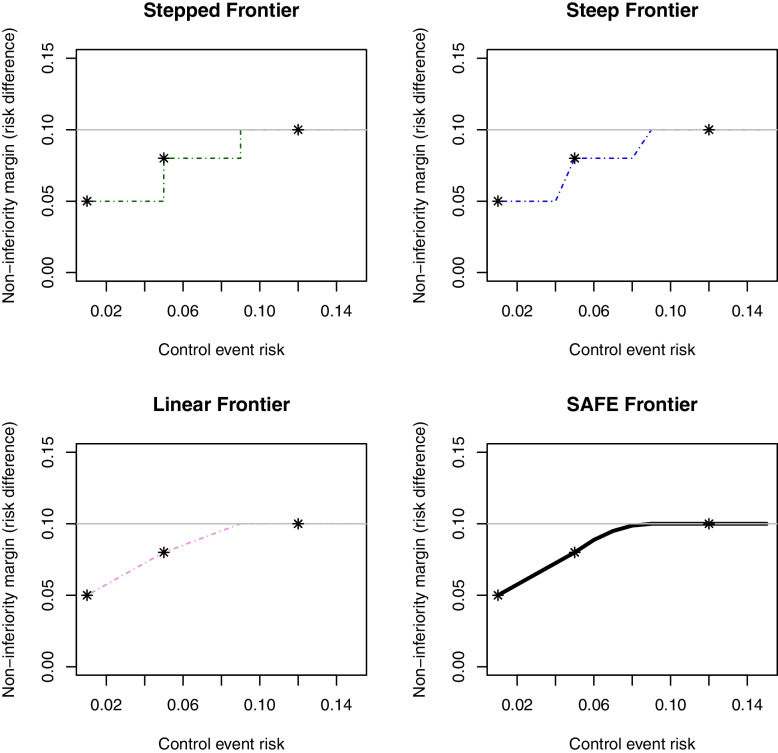
In D3, we fix the non-inferiority margin at 10%, 8% and 5% for control event risks of ≥9%, 5% and 1%, respectively. We propose four frontiers which fit these fixed points, including a Smooth Away From Expected (SAFE) frontier. Analysis approaches considered are as follows: using the pre-specified significance level (α=0.025); always using a reduced significance level (to achieve α≤0.025 across control event risks); reducing significance levels only when the control event risk differs significantly from expected (control event risk <9%); and using a likelihood ratio test. We compare power and type 1 error for SAFE with other frontiers.
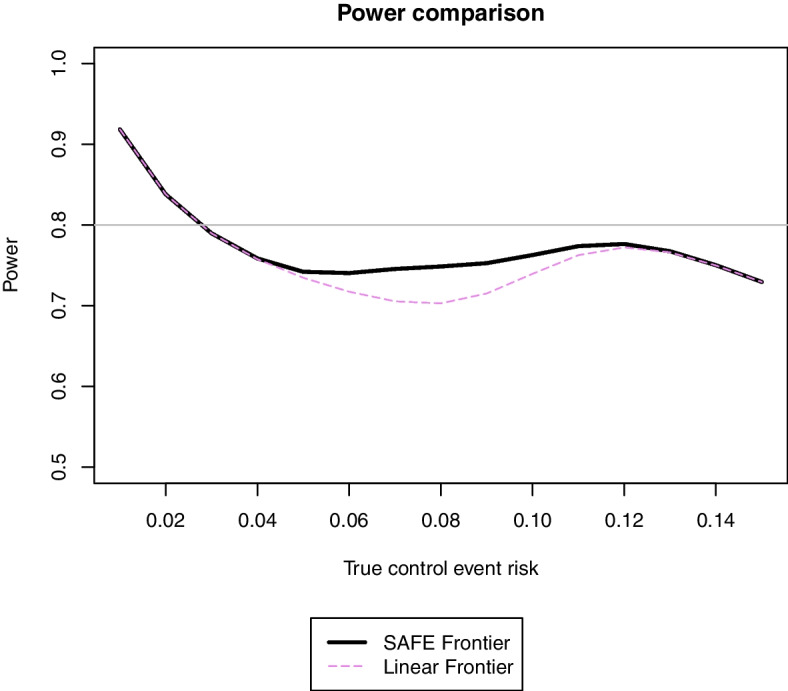
Changing the significance level only when the control event risk is <9% achieves approximately nominal (<3%) type I error rate and maintains reasonable power for control event risks between 1 and 15%. The likelihood ratio test method performs similarly, but the results are more complex to present. Other analysis methods lead to either inflated type 1 error or badly reduced power. The SAFE frontier gives more interpretable results with low control event risks than other frontiers (i.e. it uses more reasonable non-inferiority margins). Other frontiers do not achieve power close (i.e. within 1%) to SAFE across the range of likely control event risks while controlling type I error.
The SAFE non-inferiority frontier will be used in D3, and the non-inferiority margin and significance level will be modified if the control event risk is lower than expected. This ensures results will remain interpretable if design assumptions are incorrect, while achieving similar power. A similar approach could be considered for other non-inferiority trials where the control event risk is uncertain.
在非劣效性试验中,边界的选择取决于预期的对照事件风险。如果实际风险与预期不同,那么结果的效力和可解释性可能会受到影响。非劣效性前沿预先指定了每个对照事件风险值的适当非劣效性边界。D3 是一项在感染艾滋病毒的儿童中比较两种治疗方案的非劣效性试验,设计时假设对照事件风险为 12%,非劣效性边界为 10%,效力为 80%,显著性水平(α)为 0.025。我们考虑了为这个已经获得资金的试验选择和实施前沿的方法,在这种情况下,大幅改变样本量将是困难的。
在 D3 中,我们将非劣效性边界分别固定在 10%、8%和 5%,用于对照事件风险≥9%、5%和 1%。我们提出了四个符合这些固定点的前沿,包括平滑远离预期(SAFE)前沿。考虑的分析方法如下:使用预先指定的显著性水平(α=0.025);始终使用降低的显著性水平(在对照事件风险范围内达到α≤0.025);仅当对照事件风险与预期显著不同时才降低显著性水平(对照事件风险<9%);和使用似然比检验。我们比较了 SAFE 与其他前沿的效力和第一类错误。
仅当对照事件风险<9%时才改变显著性水平,可实现约为名义(<3%)的第一类错误率,并为 1 至 15%之间的对照事件风险保持合理的效力。似然比检验方法的表现类似,但结果更难呈现。其他分析方法要么导致第一类错误膨胀,要么严重降低效力。SAFE 前沿在低对照事件风险下提供了比其他前沿更具解释性的结果(即它使用了更合理的非劣效性边界)。其他前沿在控制第一类错误的同时,无法在可能的对照事件风险范围内接近(即相差 1%以内)SAFE 的效力。
SAFE 非劣效性前沿将用于 D3,如果对照事件风险低于预期,将修改非劣效性边界和显著性水平。这确保了如果设计假设不正确,结果仍然是可解释的,同时实现了类似的效力。对于其他对照事件风险不确定的非劣效性试验,可以考虑类似的方法。