Lin Po-Chih, Chen Chia-Huei, Chang Jui-Hsing, Peng Chun-Chih, Jim Wai-Tim, Lin Chia-Ying, Hsu Chyong-Hsin, Chang Hung-Yang
Department of Pediatrics, MacKay Children's Hospital, Taipei 104217, Taiwan.
Department of Medicine, MacKay Medical College, New Taipei City 25245, Taiwan.
Children (Basel). 2023 Jul 29;10(8):1307. doi: 10.3390/children10081307.
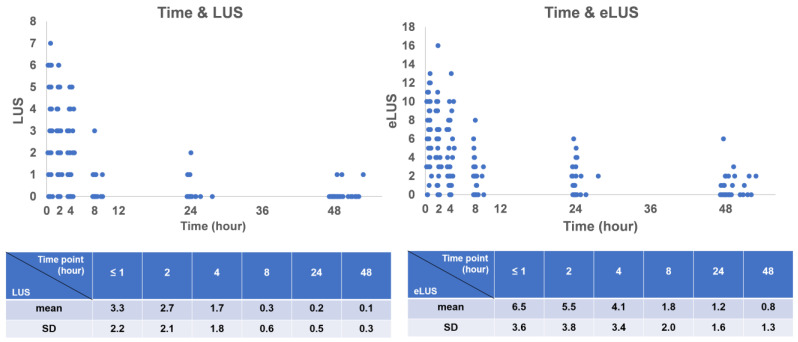
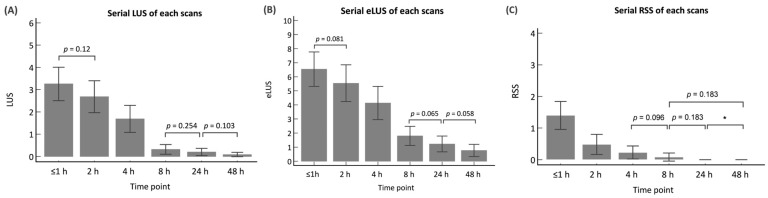
Ultrasound has been used to observe lung aeration and fluid clearance during the neonatal transition period, but there is no consensus regarding the optimal timing of lung ultrasound. We aimed to monitor the trend of the serial lung ultrasound score (LUS) and extended LUS (eLUS) throughout the neonatal transition period (≤1, 2, 4, 8, 24, and 48 h after birth), assess any correlation to the clinical presentation (using the Silverman Andersen Respiratory Severity Score (RSS)), and determine the optimal time of the ultrasound. We found both LUS and eLUS decreased significantly after 2 h of life and had similar statistical differences among the serial time points. Although both scores had a positive, moderate correlation to the RSS overall (Pearson correlation 0.499 [ < 0.001] between LUS and RSS, 0.504 [ < 0.001] between eLUS and RSS), the correlation was poor within 1 h of life (Pearson correlation 0.15 [ = 0.389] between LUS and RSS, 0.099 [ = 0.573] between eLUS and RSS). For better clinical correlation, the first lung ultrasound for the neonate may be performed at 2 h of life. Further research is warranted to explore the clinical value and limitations of earlier (≤1 h of life) lung ultrasound examinations.
超声已被用于观察新生儿过渡期的肺通气和液体清除情况,但关于肺超声的最佳检查时机尚无共识。我们旨在监测整个新生儿过渡期(出生后≤1、2、4、8、24和48小时)连续肺超声评分(LUS)和扩展肺超声评分(eLUS)的变化趋势,评估其与临床表现(使用Silverman Andersen呼吸严重度评分(RSS))的相关性,并确定超声检查的最佳时间。我们发现,出生后2小时后LUS和eLUS均显著下降,且在各连续时间点之间存在相似的统计学差异。尽管这两个评分总体上与RSS呈中度正相关(LUS与RSS之间的Pearson相关系数为0.499[<0.001],eLUS与RSS之间的Pearson相关系数为0.504[<0.001]),但在出生后1小时内相关性较差(LUS与RSS之间的Pearson相关系数为0.15[=0.389],eLUS与RSS之间的Pearson相关系数为0.099[=0.573])。为了获得更好的临床相关性,新生儿的首次肺超声检查可在出生后2小时进行。有必要进一步研究以探索更早(出生后≤1小时)肺超声检查的临床价值和局限性。