Jang Se-Hyuk, Park Young-Joon, Lee Ji-Joo, Jung Woo-Jin
Korea Disease Control and Prevention Agency (KDCA), Heungdeok-gu, Cheongju-si 28159, Republic of Korea.
Healthcare (Basel). 2023 Aug 18;11(16):2332. doi: 10.3390/healthcare11162332.
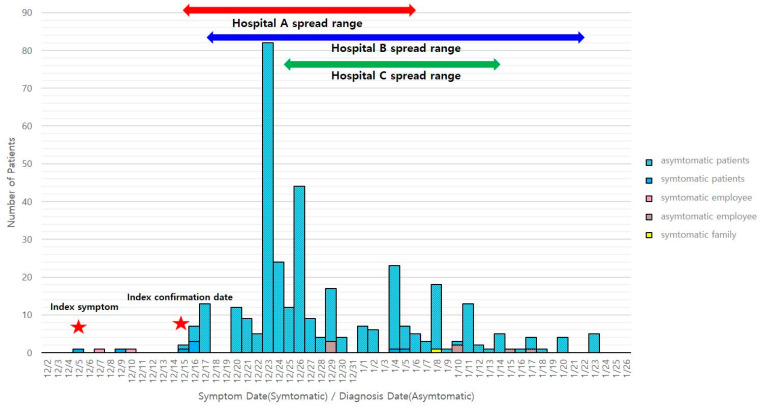
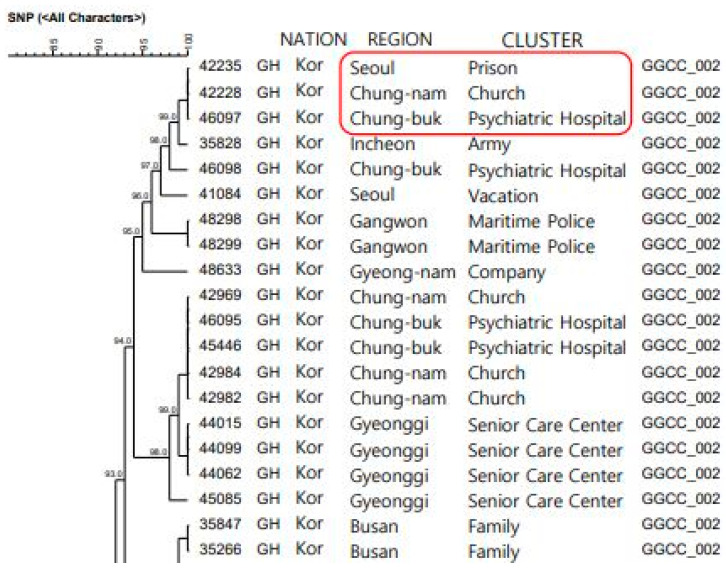
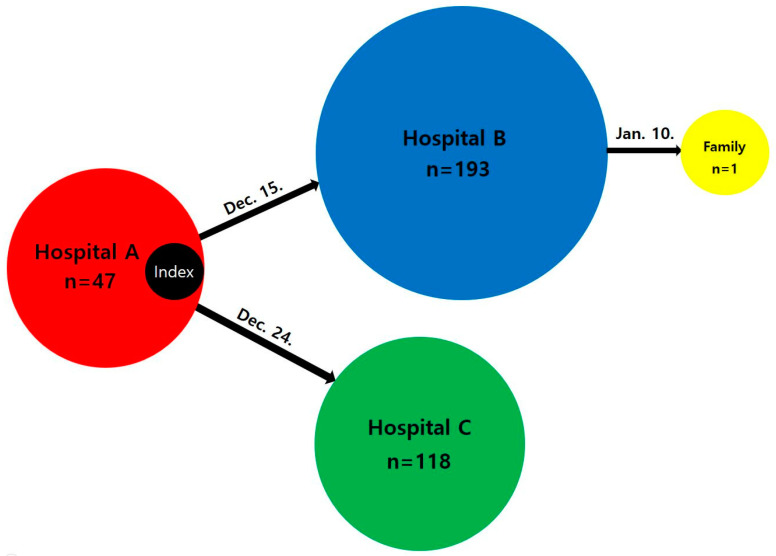
This study investigated the causes and risks for infection spread in three psychiatric hospitals in Chung-buk, South Korea, to strategize measures to block transmission and prevent a large-scale epidemic. From December 2020 to January 2021, 358 inpatients of Psychiatric Hospitals A, B, and C were enrolled to identify the epidemiological characteristics of confirmed patients. Epidemic curves and propagation relationships were constructed and a genotype analysis was conducted. The index case inpatient from Hospital A transmitted the infection to patients in Hospitals B and C; the infection was confirmed in 47, 193, and 118 patients in Hospitals A, B, and C, respectively. The patient characteristics hampered communication and the close identification of symptom onset. The incidence rate was 10 (2.9%) among employees and 348 (35.8%) among inpatients. The relative risk was 12.1 (95% CI: 6.6-22.5) times higher among inpatients than employees. Next-generation sequencing confirmed the probable infection source as a genotype identical to that of two different outbreaks, although the infection spread was undetermined. Direct risk factors emerged from patient characteristics, wherein cohort isolation was meaningless due to uncontrolled communication. Indirect risk factors included hospital-specific problems due to external factors (non-patient system deficiencies or employee negligence). Prior inspections, a confirmation of non-infection, and institutional emergent measures are needed.
本研究调查了韩国忠北地区三家精神病医院感染传播的原因和风险,以制定阻断传播和预防大规模疫情的措施。2020年12月至2021年1月,招募了A、B、C三家精神病医院的358名住院患者,以确定确诊患者的流行病学特征。构建了流行曲线和传播关系,并进行了基因分型分析。A医院的首例住院患者将感染传播给了B医院和C医院;A、B、C三家医院分别有47、193和118名患者确诊感染。患者的特征妨碍了沟通以及症状发作的密切识别。员工的发病率为10例(2.9%),住院患者的发病率为348例(35.8%)。住院患者的相对风险比员工高12.1倍(95%置信区间:6.6 - 22.5)。下一代测序证实可能的感染源是一种与两次不同疫情相同的基因型,尽管感染传播情况尚不确定。直接风险因素源于患者特征,其中由于沟通不受控制,群组隔离毫无意义。间接风险因素包括外部因素导致的医院特定问题(非患者系统缺陷或员工疏忽)。需要进行事先检查、确认未感染情况以及采取机构紧急措施。