Nathan S. Kline Institute for Psychiatric Research, Orangeburg, New York.
Department of Psychiatry, New York University Langone Medical Center, New York.
JAMA Netw Open. 2022 May 2;5(5):e2210743. doi: 10.1001/jamanetworkopen.2022.10743.
Individuals with serious mental illness are at increased risk of severe COVID-19 infection. Several psychotropic medications have been identified as potential therapeutic agents to prevent or treat COVID-19 but have not been systematically examined in this population.
To evaluate the associations between the use of psychotropic medications and the risk of COVID-19 infection among adults with serious mental illness receiving long-term inpatient psychiatric treatment.
DESIGN, SETTING, AND PARTICIPANTS: This retrospective cohort study assessed adults with serious mental illness hospitalized in a statewide psychiatric hospital system in New York between March 8 and July 1, 2020. The final date of follow-up was December 1, 2020. The study included 1958 consecutive adult inpatients with serious mental illness (affective or nonaffective psychoses) who received testing for SARS-CoV-2 by reverse transcriptase-polymerase chain reaction or antinucleocapsid antibodies and were continuously hospitalized from March 8 until medical discharge or July 1, 2020.
Psychotropic medications prescribed prior to COVID-19 testing.
COVID-19 infection was the primary outcome, defined by a positive SARS-CoV-2 reverse transcriptase-polymerase chain reaction or antibody test result. The secondary outcome was COVID-19-related death among patients with laboratory-confirmed infection.
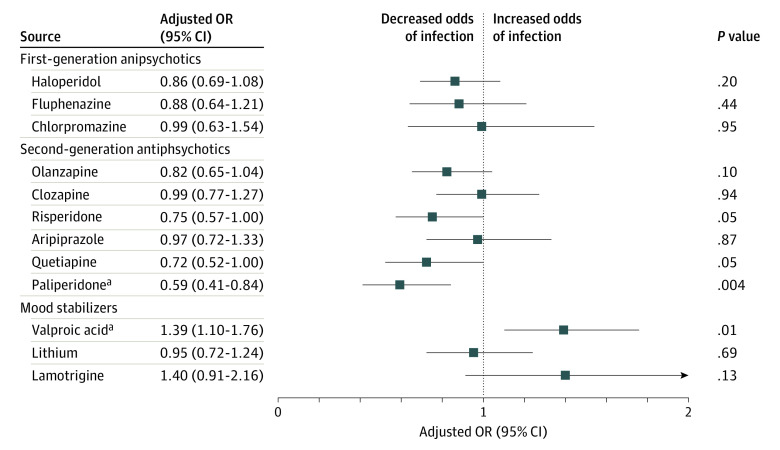
Of the 2087 adult inpatients with serious mental illness continuously hospitalized during the study period, 1958 (93.8%) underwent testing and were included in the study; 1442 (73.6%) were men, and the mean (SD) age was 51.4 (14.3) years. A total of 969 patients (49.5%) had laboratory-confirmed COVID-19 infection that occurred while they were hospitalized; of those, 38 (3.9%) died. The use of second-generation antipsychotic medications, as a class, was associated with decreased odds of infection (odds ratio [OR], 0.62; 95% CI, 0.45-0.86), whereas the use of mood stabilizers was associated with increased odds of infection (OR, 1.23; 95% CI, 1.03-1.47). In a multivariable model of individual medications, the use of paliperidone was associated with decreased odds of infection (OR, 0.59; 95% CI, 0.41-0.84), and the use of valproic acid was associated with increased odds of infection (OR, 1.39; 95% CI, 1.10-1.76). Clozapine use was associated with reduced odds of mortality in unadjusted analyses (unadjusted OR, 0.25; 95% CI, 0.10-0.62; fully adjusted OR, 0.43; 95% CI, 0.17-1.12).
In this cohort study of adults hospitalized with serious mental illness, the use of second-generation antipsychotic medications was associated with decreased risk of COVID-19 infection, whereas the use of valproic acid was associated with increased risk. Further research is needed to assess the mechanisms that underlie these findings.
患有严重精神疾病的个体患严重 COVID-19 感染的风险增加。已经确定几种精神药物可能是预防或治疗 COVID-19 的潜在治疗剂,但尚未在该人群中进行系统检查。
评估在接受长期住院精神治疗的患有严重精神疾病的成年人中,使用精神药物与 COVID-19 感染风险之间的关联。
设计、设置和参与者:这项回顾性队列研究评估了 2020 年 3 月 8 日至 7 月 1 日期间在纽约州一个全州精神病院系统住院的患有严重精神疾病的成年人。最后随访日期为 2020 年 12 月 1 日。该研究包括 1958 名连续成年住院患者患有严重精神疾病(情感或非情感精神病),他们通过逆转录酶-聚合酶链反应或抗核衣壳抗体接受了 SARS-CoV-2 检测,并且从 3 月 8 日至 2020 年 7 月 1 日连续住院。
在 COVID-19 检测之前开的精神药物。
COVID-19 感染是主要结局,定义为 SARS-CoV-2 逆转录酶-聚合酶链反应或抗体检测结果阳性。次要结局是患有实验室确诊感染的患者的 COVID-19 相关死亡。
在研究期间连续住院的 2087 名成年精神病住院患者中,有 1958 名(93.8%)接受了检测并纳入了研究;1442 名(73.6%)为男性,平均(SD)年龄为 51.4(14.3)岁。共有 969 名患者(49.5%)在住院期间发生了实验室确诊的 COVID-19 感染;其中 38 人(3.9%)死亡。第二代抗精神病药物的使用作为一类药物与感染几率降低相关(比值比[OR],0.62;95%CI,0.45-0.86),而心境稳定剂的使用与感染几率增加相关(OR,1.23;95%CI,1.03-1.47)。在对个别药物的多变量模型中,使用帕利哌酮与感染几率降低相关(OR,0.59;95%CI,0.41-0.84),而使用丙戊酸与感染几率增加相关(OR,1.39;95%CI,1.10-1.76)。在未调整分析中,氯氮平的使用与死亡率降低相关(未调整 OR,0.25;95%CI,0.10-0.62;完全调整 OR,0.43;95%CI,0.17-1.12)。
在这项对因严重精神疾病住院的成年人进行的队列研究中,第二代抗精神病药物的使用与 COVID-19 感染风险降低相关,而丙戊酸的使用与感染风险增加相关。需要进一步研究以评估这些发现背后的机制。