Department of Biochemistry, Lee Gil Ya Cancer and Diabetes Institute, College of Medicine, Gachon University, Incheon 21999, Republic of Korea.
Department of Health Sciences and Technology, GAIHST, Gachon University, Incheon 21999, Republic of Korea.
Int J Mol Sci. 2023 Aug 9;24(16):12602. doi: 10.3390/ijms241612602.
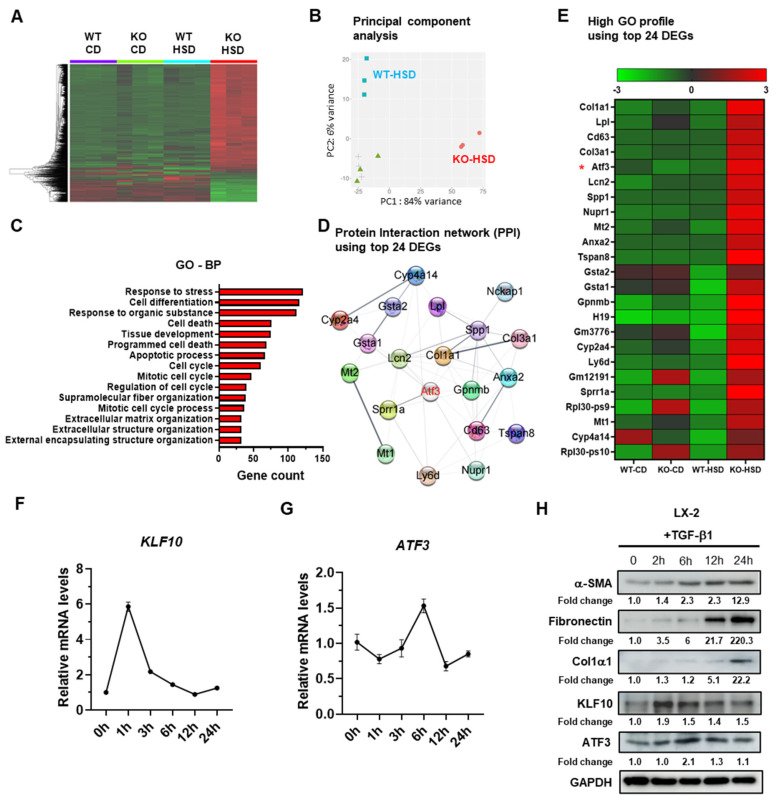
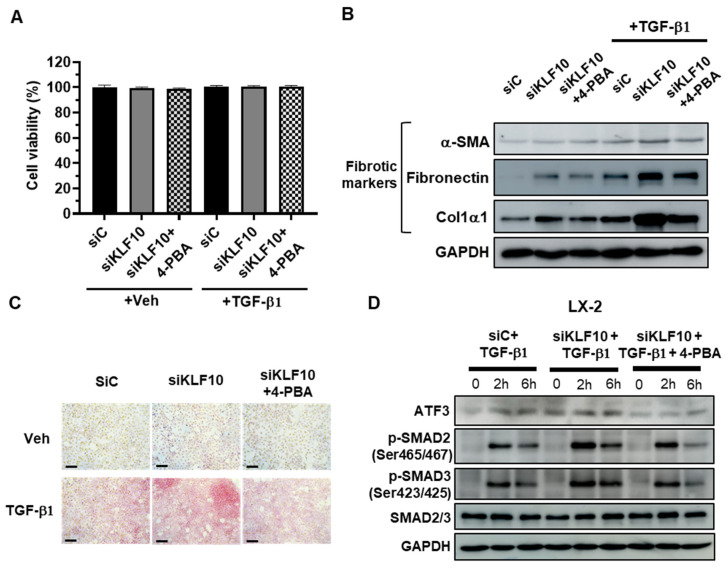
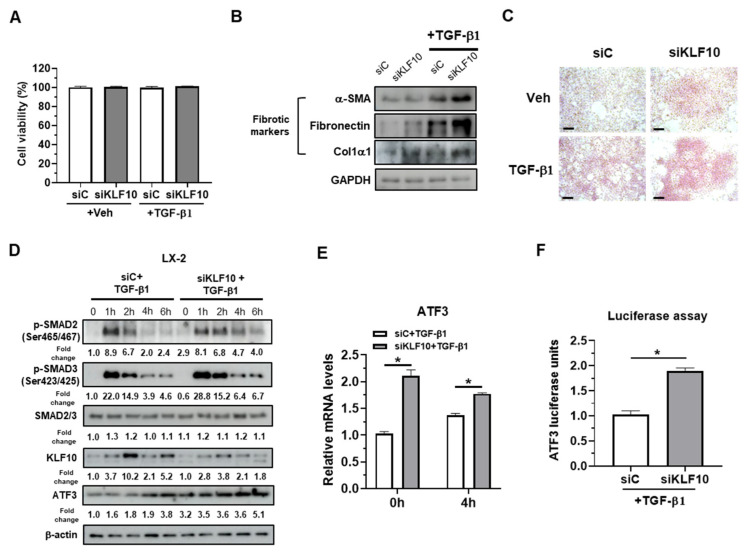
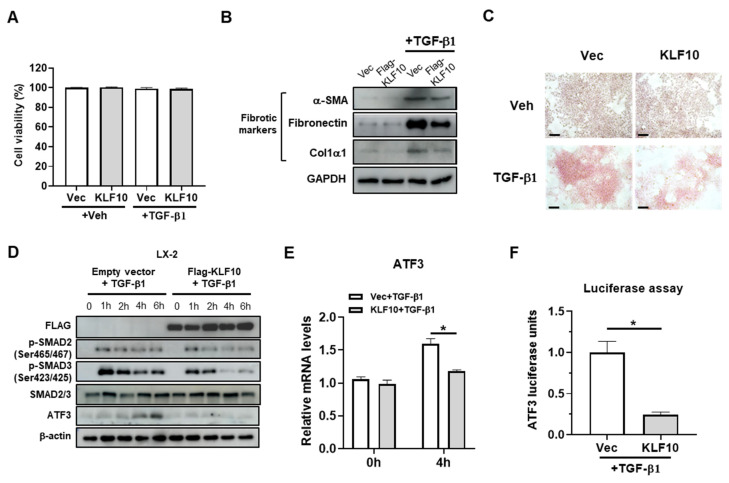
Liver fibrosis is a progressive and debilitating condition characterized by the excessive deposition of extracellular matrix proteins. Stellate cell activation, a major contributor to fibrogenesis, is influenced by Transforming growth factor (TGF-β)/SMAD signaling. Although Krüppel-like-factor (KLF) 10 is an early TGF-β-inducible gene, its specific role in hepatic stellate cell activation remains unclear. Our previous study demonstrated that KLF10 knockout mice develop severe liver fibrosis when fed a high-sucrose diet. Based on these findings, we aimed to identify potential target molecules involved in liver fibrosis and investigate the mechanisms underlying the KLF10 modulation of hepatic stellate cell activation. By RNA sequencing analysis of liver tissues from KLF10 knockout mice with severe liver fibrosis induced by a high-sucrose diet, we identified ATF3 as a potential target gene regulated by KLF10. In LX-2 cells, an immortalized human hepatic stellate cell line, KLF10 expression was induced early after TGF-β treatment, whereas ATF3 expression showed delayed induction. KLF10 knockdown in LX-2 cells enhanced TGF-β-mediated activation, as evidenced by elevated fibrogenic protein levels. Further mechanistic studies revealed that KLF10 knockdown promoted TGF-β signaling and upregulated ATF3 expression. Conversely, KLF10 overexpression suppressed TGF-β-mediated activation and downregulated ATF3 expression. Furthermore, treatment with the chemical chaperone 4-PBA attenuated siKLF10-mediated upregulation of ATF3 and fibrogenic responses in TGF-β-treated LX-2 cells. Collectively, our findings suggest that KLF10 acts as a negative regulator of the TGF-β signaling pathway, exerting suppressive effects on hepatic stellate cell activation and fibrogenesis through modulation of ATF3 expression. These results highlight the potential therapeutic implications of targeting the KLF10-ATF3 axis in liver fibrosis treatment.
肝纤维化是一种进行性和衰弱性疾病,其特征是细胞外基质蛋白的过度沉积。星状细胞激活是肝纤维化的主要原因之一,受转化生长因子 (TGF-β)/SMAD 信号的影响。虽然 Krüppel 样因子 (KLF) 10 是 TGF-β诱导的早期基因,但它在肝星状细胞激活中的具体作用尚不清楚。我们之前的研究表明,高脂高糖饮食喂养的 KLF10 基因敲除小鼠会发展为严重的肝纤维化。基于这些发现,我们旨在确定参与肝纤维化的潜在靶分子,并研究 KLF10 调节肝星状细胞激活的机制。通过 RNA 测序分析高脂高糖饮食诱导的 KLF10 基因敲除小鼠的肝组织,我们鉴定出 ATF3 是 KLF10 调控的潜在靶基因。在 LX-2 细胞系(一种永生化的人肝星状细胞系)中,KLF10 在 TGF-β 处理后早期诱导表达,而 ATF3 表达则延迟诱导。在 LX-2 细胞中敲低 KLF10 增强了 TGF-β介导的激活,表现为纤维化蛋白水平升高。进一步的机制研究表明,KLF10 敲低促进了 TGF-β 信号传导并上调了 ATF3 的表达。相反,KLF10 过表达抑制了 TGF-β 介导的激活并下调了 ATF3 的表达。此外,用化学伴侣 4-PBA 处理可减弱 siKLF10 介导的 TGF-β 处理的 LX-2 细胞中 ATF3 的上调和纤维化反应。总之,我们的研究结果表明,KLF10 作为 TGF-β 信号通路的负调节剂,通过调节 ATF3 的表达对肝星状细胞激活和纤维化产生抑制作用。这些结果强调了靶向 KLF10-ATF3 轴在肝纤维化治疗中的潜在治疗意义。