Nephrology and Dialysis Unit, Magna-Graecia University Hospital, 88100 Catanzaro, Italy.
Department of Medical and Surgical Sciences, Magna-Graecia University, 88100 Catanzaro, Italy.
Medicina (Kaunas). 2023 Jul 29;59(8):1392. doi: 10.3390/medicina59081392.
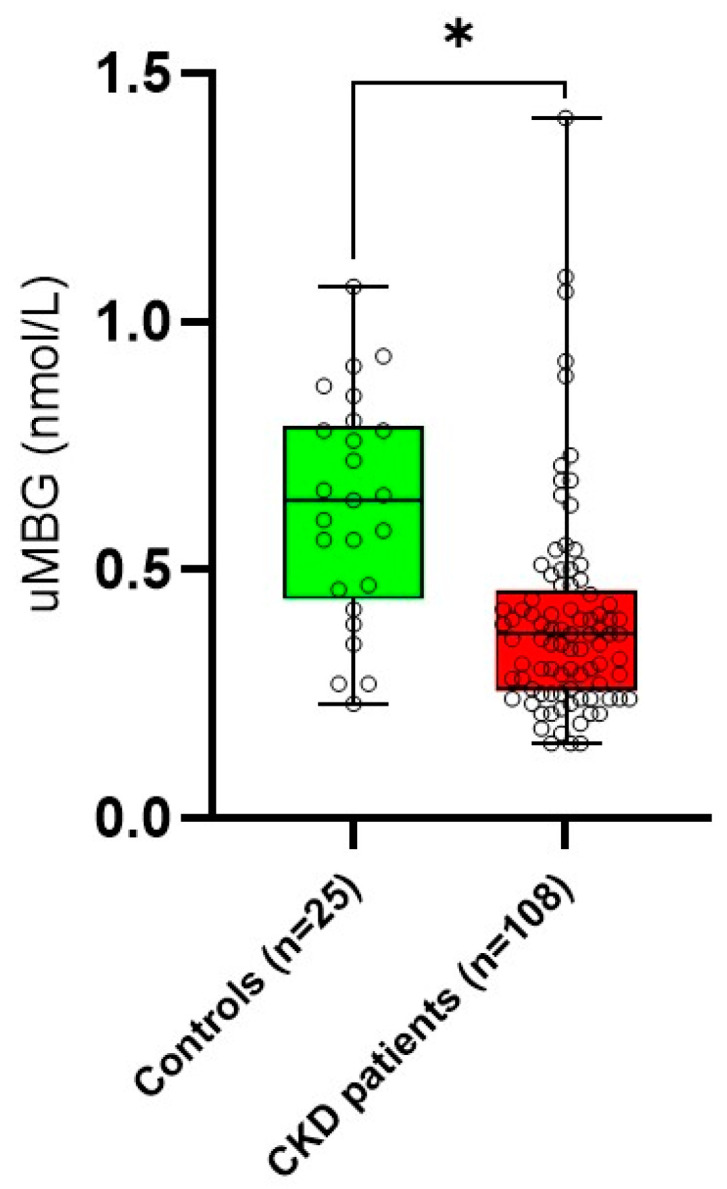
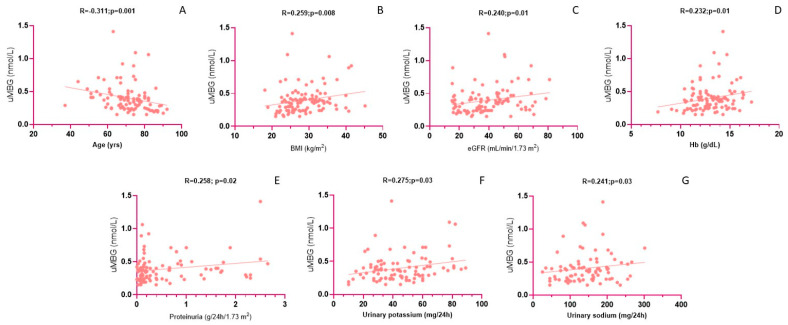
: The global prevalence of chronic kidney disease (CKD) is on the rise, posing important challenges for healthcare systems. Thus, the search for new factors potentially involved in the pathogenesis, progression and complications of early CKD remains urgent. Marinobufagenin (MBG) is a natriuretic endogenous cardiotonic steroid, and increased circulating levels of it may accelerate kidney damage. In this study, we explored the possible clinical significance of measuring urinary marinobufagenin (uMBG) in patients with non-advanced CKD. : One hundred and eight adult CKD patients (mean age 71.6 ± 10 years, 70.4% male; mean eGFR 40.54 ± 17 mL/min/1.73 m) were enrolled in this cross-sectional study. uMBG was measured together with a series of clinical, anthropometric, laboratory and instrumental analyses. Twenty-five healthy matched subjects served as controls for the uMBG measurement. : The uMBG values were lower in the patients with CKD as compared to those of the controls (0.37 [IQR: 0.25-0.45] vs. 0.64 [0.46-0.78] nmol/L. = 0.004), and a significant trend in eGFR levels was noticed across the decreasing uMBG tertiles ( = 0.03). Regarding the correlation analyses, the uMBG values remained robustly associated with the eGFR in multivariate models employing either uMBG or eGFR as the dependent variable (β = 0.248; = 0.01 and β = 0.139; = 0.04, respectively). Besides the eGFR, the independent predictors of uMBG values in this population were the use of statins (β = -0.326; = 0.001), the presence of diabetes (β = 0.243; = 0.009) and urine sodium (β = 0.204; = 0.01). : Reduced uMBG excretion may reflect impaired renal clearance, which may contribute to the detrimental effects attributed to this hormone due to systemic accumulation. Future studies are needed to clarify the biological mechanisms placing uMBG at the crossroad of sodium intake and the presence of diabetes in CKD-suffering individuals and to verify whether a statin treatment may somewhat limit the detrimental effects of MBG in the presence of impaired renal function.
: 全球慢性肾脏病 (CKD) 的患病率呈上升趋势,这对医疗系统构成了重大挑战。因此,寻找新的潜在因素来参与早期 CKD 的发病机制、进展和并发症仍然迫在眉睫。马利诺bufagenin(MBG)是一种具有利钠作用的内源性心脏毒素类固醇,其循环水平升高可能加速肾脏损伤。在这项研究中,我们探讨了测量非晚期 CKD 患者尿中马利诺 bufagenin(uMBG)的可能临床意义。 : 本横断面研究纳入了 108 名成年 CKD 患者(平均年龄 71.6±10 岁,70.4%为男性;平均 eGFR 40.54±17 mL/min/1.73 m)。同时测量了 uMBG 以及一系列临床、人体测量、实验室和仪器分析。25 名健康匹配的受试者作为 uMBG 测量的对照组。 : CKD 患者的 uMBG 值低于对照组(0.37[IQR:0.25-0.45]vs.0.64[0.46-0.78]nmol/L. = 0.004),且 uMBG 三分位越低,eGFR 水平呈显著下降趋势( = 0.03)。关于相关性分析,在以 uMBG 或 eGFR 为因变量的多变量模型中,uMBG 值与 eGFR 仍存在显著相关性(β=0.248; = 0.01 和β=0.139; = 0.04)。除了 eGFR 之外,该人群中 uMBG 值的独立预测因子还有他汀类药物的使用(β=-0.326; = 0.001)、糖尿病的存在(β=0.243; = 0.009)和尿钠(β=0.204; = 0.01)。 : 尿中 MBG 排泄减少可能反映了肾脏清除能力受损,这可能导致该激素因全身蓄积而产生有害影响。未来的研究需要阐明将 uMBG 置于 CKD 患者钠摄入和糖尿病存在的十字路口的生物学机制,并验证他汀类药物治疗是否可以在肾功能受损的情况下在一定程度上限制 MBG 的有害作用。