Department of Traumatology, Orthopaedics and Hand Surgery, Poznan University of Medical Sciences, 28 Czerwca 1956 r. Street, No. 135/147, 61-545 Poznan, Poland.
Department of Pathophysiology of Locomotor Organs, Poznan University of Medical Sciences, 28 Czerwca 1956 r. Street, No. 135/147, 61-545 Poznan, Poland.
Medicina (Kaunas). 2023 Jul 31;59(8):1404. doi: 10.3390/medicina59081404.
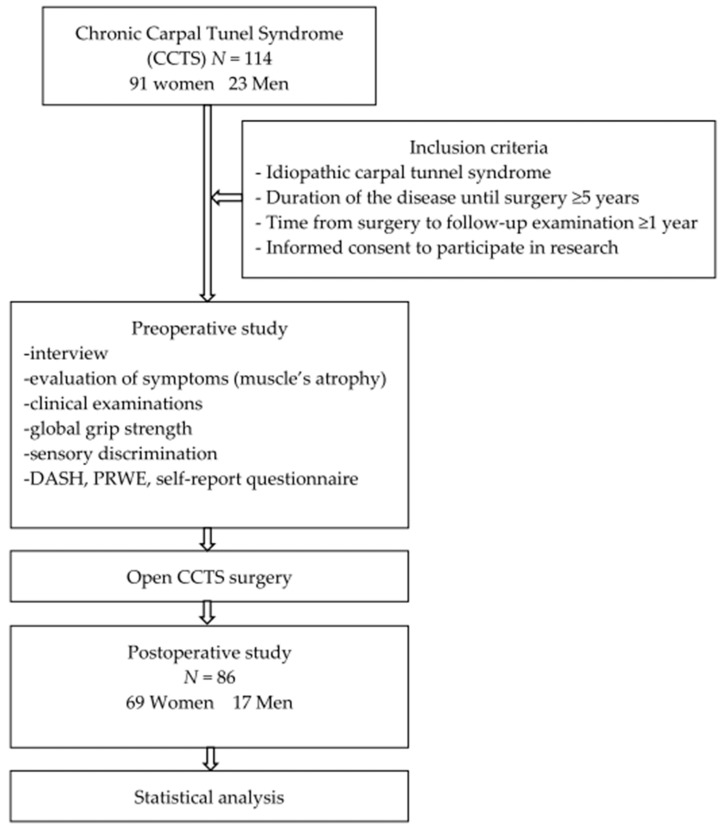
: Severe carpal tunnel syndrome (CTS) is the most common compression neuropathy in the upper extremities treated conservatively; later, when advanced, CTS is treated mostly surgically. The most prevalent symptoms comprise numbness, as well as sensation loss in the thumb, index, and middle finger, and thenar muscle strength loss, resulting in impaired daily functioning for patients. Data on the results of CTS treatment in patients with delayed surgical intervention are scarce. The aim of this study was to determine the postoperative results of chronic carpal tunnel syndrome treatment in patients with symptoms lasting for at least 5 years. : A total of 86 patients (69 females, 17 males) with a mean age of 58 years reporting symptoms of CTS for at least 5 years (mean: 8.5 years) were prospectively studied. The average follow-up time was 33 months. All patients underwent the surgical open decompression of the median nerve at the wrist. A preoperative observation was composed of an interview and a clinical examination. The subjects completed the DASH (the Disabilities of the Arm, Shoulder, and Hand), PRWE (Patient-Rated Wrist Evaluation), and self-report questionnaires. Global grip strength, sensory discrimination, characteristic symptoms of CTS, and thenar muscle atrophy were examined. Postoperatively, clinical and functional examinations were repeated, and patients expressed their opinions by completing a BCTQ (Boston Carpal Tunnel Syndrome Questionnaire). : We found improvements in daily activities and hand function postoperatively. Overall, 88% of patients were satisfied with the outcome of surgery. DASH scores decreased after surgery from 44.82 to 14.12 at < 0.001. PRWE questionnaire scores decreased from 53.34 to 15.19 at < 0.001. The mean score of the BCTQ on the scale regarding the severity of symptoms was 1.48 and 1.62 on the scale regarding function after surgery. No significant differences were found in the scores between the male and female groups or between age groups ( > 0.05). A significant increase in global grip strength from 16.61 kg to 21.91 kg was observed postoperatively at < 0.001. No significant difference was detected in the measurement of sensory discrimination (6.02 vs. 5.44). In most of the examined patients, night numbness and wrist pain subsided after surgery at < 0.001. Thenar muscle atrophy diminished after surgery at < 0.001. : Most patients were satisfied with the results of CTS surgery regarding the open decompression of the median nerve even after 5 years of ineffective conservative treatment. Significant improvement of the hand function was confirmed in the functional studies.
: 严重腕管综合征(CTS)是上肢最常见的保守治疗压迫性神经病;后期,当病情进展时,CTS 主要通过手术治疗。最常见的症状包括拇指、食指和中指麻木以及感觉丧失,大鱼际肌无力,导致患者日常活动受限。关于延迟手术干预的 CTS 治疗结果的数据很少。本研究旨在确定症状持续至少 5 年的慢性腕管综合征患者的术后治疗结果。: 共前瞻性研究了 86 名(69 名女性,17 名男性)平均年龄 58 岁的患者,这些患者报告 CTS 症状至少持续 5 年(平均:8.5 年)。平均随访时间为 33 个月。所有患者均接受腕管正中神经切开减压手术。术前观察包括访谈和临床检查。受试者完成了 DASH(上肢、肩部和手残疾)、PRWE(患者腕部评估)和自我报告问卷。检查了总体握力、感觉辨别力、CTS 的特征性症状和大鱼际肌萎缩。术后重复进行临床和功能检查,患者通过完成 BCTQ(波士顿腕管综合征问卷)表达意见。: 我们发现术后日常生活和手部功能有所改善。总体而言,88%的患者对手术结果满意。术后 DASH 评分从 44.82 降至 14.12(<0.001)。PRWE 问卷评分从 53.34 降至 15.19(<0.001)。术后症状严重程度评分 BCTQ 平均得分为 1.48,功能评分得分为 1.62。男女组或年龄组之间的评分无显著差异(>0.05)。术后总体握力从 16.61kg 显著增加至 21.91kg(<0.001)。感觉辨别力的测量无显著差异(6.02 与 5.44)。术后大多数患者夜间麻木和腕痛缓解(<0.001)。术后大鱼际肌萎缩减轻(<0.001)。: 即使经过 5 年无效的保守治疗,大多数患者对正中神经开放性减压治疗 CTS 的结果仍感到满意。功能研究证实手部功能显著改善。