
关于组织网络安全弹性的网络威胁情报的系统文献综述。
A Systematic Literature Review on Cyber Threat Intelligence for Organizational Cybersecurity Resilience.
作者信息
Saeed Saqib, Suayyid Sarah A, Al-Ghamdi Manal S, Al-Muhaisen Hayfa, Almuhaideb Abdullah M
机构信息
SAUDI ARAMCO Cybersecurity Chair, Department of Computer Information Systems, College of Computer Science and Information Technology, Imam Abdulrahman Bin Faisal University, P.O. Box 1982, Dammam 31441, Saudi Arabia.
Department of Computer Information Systems, College of Computer Science and Information Technology, Imam Abdulrahman Bin Faisal University, P.O. Box 1982, Dammam 31441, Saudi Arabia.
出版信息
Sensors (Basel). 2023 Aug 19;23(16):7273. doi: 10.3390/s23167273.
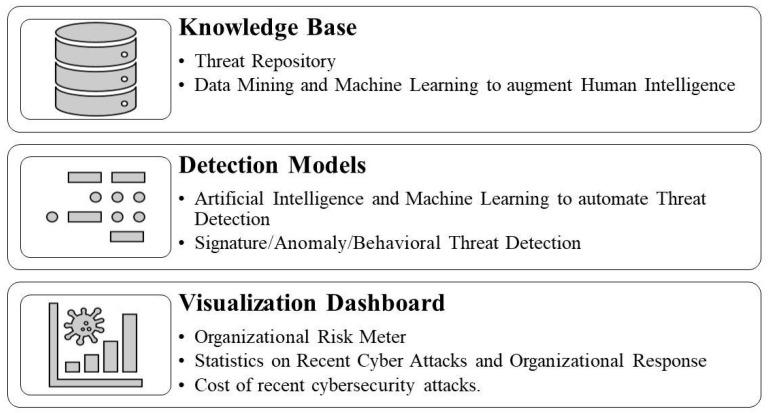
Cybersecurity is a significant concern for businesses worldwide, as cybercriminals target business data and system resources. Cyber threat intelligence (CTI) enhances organizational cybersecurity resilience by obtaining, processing, evaluating, and disseminating information about potential risks and opportunities inside the cyber domain. This research investigates how companies can employ CTI to improve their precautionary measures against security breaches. The study follows a systematic review methodology, including selecting primary studies based on specific criteria and quality valuation of the selected papers. As a result, a comprehensive framework is proposed for implementing CTI in organizations. The proposed framework is comprised of a knowledge base, detection models, and visualization dashboards. The detection model layer consists of behavior-based, signature-based, and anomaly-based detection. In contrast, the knowledge base layer contains information resources on possible threats, vulnerabilities, and dangers to key assets. The visualization dashboard layer provides an overview of key metrics related to cyber threats, such as an organizational risk meter, the number of attacks detected, types of attacks, and their severity level. This relevant systematic study also provides insight for future studies, such as how organizations can tailor their approach to their needs and resources to facilitate more effective collaboration between stakeholders while navigating legal/regulatory constraints related to information sharing.
网络安全是全球企业的重大关切,因为网络犯罪分子将企业数据和系统资源作为目标。网络威胁情报(CTI)通过获取、处理、评估和传播有关网络领域内潜在风险和机遇的信息,增强组织的网络安全弹性。本研究调查了公司如何利用CTI来改进其针对安全漏洞的预防措施。该研究采用系统综述方法,包括根据特定标准选择初步研究以及对所选论文进行质量评估。结果,提出了一个在组织中实施CTI的综合框架。所提出的框架由知识库、检测模型和可视化仪表板组成。检测模型层包括基于行为、基于特征和基于异常的检测。相比之下,知识库层包含有关可能威胁、漏洞以及对关键资产的危险的信息资源。可视化仪表板层提供与网络威胁相关的关键指标的概述,例如组织风险计量表、检测到的攻击数量、攻击类型及其严重程度级别。这项相关的系统研究还为未来研究提供了见解, 例如组织如何根据自身需求和资源调整方法,以在应对与信息共享相关的法律/监管限制时促进利益相关者之间更有效的协作。
 Zotero 插件