Unidade de Pesquisa Clínica e Experimental do Sistema Urogenital (UPCEURG), Instituto de Ciências da Saúde, Universidade Federal do Pará (UFPA), Belém 66075-110, PA, Brazil.
Programa de Pós-Graduação em Ciências Ambientais, Universidade do Estado do Pará (UEPA), Belém 66095-100, PA, Brazil.
Viruses. 2023 Jul 31;15(8):1675. doi: 10.3390/v15081675.
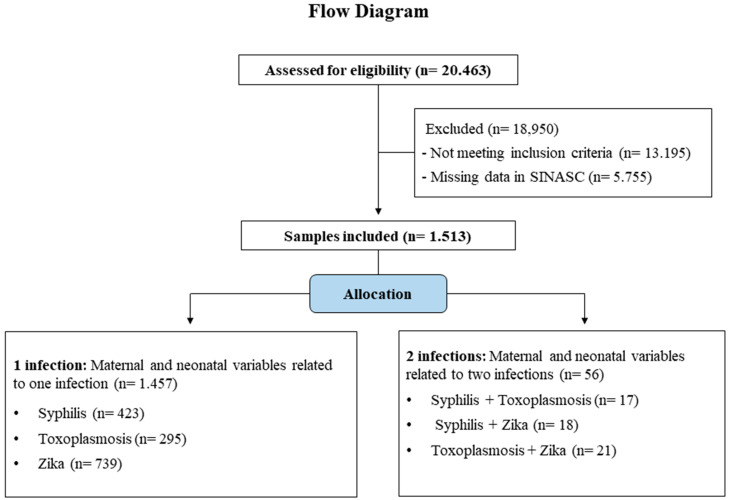
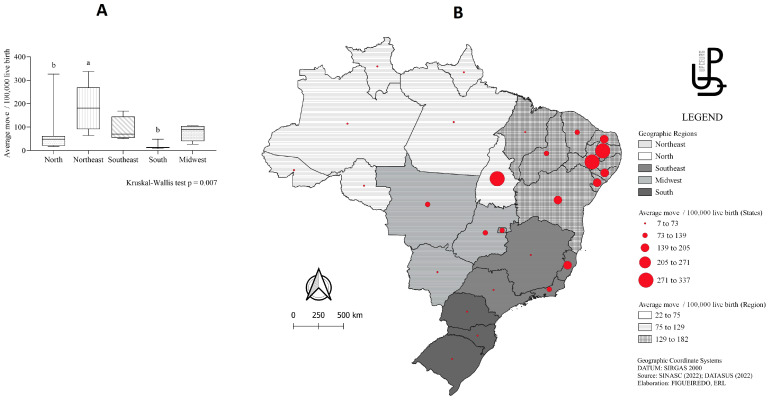
Microcephaly is a neurological condition characterized by anomalies in the growth of the cranial circumference. This study aims to examine the association between sociodemographic and clinical variables and the occurrence of secondary microcephaly in newborns in Brazil. It also aims to investigate the association between this congenital anomaly and teratogenic infections. This research adopts an observational approach with an ecological, descriptive, and analytical design. The sample includes infants aged ≤28 days and registered in the country's Live Births Information System from January 2015 to December 2021. Newborns were categorized into G1, consisting of newborns with one of the three infections (Zika, toxoplasmosis, or syphilis), and G2, consisting of newborns with two of the three infections. A total of 1513 samples were analyzed and divided into two groups: one infection (syphilis n = 423; toxoplasmosis n = 295; or Zika n = 739) and two infections (n = 56). The northeastern region of Brazil has the highest prevalence of microcephaly. Regarding the population profile, the Zika virus infection is more common among white mothers, while the syphilis infection is more common among black mothers. Among newborns with microcephaly, boys have a lower prevalence of toxoplasmosis infection, while girls have a lower prevalence of Zika virus infection. This study provides pertinent information on each infection and contributes to the epidemiologic understanding of the association between teratogenic infections and microcephaly.
小头症是一种以头颅周长生长异常为特征的神经学疾病。本研究旨在检验巴西新生儿继发性小头症与社会人口学和临床变量之间的关联,并研究该先天性畸形与致畸性感染之间的关联。本研究采用观察性方法,具有生态、描述和分析设计。该样本包括年龄≤28 天的婴儿,以及 2015 年 1 月至 2021 年 12 月期间在该国活产信息系统中登记的婴儿。新生儿分为 G1 组,包括三种感染(寨卡病毒、弓形虫病或梅毒)之一的新生儿,和 G2 组,包括三种感染中的两种的新生儿。共分析了 1513 个样本,并将其分为两组:一种感染(梅毒 n = 423;弓形虫病 n = 295;或寨卡病毒 n = 739)和两种感染(n = 56)。巴西东北部地区小头症的发病率最高。就人口特征而言,寨卡病毒感染在白人母亲中更为常见,而梅毒感染在黑人母亲中更为常见。在小头症新生儿中,男孩的弓形虫感染率较低,而女孩的寨卡病毒感染率较低。本研究提供了关于每种感染的相关信息,有助于了解致畸性感染与小头症之间的关联的流行病学认识。