Rodinkova Victoria, Yuriev Serhii, Mokin Vitalii, Sharikadze Olena, Kryzhanovskyi Yevhenii, Kremenska Lilia, Kaminska Olha, Kurchenko Andrii
Department of Pharmacy, National Pirogov Memorial Medical University, Vinnytsya, Ukraine.
Department of Clinical Immunology and Allergology, Bohomolets National Medical University, Kyiv, Ukraine.
Clin Transl Allergy. 2023 Aug;13(8):e12287. doi: 10.1002/clt2.12287.
The allergenicity of pollen of Poaceae family members is a well-known and confirmed fact. Using the data of component-resolved molecular diagnostics of allergy, we set a goal to establish the population and individual characteristics of sensitization to grass pollen and assess the patterns of its development.
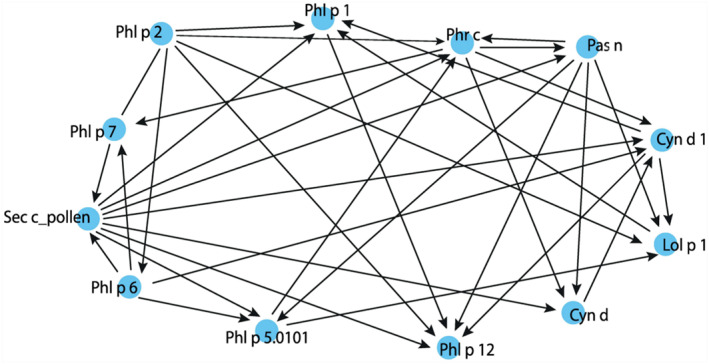
Multiplex allergy Alex test results of 20,033 patients were used. In addition to descriptive statistics to uncover traits of the sensitized population, statistical inference was utilized to establish the conditional probability of sensitisation, the nature of links between allergens, and the most frequent combinations of allergens in individual patient profiles.
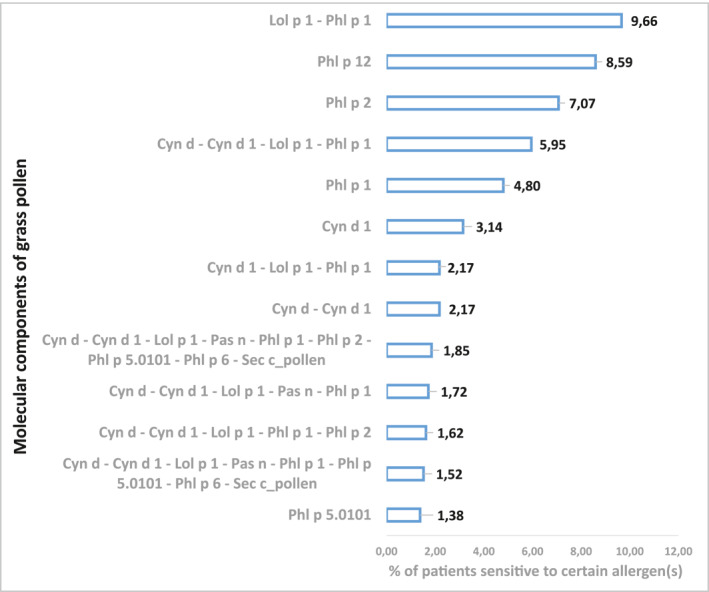
Sensitivity to grass pollen comprised 30.79% of the studied sample. Children accounted for 62.21%, adults-37.79%. Sensitisation to Phl p 1, Lol p 1, and Cyn d 1 was the most frequent in all age groups. Among them, Phl p 1 and Lol p 1 were the major ones. Phl p 2, Phl p 5.0101, and Phl p 6 were also responsible for primary sensitization; Phl p 5.0101 promoted the highest sIgE levels. A combination "Lol p 1-Phl p 1", where Lol p 1 might play a leading role, was most frequent in individual profiles. Monosensitization to Phl p 2 was the second most frequent and Bayesian Network suggested its independent development. Monosensitization to Cyn d 1, especially among children, may indicate the impact of climate change, promoting the spread of the subtropical grasses to the temperate region.
Descriptive statistics and known clinical data coincide well with statistical inference results and can provide for new clinical insights.
禾本科植物花粉的致敏性是一个众所周知且已得到证实的事实。利用过敏的组分分辨分子诊断数据,我们设定了一个目标,即确定对草花粉致敏的人群和个体特征,并评估其发展模式。
使用了20033名患者的多重过敏Alex测试结果。除了进行描述性统计以揭示致敏人群的特征外,还利用统计推断来确定致敏的条件概率、过敏原之间联系的性质以及个体患者档案中最常见的过敏原组合。
对草花粉的敏感性占研究样本的30.79%。儿童占62.21%,成人占37.79%。在所有年龄组中,对Phl p 1、Lol p 1和Cyn d 1的致敏最为常见。其中,Phl p 1和Lol p 1是主要的。Phl p 2、Phl p 5.0101和Phl p 6也导致初次致敏;Phl p 5.0101促使产生最高的特异性IgE水平。“Lol p 1-Phl p 1”组合在个体档案中最为常见,其中Lol p 1可能起主导作用。对Phl p 2的单一致敏是第二常见的,贝叶斯网络表明其独立发展。对Cyn d 1的单一致敏,尤其是在儿童中,可能表明气候变化的影响,促进了亚热带草向温带地区的传播。
描述性统计和已知临床数据与统计推断结果吻合良好,并能提供新的临床见解。