Center for Respiratory and Pulmonary Vascular Diseases, Department of Cardiology, Fuwai Hospital, National Clinical Research Center for Cardiovascular Diseases, National Center for Cardiovascular Diseases, Chinese Academy of Medical Sciences and Peking Union Medical College, No.167 Beilishi Rd, Xicheng District, Beijing, 100037, China.
Department of Cardiology, Shanghai Institute of Cardiovascular Disease, Zhongshan Hospital, Fudan University, Shanghai, China.
BMC Pulm Med. 2023 Aug 26;23(1):311. doi: 10.1186/s12890-023-02595-1.
Cystatin C is a novel biomarker to identify renal dysfunction and cardiovascular risk.
The aim of this study was to investigate the role of cystatin C in non-invasive risk prediction in a large cohort of patients with pre-capillary pulmonary hypertension (PH).
We retrospectively analyzed pre-capillary PH patients with available cystatin C and hemodynamic data derived from right heart catheterization.
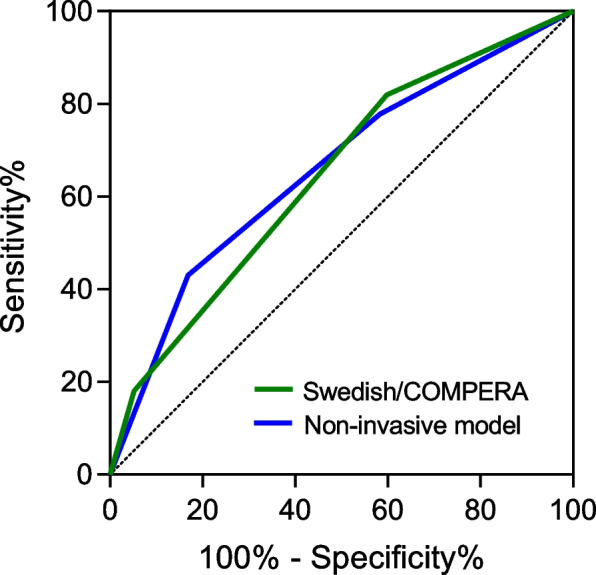
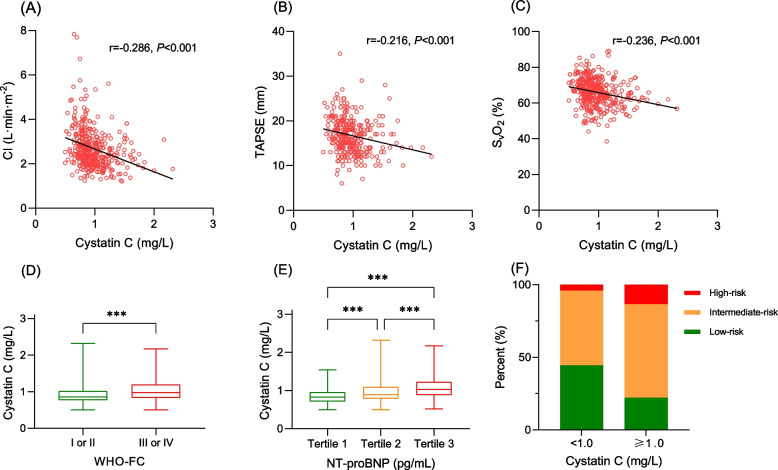
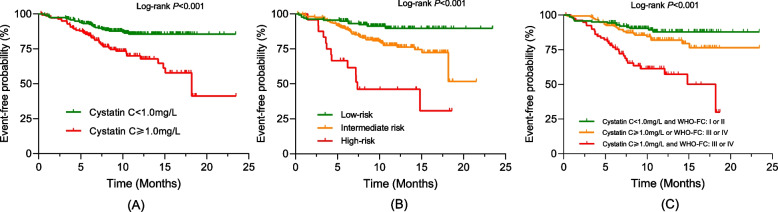
A total of 398 consecutive patients with confirmed pre-capillary PH were recruited from Fuwai Hospital between November 2020 and November 2021. Over a median duration of 282 days, 72 (18.1%) of these patients experienced clinical worsening. Cystatin C levels significantly correlated with cardiac index (r = -0.286, P < 0.001), mixed venous oxygen saturation (r = -0.216, P < 0.001), and tricuspid annular plane systolic excursion (r = -0.236, P < 0.001), and high cystatin C levels independently predicted a poor prognosis after adjusting potential confounders in different models (all P < 0.05). A three-group non-invasive risk model was constructed based on the combined assessment of the cystatin C and WHO-FC using dichotomous cut-off value. Those patients with higher cystatin C (≥ 1.0 mg/L) and a worse WHO-FC experienced the highest risk of endpoint occurrence. The predictive capacity of this model was comparable to that of an existing invasive risk stratification model (area under curve: 0.657 vs 0.643, P = 0.619).
Cystatin C levels were associated with disease severity and prognosis in patients with pre-capillary PH. A combination of high cystatin C and advanced WHO-FC identifies patients at particularly high risk of clinical deterioration.
半胱氨酸蛋白酶抑制剂 C 是一种新型生物标志物,可用于识别肾功能障碍和心血管风险。
本研究旨在探讨半胱氨酸蛋白酶抑制剂 C 在大样本毛细血管前肺动脉高压(PH)患者中进行非侵入性风险预测的作用。
我们回顾性分析了来自阜外医院的毛细血管前 PH 患者,这些患者具有可用的半胱氨酸蛋白酶抑制剂 C 和右心导管检查获得的血流动力学数据。
2020 年 11 月至 2021 年 11 月期间,共纳入 398 例确诊的毛细血管前 PH 患者。在中位随访时间 282 天内,72 例(18.1%)患者出现临床恶化。半胱氨酸蛋白酶抑制剂 C 水平与心指数(r=-0.286,P<0.001)、混合静脉血氧饱和度(r=-0.216,P<0.001)和三尖瓣环平面收缩期位移(r=-0.236,P<0.001)显著相关,且在校正不同模型中的潜在混杂因素后,高半胱氨酸蛋白酶抑制剂 C 水平独立预测预后不良(均 P<0.05)。根据半胱氨酸蛋白酶抑制剂 C 和 WHO-FC 的联合评估,构建了一个三分组非侵入性风险模型,使用二分类截断值。那些半胱氨酸蛋白酶抑制剂 C 较高(≥1.0mg/L)和 WHO-FC 较差的患者发生终点事件的风险最高。该模型的预测能力与现有的有创风险分层模型相当(曲线下面积:0.657 与 0.643,P=0.619)。
半胱氨酸蛋白酶抑制剂 C 水平与毛细血管前 PH 患者的疾病严重程度和预后相关。高半胱氨酸蛋白酶抑制剂 C 与晚期 WHO-FC 相结合可识别出临床恶化风险极高的患者。