Takeda Kazuya, Wada Mineko, Yorozuya Kyosuke, Hara Yuhei, Watanabe Toyoaki, Hanaoka Hideaki
Department of Rehabilitation, Kaneda Hospital, Okayama, Japan.
Graduate School of Biomedical and Health Sciences, Hiroshima University, Hiroshima, Japan.
Ann Geriatr Med Res. 2023 Sep;27(3):220-227. doi: 10.4235/agmr.23.0040. Epub 2023 Aug 28.
In this study, we aimed to examine the changes in delirium during hospitalization of patients and its association with behavioral and psychological symptoms of dementia (BPSD), as well as improvements in activities of daily living (ADL).
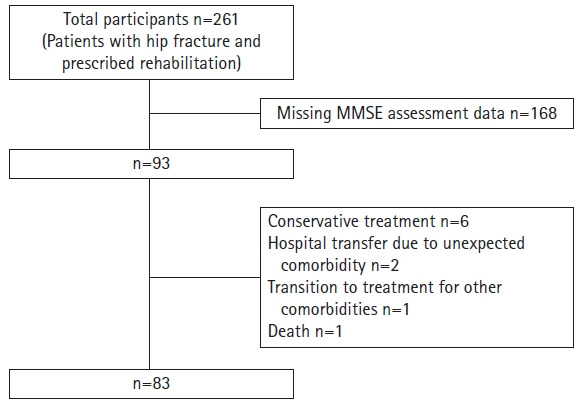
A longitudinal, retrospective cohort study was conducted involving 83 older adults (≥65 years) with hip fractures. We collected Mini-Mental State Examination (MMSE) and Functional Independence Measure-motor domain (m-FIM) assessment results from the medical charts at two time points: baseline (first week of hospitalization) and pre-discharge (final week before discharge). Additionally, we collected data on delirium and BPSD at three points: baseline, week 2 post-admission, and pre-discharge. We performed univariate logistic regression analysis using changes in m-FIM scores as the dependent variable and MMSE and m-FIM scores at baseline and pre-discharge, along with delirium and BPSD subtypes at baseline, week 2 post-admission, and pre-discharge, as the explanatory variables. Finally, we performed a multivariate logistic regression analysis incorporating the significant variables from the univariate analysis to identify factors associated with ADL improvement during hospitalization.
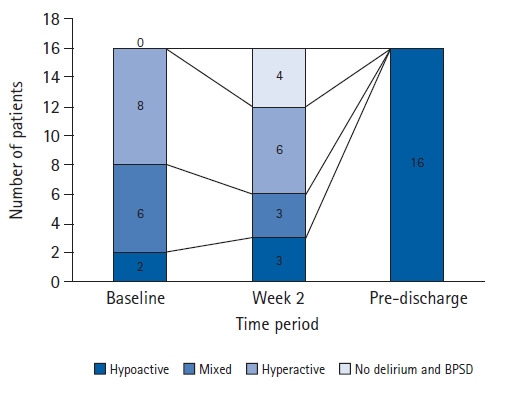
We observed significant correlations between ADL improvement during hospitalization and baseline m-FIM and MMSE scores, hypoactive delirium state, and BPSD subtype pre-discharge. Notably, all participants with hypoactive symptoms before discharge exhibited some subtype of delirium and BPSD at baseline.
Besides ADL ability and cognitive function at admission, the presence of hypoactive delirium and BPSD subtype before discharge may hinder ADL improvement during hospitalization.
在本研究中,我们旨在研究患者住院期间谵妄的变化及其与痴呆行为和心理症状(BPSD)的关联,以及日常生活活动(ADL)的改善情况。
进行了一项纵向回顾性队列研究,纳入83名≥65岁的髋部骨折老年人。我们在两个时间点从病历中收集简易精神状态检查表(MMSE)和功能独立性测量-运动领域(m-FIM)评估结果:基线(住院第一周)和出院前(出院前最后一周)。此外,我们在三个时间点收集谵妄和BPSD的数据:基线、入院后第2周和出院前。我们以m-FIM评分的变化作为因变量,以基线和出院前的MMSE和m-FIM评分,以及基线、入院后第2周和出院前的谵妄和BPSD亚型作为解释变量,进行单因素逻辑回归分析。最后,我们进行多因素逻辑回归分析,纳入单因素分析中的显著变量,以确定与住院期间ADL改善相关的因素。
我们观察到住院期间ADL改善与基线m-FIM和MMSE评分、活动减退型谵妄状态以及出院前的BPSD亚型之间存在显著相关性。值得注意的是,所有出院前有活动减退症状的参与者在基线时均表现出某种谵妄和BPSD亚型。
除了入院时的ADL能力和认知功能外,出院前存在活动减退型谵妄和BPSD亚型可能会阻碍住院期间ADL的改善。