Department of Geriatric Medicine, Graduate School of Medicine, The University of Tokyo, Bunkyo-ku, Tokyo, Japan.
Asahi Neurology and Rehabilitation Hospital, Matsudo City, Chiba, Japan.
PLoS One. 2018 Jul 5;13(7):e0200143. doi: 10.1371/journal.pone.0200143. eCollection 2018.
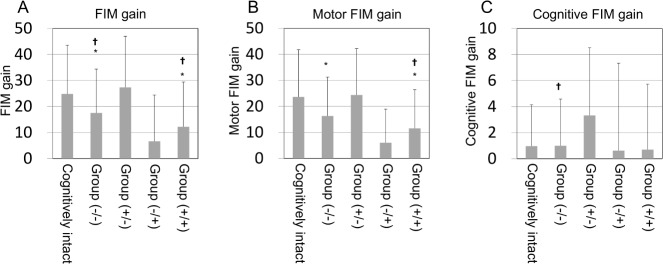
The aim is to investigate the relationship between a positive outcome on rehabilitation after hip fracture and behavioral psychological symptoms of dementia (BPSD) transition during rehabilitation. This study is a retrospective cohort study based on the Japan Rehabilitation Database. We recruited 756 subjects 65 years of age or older from 31 hospitals in the database. All subjects were in the hospital as patients undergoing rehabilitation for hip fracture. Functional independence measure (FIM), walking ability, Mini-Mental State Examination (MMSE), and BPSD were measured both at the beginning and at the end of rehabilitation. MMSE for 23 or under was defined as the cognitive-impaired group. MMSE for 24 or over was used as the cognitively intact group. Cognitive impaired participants were divided into four groups: participants presented no BPSD both at the beginning of rehabilitation and at the end of rehabilitation (Group (-/-)), participants presented BPSD at the beginning of rehabilitation but resolved at the end of rehabilitation (Group (+/-)), participants had no BPSD at the beginning of rehabilitation but appeared at the end of rehabilitation (Group (-/+)) and participants had sign of BPSD both at the beginning of rehabilitation and at the end of rehabilitation (Group (+/+)). The endpoints were waking ability, FIM gain. As results, one hundred thirty-seven cognitive-impaired older people patients out of 471 (29.1%) suffered from BPSD at the beginning of rehabilitation. FIM gains in cognitively intact group, Group (-/-), Group (+/-), Group (-/+) and Group (+/+) were 24.8 ± 18.7, 17.5 ± 16.9, 27.3 ± 19.7, 17.8 ± 12.2 and 12.2 ± 17.2, respectively. The Group (+/-) was significantly connected to a positive outcome for rehabilitation. The present study suggested that the management of BPSD can lead to better functional recovery during rehabilitation.
目的在于探究髋部骨折康复后取得积极成效与康复期间发生痴呆行为心理症状(BPSD)转变之间的关系。本研究基于日本康复数据库,采用回顾性队列研究方法,纳入数据库内 31 家医院的 756 名 65 岁及以上髋部骨折康复患者。所有患者均因髋部骨折在院接受康复治疗。于康复治疗开始及结束时,分别采用功能独立性量表(FIM)、步行能力、简易精神状态检查量表(MMSE)和 BPSD 对患者进行评估。MMSE 评分 23 分及以下者被定义为认知障碍组,MMSE 评分 24 分及以上者为认知正常组。认知障碍组进一步分为四组:康复治疗开始及结束时均无 BPSD(组(-/-))、康复治疗开始时有 BPSD 但结束时已缓解(组(+/ -))、康复治疗开始时无 BPSD 但结束时出现 BPSD(组(-/+))和康复治疗开始及结束时均有 BPSD(组(+/+))。观察指标为康复治疗后的觉醒能力和 FIM 评分提高情况。结果,471 名认知正常患者中有 137 名(29.1%)在康复治疗开始时患有 BPSD。认知正常组、组(-/-)、组(+/ -)、组(-/+)和组(+/+)的 FIM 评分增加值分别为 24.8±18.7、17.5±16.9、27.3±19.7、17.8±12.2 和 12.2±17.2。组(+/ -)与康复后取得积极成效显著相关。本研究表明,BPSD 的管理有助于患者在康复期间实现更好的功能恢复。