ICON Health Economics, ICON plc, Vancouver, BC, Canada.
Value Evidence and Outcomes, GSK, London, UK.
Int J Chron Obstruct Pulmon Dis. 2023 Aug 21;18:1815-1825. doi: 10.2147/COPD.S400707. eCollection 2023.
For patients with chronic obstructive pulmonary disease (COPD) who remain symptomatic despite maintenance treatment, clinical management guidelines recommend a stepwise escalation from monotherapy to dual therapy, and from dual therapy to triple therapy. However, in clinical practice, patients are often escalated directly from monotherapy to triple therapy based on disease severity. This study evaluated the cost-effectiveness of once-daily, single-inhaler fluticasone furoate, umeclidinium, and vilanterol (FF/UMEC/VI) triple therapy compared with long-acting muscarinic antagonist monotherapy with once-daily tiotropium (TIO) in patients with symptomatic moderate-to-very severe COPD, from a UK National Health Service perspective.
The validated GALAXY-COPD disease progression model was populated with patient baseline characteristics and treatment effect data from the 12-week GSK Study 207626 comparing FF/UMEC/VI with TIO in patients with moderate-to-very severe COPD. UK unit costs and drug costs (British Pound, 2021) were applied to healthcare resource utilization and treatments. The base case analysis was conducted over a lifetime horizon, and costs and health outcomes (except for life years [LYs]) were discounted at 3.5% per year. Model outputs included exacerbation rates, healthcare costs, LYs, quality-adjusted LYs (QALYs), and incremental cost-effectiveness ratios.
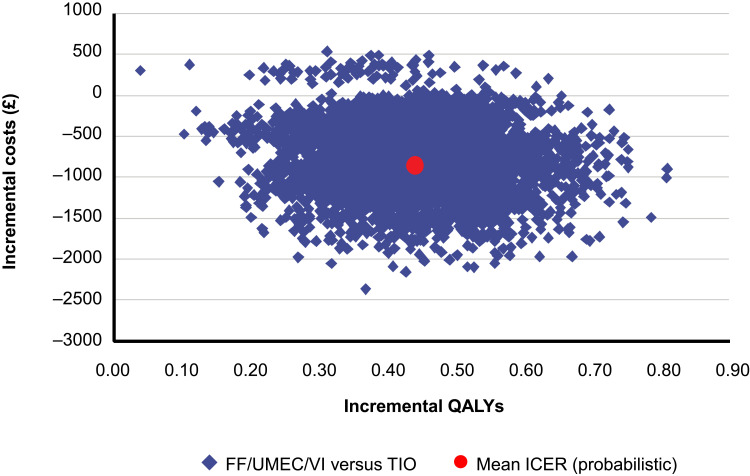
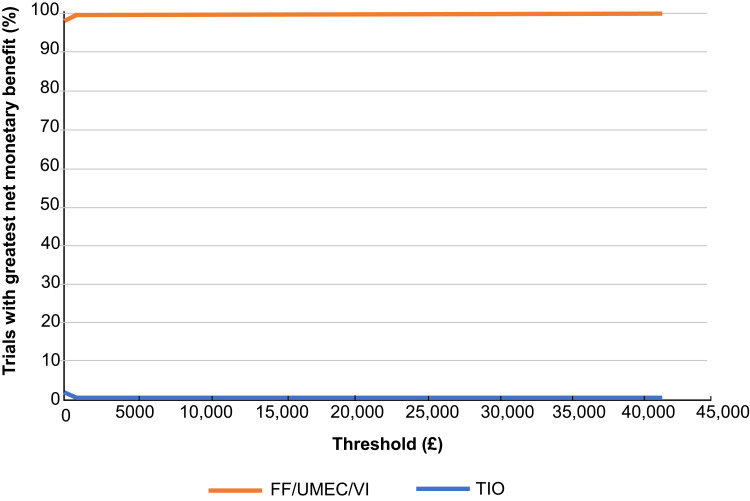
Overall, treatment with FF/UMEC/VI resulted in increased clinical benefit (reduction in total exacerbations and increased overall survival and QALYs), coupled with cost savings (derived from lower maintenance and exacerbation healthcare costs) compared with TIO monotherapy. In the base case analysis, FF/UMEC/VI provided an additional 0.393 LYs (95% range: 0.176, 0.655) and 0.443 QALYs (0.246, 0.648), at a cost saving of £880 (£54, £1608) versus TIO. FF/UMEC/VI remained the cost-effective (dominant) treatment option across sensitivity and scenario analyses.
FF/UMEC/VI offers greater clinical benefits and is a cost-effective treatment option compared with TIO for the treatment of adult patients with COPD with persistent symptoms and/or who are at risk of exacerbation in the UK.
对于慢性阻塞性肺疾病(COPD)患者,尽管维持治疗,但仍有症状,临床管理指南建议从单药治疗逐步升级为双药治疗,再升级为三药治疗。然而,在临床实践中,根据疾病严重程度,患者经常直接从单药治疗升级为三药治疗。本研究从英国国家医疗服务体系的角度评估了每日一次、单吸入器糠酸氟替卡松、乌美溴铵和维兰特罗(FF/UMEC/VI)三联疗法与每日一次噻托溴铵(TIO)长效抗毒蕈碱药物单药治疗对有症状的中重度 COPD 患者的成本效益。
使用经过验证的 GALAXY-COPD 疾病进展模型,根据 GSK 研究 207626 的患者基线特征和治疗效果数据,对有中重度 COPD 的患者进行了每日一次 FF/UMEC/VI 与 TIO 的比较。英国单位成本和药物成本(2021 年英镑)应用于医疗资源利用和治疗。基础病例分析在终身范围内进行,成本和健康结果(除了生命年[LYs])按每年 3.5%贴现。模型输出包括加重率、医疗保健成本、LYs、质量调整 LYs(QALYs)和增量成本效益比。
总体而言,与 TIO 单药治疗相比,FF/UMEC/VI 治疗可降低总加重率,并增加整体生存率和 QALYs,同时节省成本(源于降低维持和加重治疗的医疗保健成本)。在基础病例分析中,FF/UMEC/VI 提供了额外的 0.393 LYs(95%范围:0.176,0.655)和 0.443 QALYs(0.246,0.648),同时节省了 880 英镑(54 英镑,1608 英镑)的成本。FF/UMEC/VI 在成本效益方面仍然是一种有效的(优势)治疗选择,而 TIO 是一种有效的(优势)治疗选择。
与 TIO 相比,FF/UMEC/VI 为治疗英国 COPD 患者提供了更大的临床获益,并且是一种具有成本效益的治疗选择,这些患者有持续的症状和/或有加重风险。