
中国西南四川盆地中侏罗统沙溪庙组泥岩元素地球化学特征及地质意义
Element Geochemical Characteristics and Geological Significance of Mudstones from the Middle Jurassic Shaximiao Formation in Sichuan Basin, Southwest China.
作者信息
Ma Di, Zhang Zhijie, Zhou Chuanmin, Cheng Dawei, Hong Haitao, Meng Hao, Yu Xinghe, Peng Zixiao
机构信息
School of Energy Resources, China University of Geosciences, Beijing 100083, China.
Research Institute of Petroleum Exploration and Development, Beijing 100083, China.
出版信息
ACS Omega. 2023 Aug 10;8(33):29979-30000. doi: 10.1021/acsomega.3c01496. eCollection 2023 Aug 22.
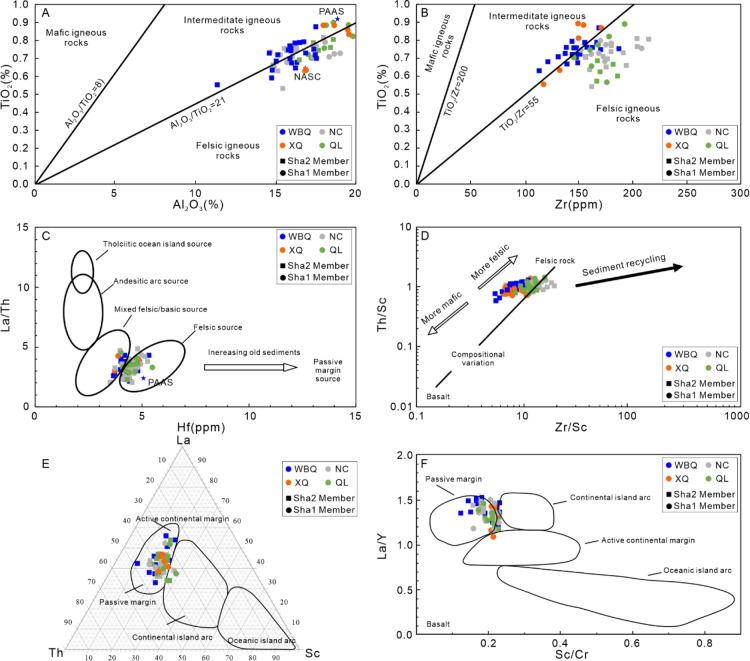
Thick sequences of terrestrial multicolored mudstones of the Middle Jurassic Shaximiao Formation in the Sichuan Basin, Southwest China, effectively recorded paleoclimate and paleoenvironment changes. The paleoenvironment of the Shaximiao Formation is reconstructed by using detailed sedimentological and elemental geochemical analysis of the multicolored mudstones. The provenance, paleoclimate, paleosalinity, and paleoredox conditions are distinguished by using the discriminant indicators of CIA, C-value, Sr/Cu, Rb/Sr, Th/U, V/Cr, and V/(V + Ni). The results show that all samples derive primarily from felsic igneous rocks and intermediate rocks rather than recycled sediments. The mudstone sequences were deposited under semiarid and semihumid regions with paleoclimate evolved to drier and cooler conditions from lower to upper Shaximiao Formation. Such a paleoclimate coincided with the records of several basins in the lower paleolatitudes of the Northern Hemisphere and were possibly affected by the Middle Jurassic global geological events such as wildfire, paleogeographic reorganizations, and seaway dynamics change. The paleowater body belongs to a typical terrestrial freshwater environment, although the paleosalinity increased significantly during arid periods. The multicolored mudstones were deposited in oxidation and weak-oxidation to weak-anoxic conditions. We also propose a detailed conceptual paleoenvironment model for Shaximiao Formation, with a large perennial lake surrounded by limited alluvial plain during a period of high lake level and small ephemeral lakes scattering extensive alluvial plain during a phase of low lake level.
中国西南部四川盆地中侏罗统沙溪庙组厚层陆相杂色泥岩有效记录了古气候和古环境变化。通过对杂色泥岩进行详细的沉积学和元素地球化学分析,重建了沙溪庙组的古环境。利用CIA、C值、Sr/Cu、Rb/Sr、Th/U、V/Cr和V/(V + Ni)等判别指标区分物源、古气候、古盐度和古氧化还原条件。结果表明,所有样品主要来源于长英质火成岩和中性岩,而非再循环沉积物。泥岩序列沉积于半干旱和半湿润地区,从古气候来看,沙溪庙组下部到上部逐渐演变为更干燥、更凉爽的环境。这种古气候与北半球低古纬度几个盆地的记录一致,可能受到中侏罗世全球地质事件如野火、古地理重组和海道动力学变化的影响。尽管在干旱时期古盐度显著增加,但古水体属于典型的陆地淡水环境。杂色泥岩沉积于氧化和弱氧化至弱缺氧条件下。我们还提出了一个详细的沙溪庙组古环境概念模型,在高湖平面期有一个被有限冲积平原环绕的大型常年湖泊,在低湖平面期有散布在广阔冲积平原上的小型短暂湖泊。




 Zotero 插件