
利用腺相关病毒9型-肌特异性肌酸激酶启动子驱动的DOK7(AAV9-tMCK-DOK7)在小鼠中长期进行肌肉特异性的DOK7过表达。
Long-term muscle-specific overexpression of DOK7 in mice using AAV9-tMCK-DOK7.
作者信息
Huang Yu-Ting, Crick Hannah R, Chaytow Helena, van der Hoorn Dinja, Alhindi Abrar, Jones Ross A, Hector Ralph D, Cobb Stuart R, Gillingwater Thomas H
机构信息
Edinburgh Medical School: Biomedical Sciences, University of Edinburgh, Edinburgh EH16 4SB, UK.
Euan MacDonald Centre for Motor Neuron Disease Research, Edinburgh EH16 4SB, UK.
出版信息
Mol Ther Nucleic Acids. 2023 Aug 2;33:617-628. doi: 10.1016/j.omtn.2023.07.036. eCollection 2023 Sep 12.
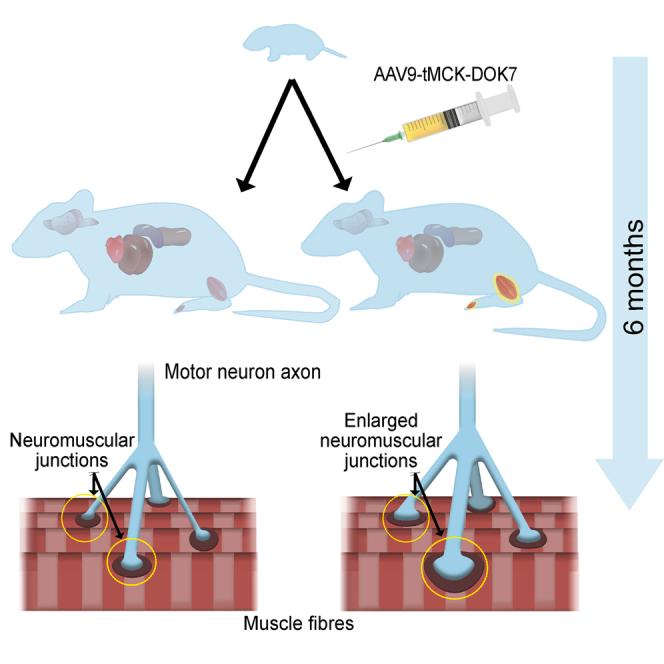
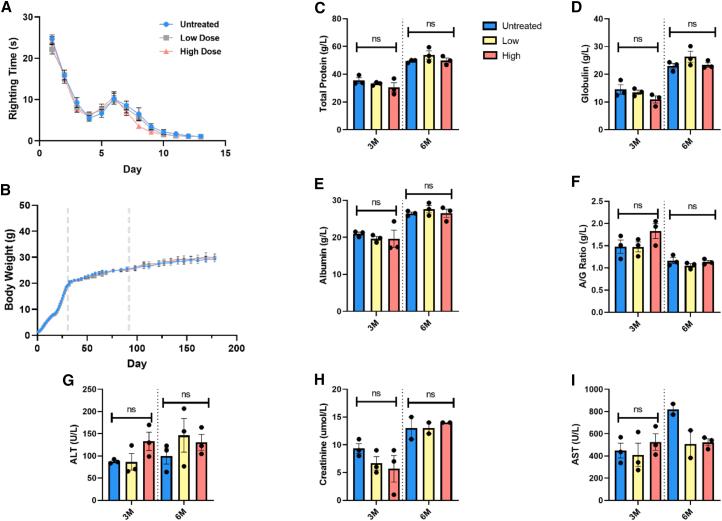
Neuromuscular junction (NMJ) dysfunction underlies several diseases, including congenital myasthenic syndromes (CMSs) and motor neuron disease (MND). Molecular pathways governing NMJ stability are therefore of interest from both biological and therapeutic perspectives. Muscle-specific kinase (MuSK) is necessary for the formation and maintenance of post-synaptic elements of the NMJ, and downstream of tyrosine kinases 7 (DOK7) is crucial for activation of the MuSK pathway. Overexpression of DOK7 using AAV9 has been shown to ameliorate neuromuscular pathology in pre-clinical disease models of CMS and MND. However, long-term consequences of DOK7 expression have been sparsely investigated and targeted overexpression of DOK7 in skeletal muscle yet to be established. Here, we developed and characterized a novel AAV9-DOK7 facilitating forced expression of DOK7 under a skeletal muscle-specific promoter. AAV9-tMCK-DOK7 was systemically delivered to newborn mice that were monitored over 6 months. DOK7 overexpression was restricted to skeletal muscles. Body weight, blood biochemistry, and histopathological assessments were unaffected by AAV9-tMCK-DOK7 treatment. In contrast, forced expression of DOK7 resulted in enlargement of both the pre- and post-synaptic components of the NMJ, without causing denervation. We conclude that muscle-specific DOK7 overexpression can be achieved in a safe manner, with the capacity to target NMJs .
神经肌肉接头(NMJ)功能障碍是多种疾病的基础,包括先天性肌无力综合征(CMS)和运动神经元病(MND)。因此,从生物学和治疗学角度来看,调控NMJ稳定性的分子途径都备受关注。肌肉特异性激酶(MuSK)对于NMJ突触后元件的形成和维持是必需的,而酪氨酸激酶7下游蛋白(DOK7)对MuSK途径的激活至关重要。在临床前CMS和MND疾病模型中,使用腺相关病毒9型(AAV9)过表达DOK7已被证明可改善神经肌肉病理状况。然而,DOK7表达的长期后果研究较少,且在骨骼肌中靶向过表达DOK7的方法尚未确立。在此,我们开发并鉴定了一种新型的AAV9-DOK7,它能在骨骼肌特异性启动子的控制下促进DOK7的强制表达。将AAV9-tMCK-DOK7全身注射给新生小鼠,并对其进行6个月的监测。DOK7的过表达仅限于骨骼肌。AAV9-tMCK-DOK7治疗对体重、血液生化和组织病理学评估均无影响。相反,DOK7的强制表达导致NMJ突触前和突触后成分均增大,但未引起失神经支配。我们得出结论,肌肉特异性过表达DOK7可以安全实现,且具有靶向NMJ的能力。





 Zotero 插件